



















 Pin
Pin Shillong Bara Bazaar Breakfast Healthy Street Food / Photo courtesy of Diaries Around the Globe
Synopsis: Shillong Bara Bazaar Breakfast Healthy Street Food is the city’s best-kept secret. At Lewduh — northeast India’s largest traditional market — Khasi women rise before dawn to serve rice cakes, Jadoh, smoked pork, and sweet Pukhlein to hungry locals. No hotel buffet comes close. This guide takes you through the flavours, the people, and the morning rituals of a market that has fed Shillong’s soul since the 19th century.
There is a moment — somewhere between 6 and 7 in the morning in Shillong — when the mist hasn’t quite lifted off the hills, and the alleys of Bara Bazaar are already thick with the smell of steaming rice and woodsmoke. Vendors arrange baskets of sticky rice cakes. An old woman in a Jainkyrshah — the traditional Khasi wrap — ladles something fragrant into a small steel bowl. A man on a low stool drinks milky tea and tears at a soft, jaggery-sweet Pukhlein without looking up once.
This is not a scene you find on a hotel menu or a food-delivery app. This is breakfast the way Shillong has always eaten it — warm, unpretentious, and deeply local. And it all happens inside Lewduh, the massive market that most tourists walk past on their way to Police Bazaar. Their loss.
What follows is a walkthrough of everything that makes a Bara Bazaar breakfast worth waking up early for — the food, the people, the history, and a few things you absolutely should not leave without trying.
Table of Contents
What Is Bara Bazaar, Really?
Most people hear ‘Bara Bazaar’ and think of a chaotic street market selling shoes or trinkets. They are not wrong, but they are not seeing the full picture either. Lewduh — that is its real name, meaning ‘the market of common people’ in Khasi — is the largest traditional market in all of northeast India. It sits about 2 km west of central Shillong and has been trading since the 19th century. The British called it Bara Bazaar simply because ‘bara’ means big, and big it certainly is.
The market has separate sections for vegetables, fruits, fish, beef, iron goods, dried produce, and betel. There is even a dedicated section for second-hand clothes. But what sets Lewduh apart from any other market in India — north, south, or east — is who runs it. The majority of shopkeepers, vendors, and hawkers here are women. Meghalaya follows a matrilineal system, where property and lineage pass through the mother’s side, and the market is a living expression of that culture.
Every April, the market comes alive with traditional rituals, including the installation of large monoliths called ‘mawbynnas.’ It is not just a shopping destination. It is a cultural institution.
- Located ~2 km west of main Shillong town
- Heritage traceable to the 19th century
- Administered under Mylliem’s Syiem (traditional chief)
- Separate sections: vegetables, fruits, fish, beef, iron, dried goods, textiles
Why Mornings Are the Best Time to Go
The best time to visit Bara Bazaar is also the quietest — which is saying something for a market this size. Arrive between 6:30 and 8:30 in the morning and fresh stock from local farms has just come in. Baskets overflow with vegetables that still have soil on the roots. The food stalls are warm and steaming. And the atmosphere carries a calm, purposeful energy that the afternoon rush simply does not have.
Vendors in traditional Khasi attire set up their breakfast spreads with an unhurried confidence. There are no menus. No signboards with translated dish names. You walk up, point at something golden and crispy, and a woman with kind eyes hands it to you wrapped in a leaf. That is the whole transaction. Tea arrives in a simple glass. The snack basket comes out next.
The morning crowd is entirely local — market workers, daily labourers, office-goers picking up a quick bite, and older residents who have been eating here for decades. For anyone curious about how a city actually eats before it performs for tourists, this is the hour and this is the place.
💡 Tip: Go on a weekday. Weekends bring more outsiders. Weekday mornings are almost entirely locals.
Pusaw — The Humble Rice Cake That Starts Every Morning
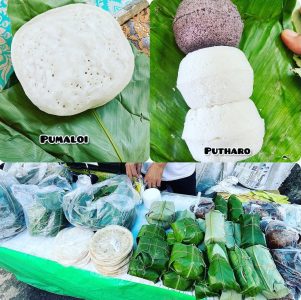
The Pusaw is the most straightforward thing on the Bara Bazaar breakfast table, and somehow the most satisfying. It is a plain, steamed sticky rice cake — white, soft, and almost completely flavourless on its own. That is intentional. The Pusaw is not trying to be the star. It is the quiet supporting character that makes every sip of sweet, milky Khasi tea taste like it was made for it.
Made from special varieties of sticky rice, these cakes are prepared at home by women before the market opens and brought in baskets. The processing is simple — soaking the rice, grinding it, and then steaming — but the result has a clean, starchy warmth that is genuinely comforting on a cold Shillong morning. Research into Khasi traditional snacks has found that these rice-based preparations are nutritionally superior to many commercially available Indian snacks, particularly in their low fat content.
At the market, Pusaw usually arrives in a basket alongside its siblings — Pumaloi and Pusla. A vendor will present the whole basket to the table. Customers pick what they like, leave the rest. It is an informal, communal way of eating that feels less like a food transaction and more like breakfast at someone’s grandmother’s house.
Pumaloi and Pu Maloi — The Red Rice Cousin
If Pusaw is the neutral base note of the Khasi breakfast, Pumaloi adds a little colour — literally. This is a steamed red rice cake, and the reddish-brown hue comes from the variety of rice used, not from any additive or dye. The texture is slightly denser than Pusaw, and the flavour carries a faint earthiness that the white cake does not have. Still mild, still meant to be paired with tea, but with just a little more character.
Red rice, used widely across Meghalaya, is also nutritionally richer than white rice — higher in fibre, iron, and antioxidants. The Khasi practice of using it in daily breakfast foods is less a trend and more a centuries-old intuition about what works for the body in a highland climate. The people of Shillong live at around 1,500 metres above sea level. Mornings are cold. A warm, starchy, slow-burning rice cake makes practical sense.
Pumaloi appears alongside Pusaw in most of the breakfast baskets at Lewduh. The two together, dipped briefly into sweet milky tea, create a texturally interesting pairing — soft and yielding, clean and warming. It is the kind of breakfast that does not need a name or a hashtag to be worth eating.
Pukhlein — The One That Tastes Like a Decision
If Pusaw and Pumaloi are the gentle start to the meal, Pukhlein is where things get interesting. This is a deep-fried rice flour and jaggery snack, fried in mustard oil, and it arrives at the table looking golden, slightly crispy at the edges, and smelling of something sweet and sharp at once. The jaggery gives it a rich, caramel-like sweetness. The mustard oil cuts right through it with a pungency that is unmistakably northeastern.
Foodies who have eaten their way through Bara Bazaar in the morning consistently single out the Pukhlein as the standout snack of the basket. It is not delicate. It is not refined. It is exactly the kind of thing that tastes extraordinary at 7 a.m. in a cold market with a glass of hot tea in the other hand.
Despite being fried, Pukhlein is not a heavy snack by any measure. The rice flour base keeps it lighter than most fried breakfast foods. Scientific evaluation of traditional Khasi snacks has confirmed that these preparations compare favourably in fat content against other commonly consumed Indian street snacks. So the guilty pleasure is not quite as guilty as it might feel.
- Main ingredients: rice flour + jaggery + mustard oil
- Texture: crispy outside, slightly chewy inside
- Flavour profile: sweet, nutty, with mustard sharpness
- Best eaten fresh from the oil, while still warm
Jadoh — The Breakfast That Eats Like a Meal
Jadoh is the heart of Khasi cuisine, and at Bara Bazaar it starts appearing on plates as early as 7 in the morning. This is not a light snack situation. Jadoh is red rice cooked with pork — or sometimes chicken — along with green chillies, ginger, onions, turmeric, black pepper, and bay leaves. The turmeric turns the rice a rich amber-yellow and fills the air with a warm, almost festive aroma. It is a full, proper meal that happens to be eaten at breakfast time.
Inside the market, the famous Nat Khasi Restaurant is the go-to spot for a plate of Jadoh. Their chicken rice — or Plate Jadoh — is a staple order for locals who want something more substantial before a long morning at work. The portions are generous, the prices are honest, and the flavour is the kind that makes a person quietly plan a second visit before they’ve finished the first plate.
For the more adventurous, Jadoh can also be cooked with pork blood, which gives the rice an even deeper colour and a richer, more mineral flavour. This version is not on the tourist shortlist, but it is very much on the local one. Either way, a plate of Jadoh at Bara Bazaar is one of those meals that makes hotel breakfast feel like a minor disappointment.
Smoked Pork and Dohneiiong — The Savoury Depth
Smoked pork is not just a dish in Shillong — it is an identity. The pork is typically smoked over wood for hours, sometimes days, giving it a flavour that is simultaneously deep, fatty, and clean in a way that only proper smoking can produce. At Bara Bazaar, smoked pork appears in several forms: in Jadoh, as a standalone pork salad, as sausages, and sometimes in stir-fries served from small makeshift kitchens tucked into the market lanes.
Dohneiiong, or pork cooked with black sesame seeds and soy sauce, is another Khasi classic that shows up at the morning stalls. The sesame seeds are toasted before being added, which gives them a nuttiness that pairs unexpectedly well with the fatty richness of the pork. It is a dish that has no real parallel in mainland Indian cooking — closer in spirit to something from the hill kitchens of Southeast Asia than to anything from Rajasthan or Gujarat.
These pork-based dishes reflect the Khasi preference for meat that is prepared with simplicity and technique rather than an excess of spices. There is no attempt to overwhelm. The smoking does the work. The sesame does the work. The cook just makes sure nothing gets in the way.
Big Momos — Not What You Think
Most people who have travelled in India have eaten momos. They are everywhere — from Leh to Kolkata, from Delhi’s street carts to Bengaluru’s food courts. But the momos at Bara Bazaar’s morning stalls are a different proposition entirely. These are what locals call Big Momos — oversized, fluffy-textured steamed dumplings with a dough that is thicker and breadier than the standard version.
The filling is typically pork or chicken, well-seasoned and juicy. But the real difference is the wrapper — it is softer, almost pillowy, with a chew that is more satisfying than the thin-skinned momos that dominate the rest of India. They arrive hot, alongside a chilli-vinegar chutney that is simple, sharp, and perfectly calibrated. No peanut sauce, no cream. Just heat and acid against the fatty richness of the dumpling.
In the mornings at the market, Big Momos are the preferred quick-breakfast option for vendors who want something filling before the day really kicks in. They are eaten standing up, sometimes with both hands, and finished in four or five bites. There is an efficiency to it that seems appropriate for a market where everyone has somewhere to be.
The Chai Ritual — Flattened Rice in Tea
There is one Bara Bazaar breakfast habit that catches outside visitors completely off guard: flattened rice — chiwda or poha — eaten by dropping spoonfuls of it directly into tea. Not alongside tea. In tea. The rice soaks up the sweet, milky liquid, swells slightly, and becomes a soft, porridge-like mass that is eaten with a spoon or scooped up and drunk from the glass.
It sounds unusual. It works entirely. The rice cuts the sweetness of the tea and gives the drink a body and substance that turns it into a proper, satiating morning meal. Khasi people have been eating breakfast this way for generations, and it makes a certain intuitive sense — warm, filling, quick, and made from the most accessible ingredients imaginable.
The chai at Bara Bazaar is strong and milky, sweetened with enough sugar to balance the rice’s neutral starch. At the morning stalls, a glass costs almost nothing. The chiwda arrives in a small bowl beside it. The whole ritual takes about ten minutes and leaves a person feeling more fed than a full continental breakfast at most mid-range hotels.
☕ The snack basket that arrives with tea at Lewduh stalls often contains Pusaw, Pumaloi, Pukhlein, Pusla, and sweet buns — customers pick what they like, pay only for what they ate.
The Women Who Make It All Happen
Any honest account of Bara Bazaar breakfast must spend time on the people who make it possible. These are predominantly women — dressed in their traditional Jainkyrshah wraps, sitting behind baskets and small stoves, chatting with regulars, chewing kwai (betel nut), and managing the morning rush with a calm that only comes from decades of practice. Some of these women have been vendors here since their own mothers brought them as children.
Meghalaya’s matrilineal society has ensured that women are not peripheral figures in commerce — they are the centre of it. Lewduh is the most visible expression of this. The market is not run by women as a novelty or a policy initiative. It is run by women because that is simply how the Khasi economy has always worked. Property passes through the mother. Trade is managed by women. The market reflects the culture.
For a visitor, this creates a specific kind of warm authority at the breakfast stalls. These women know their food better than anyone. They know what goes with what. They know when the rice cakes are at their best — still warm from the home kitchen, not yet cooled in the morning air. And they serve with a matter-of-fact generosity that needs no performance.
What to Eat, What to Skip, and How to Do It Right
A first-time visitor to Bara Bazaar for breakfast does not need a long list of instructions. The market is navigable by instinct and smell. But a few practical notes help. Arrive before 8:30 a.m. — by 9, many of the best morning stalls are beginning to transition into the full market day and the breakfast-specific foods start disappearing. Go to a stall where locals are already eating. The queue is the review.
For a complete Bara Bazaar breakfast experience, aim to try at least the following:
- Pusaw or Pumaloi with tea — the gentle, warm opening
- Pukhlein — for texture and that sharp mustard-jaggery punch
- Plate Jadoh at Nat Khasi Restaurant — the full Khasi morning meal
- A Big Momo with vinegar chutney — ideally eaten standing
- Chiwda soaked in sweet Khasi chai — the local ritual, not to be skipped
Skip anything that looks like it has been sitting out too long. Fresh is the whole point here. And skip the temptation to eat at the hotel first — arriving hungry is the correct strategy. The market will feed anyone well.
One final note: ask before photographing vendors. Some are happy to oblige; others are there to work, not to be documented. A small acknowledgement of that goes a long way in a place as grounded and unhurried as this one.
FAQs
Go between 6:30–8:30 a.m. That’s when fresh stock arrives, breakfast stalls are fully set up, and the crowd is almost entirely local.
Generally yes — everything is made fresh that morning, often at home before the stall opens. Eat at busy stalls. High turnover means fresher food.
Yes. Pusaw, Pumaloi, Pukhlein, and the chai-chiwda combination are all vegetarian. The Khasi rice cakes are a solid meatless breakfast on their own.
Very little. A rice cake basket with tea is under ₹50. A plate of Jadoh at Nat Khasi Restaurant runs around ₹100–₹150. Budget ₹200 for a filling morning.
Yes — Lewduh (Bara Bazaar) is well-known in Shillong and easy to find by auto or cab. Tell the driver ‘Lewduh market’ and they’ll know exactly where to go.









 Login with Google