
























 Pin
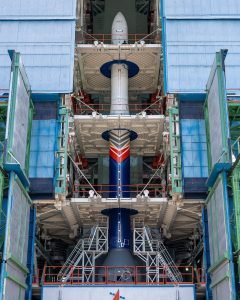
Pin Photo Courtesy of SkyRoot
Synopsis: Skyroot Vikram-1 successfully reached orbit on its very first flight, marking a historic milestone for India’s growing private space industry. The successful maiden launch demonstrated the capabilities of India’s first privately developed orbital rocket and positioned Skyroot Aerospace among the world’s leading commercial launch providers.
There is a particular satisfaction in watching a plan unfold exactly as drawn, without a single hitch to explain away afterward. Engineers rarely get that pleasure, and rocket engineers get it least of all, given how often their machines have a mind of their own on the first outing.
That is precisely what unfolded early Saturday morning at the Satish Dhawan Space Centre, when a homegrown four-stage rocket named Vikram-1 climbed off its launch pad and, without so much as a stumble, settled into orbit on its very first try. For a company that started with a handful of desks back in 2018, this was no ordinary test flight. It was eight years of patient, stubborn tinkering paying off in the grandest way a young rocket company could hope for.
The successful Vikram-1 launch represents one of the biggest milestones in India’s commercial space sector. Developed by Hyderabad-based Skyroot Aerospace, Vikram-1 became India’s first privately developed orbital launch vehicle to successfully reach orbit, showcasing the country’s rapidly growing private space ecosystem and strengthening its position in the global small-satellite launch market.
This is the story of two former government scientists who quietly built a machine that now puts their country in the company of just a handful of nations on Earth. Settle in, because the tale is worth the telling, right down to the eighteen-karat gold trinket riding along for the ride.
Table of Contents
The Morning Everything Went Right
 Pin
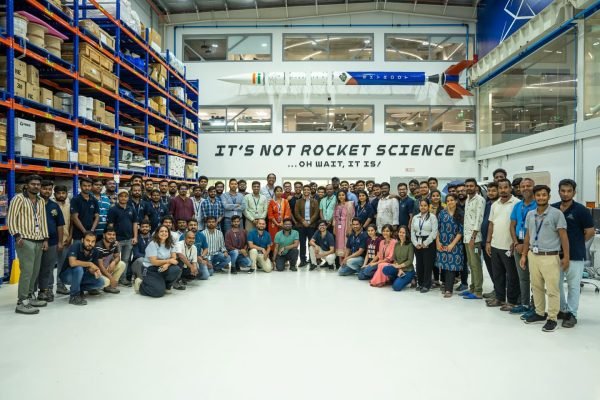
Pin Photo courtesy of SkyRoot
The countdown clock at Sriharikota does not care much for anyone’s nerves, and on the morning of July 18, it threw in one last scare before letting go. A technical snag turned up at the five-minute mark, holding the whole show back by thirty-five minutes while ground crews sorted it out.
Once the delay was cleared, Vikram-1 lit its first-stage solid motor and left the pad in a hurry. Each of its three solid-fuel stages fired in turn exactly as rehearsed on paper, and then the rocket’s liquid-fuelled kick stage took over, burning for about six minutes to nudge everything into its final orbit.
Fifteen minutes after liftoff, the rocket had reached a steady 450-kilometer orbit, and the people watching the webcast let out the kind of cheer usually reserved for last-minute sporting wins.
- Launch site: Satish Dhawan Space Centre, Sriharikota
- Liftoff time: 12:05 p.m. IST (2:35 a.m. Eastern)
- Orbit achieved: 450 km, at a 60-degree inclination
- Time from liftoff to orbit: about 15 minutes
A Name That Means Arrival
Skyroot gave this flight a name with some weight behind it: Mission Aagaman, a Sanskrit word that simply means arrival. It is a fitting choice, since the whole point of the flight was to arrive somewhere the company had never been before.
The mission’s chief job was not to prove anything to outsiders but to gather data on Vikram-1’s own behavior — how its propulsion, guidance, and stage separations held up once real flight conditions replaced simulations and wind-tunnel guesses. Everything after that was, in a sense, a bonus.
Company officials had gone into the flight with their fingers crossed rather than any grand promises. Rockets have a well-earned reputation for humbling their makers on debut flights, and Skyroot’s leadership said as much beforehand, choosing caution over bravado.
What Vikram-1 Is Actually Made Of
Vikram-1 stands about twenty-two meters tall, roughly the height of a seven-story building, and is built almost entirely from carbon-composite material rather than the heavier metals older rockets rely on. That choice trims weight, which in rocketry is another word for money and performance both.
The rocket runs on four stages. Three burn solid fuel and handle the brute-force climb out of the atmosphere, while a fourth stage, powered by liquid propellant engines, handles the delicate business of settling payloads into their exact intended orbit.
Skyroot built the engines in-house, including some manufactured through 3D printing, a detail that says a good deal about how young companies are rewriting old assumptions about who gets to build rockets.
- Stage 1 (Kalam 1200): solid fuel, 1,000 kN thrust
- Stage 2 (Kalam 250): solid fuel, 250 kN thrust
- Stage 3 (Kalam 100): solid fuel, 100 kN thrust
- Stage 4: four Raman-I engines, liquid propellant, for orbital insertion
- Maximum payload to low Earth orbit: 350 kg
The Curious Cargo Riding Along
A rocket’s first flight is usually light on paying customers and heavy on things that need testing, and Vikram-1 carried a fair mix of both. Grahaa Space sent up its SOLARAS S3 satellite, while Cosmoserve Space’s Embrace, a small robotic arm meant to practice grabbing hold of space debris, hitched a ride too.
A German company called DCUBED had its own technology demonstrator aboard, and Skyroot flew its own satellite, SCOPE, mainly to gather data on how the rocket itself behaved in flight.
Then came the sentimental cargo: a golden micro-rocket smaller than a grain of rice, carrying tiny sculpted likenesses of scientists C.V. Raman, Vikram Sarabhai, and A.P.J. Abdul Kalam, plus a handwritten postcard from Prime Minister Narendra Modi reading ‘Vande Mataram.’
- SOLARAS S3 — nanosatellite pathfinder, Grahaa Space
- Embrace — debris-capture robotic arm, Cosmoserve Space
- Technology demonstrator — DCUBED
- SCOPE — Skyroot’s own data-gathering satellite
- A gold micro-rocket and a postcard from the Prime Minister
Joining a Very Small Club
Before this flight, only the United States and China had seen a privately built rocket from their soil reach orbit. With Vikram-1’s success, India joined that very small group of nations where a privately developed orbital rocket has successfully reached orbit, and did so with far less fanfare than the milestone probably deserved.
It is worth pausing on how narrow that club really is. Dozens of countries can build satellites. Far fewer can launch government rockets. And only a small handful can say a private company managed to get a payload into orbit on its own steam. Although the mission benefited from India’s reformed space ecosystem, including support from ISRO and IN-SPACe, Vikram-1 was designed, developed, and operated by Skyroot Aerospace as a privately built orbital launch vehicle.
For India’s commercial space ambitions, this was the equivalent of a first solo flight after years of watching from the passenger seat.
Two Engineers Who Used to Work for the Government
Skyroot Aerospace was founded in 2018 by Pawan Kumar Chandana and Naga Bharath Daka, both of whom left steady jobs at India’s national space agency to build rockets of their own. It is the kind of career change that raises eyebrows at family dinners, but it paid off handsomely.
The company set up shop in Hyderabad, and rather than chase headlines early on, it spent years quietly testing engines, materials, and stage separations on the ground before ever asking for a launch slot.
Chandana, now the company’s chief executive, has described the small-satellite launch market as short on suppliers even as demand keeps climbing — a gap he believes Skyroot is well placed to fill.
The Rehearsal That Came Four Years Earlier
Before Vikram-1 could fly, Skyroot needed to prove it could build a rocket at all. That proof came in November 2022, when its suborbital Vikram-S became the first rocket built by an Indian private company to reach space, climbing to roughly 88 kilometers before falling back down.
Vikram-S never intended to reach orbit; it was a technology demonstrator, plain and simple. But according to Chandana, about eighty percent of the technology now flying on Vikram-1, including its carbon-composite structure and solid propulsion systems, was first proven on that earlier, smaller flight.
Getting from that suborbital hop to a full orbital rocket still took another four years of grinding, unglamorous work, longer than the company had originally hoped.
The Money That Made It Possible
Rockets are an expensive habit, and Skyroot has not been shy about raising funds to support it. In May 2026, the company pulled in sixty million dollars to scale up Vikram-1 production and begin work on a larger sibling, Vikram-2.
The latest funding round significantly strengthened Skyroot’s expansion plans and supports the continued development of the Vikram launch vehicle family, a rare vote of confidence for an Indian hardware startup and rarer still for one building rockets rather than software.
Investors betting on Skyroot are, in effect, betting on the idea that small satellites will need rides to orbit far more often in the coming years than today’s launch providers can offer.
What Skyroot Plans to Do Next
One successful flight does not make a launch business; it makes a very good start. Skyroot has announced plans for additional Vikram-1 missions before beginning regular commercial launch services, subject to mission readiness and customer demand, with up to two more flights targeted before the year is out.
An upgraded version, Vikram-1U, fitted with strap-on boosters, is already on the drawing board and is expected to lift payloads of up to 550 kilograms, a healthy jump from the base model’s 350.
Longer term, the company hopes to build one orbital rocket a month out of its Hyderabad facilities, a pace that would have sounded far-fetched only a few years back.
Why India's Government Has Reason to Smile Too
None of this happened in a vacuum. India’s space regulator, IN-SPACe, along with a string of policy reforms, opened the door for private companies to use ISRO’s own launch facilities, something that would have been unthinkable a decade ago.
Chandana himself thanked ISRO and IN-SPACe for their support after the launch, a nod to how much groundwork had to be laid on the government side before a private rocket could ever leave that pad.
The result is a small but fast-growing ecosystem of Indian space startups, with Skyroot now serving as the proof that the model can actually work, not just on paper but in orbit.
The Bigger Picture for a Crowded Sky
Small satellites are multiplying fast, used for everything from farm monitoring to disaster tracking to communications, and the rockets built to carry them have not kept pace with demand. Chandana has pointed to this exact gap as the market Skyroot means to serve.
Vikram-1’s 350-kilogram capacity places it firmly in that small-satellite category rather than in competition with the giant rockets used for heavier national missions, and that focus appears deliberate rather than accidental.
Whatever comes next for Skyroot, the flight of Vikram-1 has already done its most important job: it showed that a private Indian rocket, built without a safety net of decades of institutional experience, could do the one thing that matters most in this business — get there on the first try.
Why the Skyroot Vikram-1 Launch Matters
Strip away the drama of liftoff and what remains is a genuinely important shift in how India gets things into space. Vikram-1 stands as India’s first private orbital rocket to succeed on a maiden launch, a distinction that matters far beyond bragging rights.
It signals that commercial launch services are no longer a distant ambition for the country’s private space industry but a working reality, with a real rocket, a real orbit, and real customers lining up behind it.
For the broader Indian space startup scene, Vikram-1’s success works like a proof of concept the whole sector can point to, showing investors and future satellite customers alike that the small satellite launch market has a credible new supplier.
- India’s first private orbital rocket to succeed on its maiden launch
- A working example of commercial launch services built outside ISRO
- A confidence boost for the wider Indian space startup ecosystem
- A new credible supplier entering the global small satellite launch market
FAQs
Yes. It lifted off July 18, 2026, and reached a 450-km orbit within 15 minutes — no repeat attempts needed.
Skyroot Aerospace, a Hyderabad startup founded in 2018 by former ISRO scientists Pawan Chandana and Naga Bharath Daka.
Satellites from Grahaa Space and Cosmoserve, a Skyroot satellite, a DCUBED demo, a gold micro-rocket, and a PM Modi postcard.
Up to 350 kg to low Earth orbit; an upgraded Vikram-1U variant will carry up to 550 kg.
Up to two more Vikram-1 flights this year, plus development of the larger Vikram-2 rocket.
It’s India’s first privately developed orbital rocket to reach orbit, strengthening the country’s place in the global commercial launch market.









 Login with Google