


















 Pin
Photo Source: ASML
Synopsis: Reuters reported that a secret Shenzhen lab has built a prototype of the machine that prints the world’s most advanced chips. It reportedly makes the special light but has yet to print a working chip. Since then, ASML has posted record sales, China has started building older-style tools of its own, and Congress is weighing new limits. This article explains how EUV works, what the prototype can and cannot do, and what it means for ASML, chip prices, and AI.
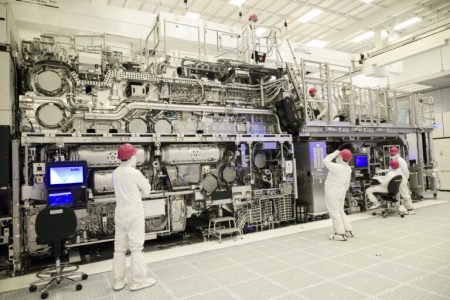
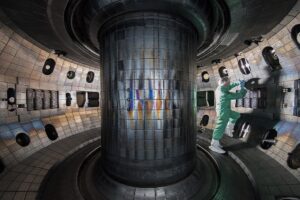
In a high-security laboratory in Shenzhen, a machine fills nearly a whole factory floor, and almost nobody outside the compound is supposed to know it exists. Recruits were reportedly handed ID cards bearing names that were not theirs, which gives the place the cheerful atmosphere of a bank that has misplaced its vault.
According to Reuters, which spoke to people with knowledge of the project, China just built its own EUV lithography machine, or at least a prototype of one. It was reportedly finished in early 2025 by a team that included former ASML engineers. ASML’s chief executive had said, in April 2025, that China would need many, many years.
The catch is a big one. The machine reportedly makes the light but has not printed a working chip. Since the report, ASML has posted record sales and China has started building older-style tools. What follows separates what is known from what is merely loud.
Table of Contents
What EUV Is, and How the Light Gets Made
EUV stands for extreme ultraviolet: light with a wavelength of 13.5 nanometres, against 193 for the older machines. Shorter waves draw finer lines, which is why a needle can embroider what a broom cannot. Reuters describes the circuits as thousands of times thinner than a human hair, and Zeiss says around ten billion transistors fit on a surface the size of a fingernail.
Making that light is a job for a very small, very short-lived star. Molten tin droplets, about 25 microns wide, race through a vacuum chamber around 50,000 times a second. Each is hit by a laser twice, first to flatten it, then to blast it into plasma at roughly 200,000 degrees Celsius. (The vacuum is needed because air swallows EUV light whole.)
Glass cannot focus the result, so mirrors do the work, and Zeiss says each one takes months to make. The machine is, in short, a precision instrument that is constantly pelted with its own fuel.
- EUV light: 13.5 nm. Older deep ultraviolet (DUV) light: 193 nm.
- Used mainly for the most demanding chip layers.
- ASML is the only company selling EUV systems for chip production.
Why Only One Company Ever Pulled It Off
ASML built its first working EUV prototype in 2001. By its own account, it then spent nearly two decades and billions of euros before the first commercial chips appeared in 2019. A current machine weighs about 180 tons, is roughly the size of a school bus, and costs around $250 million. ASML delivered 48 of them in 2025.
Nobody did it alone. Germany’s Zeiss makes the mirrors, which it calls the most precise in the world. Trumpf builds the lasers. The light source comes from Cymer, a company ASML bought. Each of these is the work of a corporate lifetime, and ASML needed all of them to cooperate on a deadline.
ASML’s chief executive, Christophe Fouquet, has said about 80 percent of the machine already existed in earlier knowledge, and that creating EUV light, the one truly new problem, took 20 years by itself. The monopoly, then, is less a clever trick than a very tall wall of homework.
The Wall Around the Machine
Starting in 2018, the United States pressed the Netherlands to keep EUV machines out of China, and the rules widened in 2022. ASML told Reuters that no EUV system has ever been sold to a customer in China. The controls also reach older DUV machines, with the aim of keeping China at least a generation behind.
Fouquet has said that banning EUV leaves China something like 10 to 15 years behind. Beijing, meanwhile, launched a recruitment drive in 2019 for chip experts working abroad, with signing bonuses of 3 to 5 million yuan and home-purchase subsidies, according to Reuters’ review of government policy documents.
A wall this tall makes whatever is behind it very interesting. ASML won an $845 million judgment in 2019 against a former engineer accused of stealing trade secrets, who then filed for bankruptcy and kept working in Beijing. Dutch intelligence warned in April 2025 about Chinese efforts to recruit staff from Western high-tech firms.
Inside the Shenzhen Project
Reuters described a project run like a vault. It was classified as a national security effort, recruits were reportedly issued ID cards under false names, and Huawei staff on the semiconductor teams often slept on-site during the workweek. One source said the teams were kept isolated, so that none knew what the others worked on.
Huawei is said to coordinate a web of companies and state institutes involving thousands of engineers. Among those recruited was Lin Nan, ASML’s former head of light-source technology, whose team has filed eight EUV light-source patents in 18 months. A Chinese Academy of Sciences institute in Changchun reportedly fitted the EUV light into the optical system.
Parts were not conjured from nothing. China reportedly salvaged components from older ASML machines, bought others through middlemen, and used export-restricted pieces from Nikon and Canon, though Canon said it knew of no such reports. About 100 recent graduates took parts apart under desk cameras, earning bonuses for putting them back together.
What the Prototype Can and Cannot Do
The good news for its builders is the light. Reuters said the machine is operational and generating EUV light, which is widely seen as the hardest part. After failed attempts to match ASML’s size, the prototype reportedly grew many times larger to make up for power. It is crude, but good enough for testing.
The bad news is everything after the light. Researchers have reportedly struggled to obtain optics like Zeiss makes, and the optics in the prototype still need serious refinement. Tom’s Hardware reported in August 2026 that the machine had not yet exposed a wafer, and that one Chinese light-source team had reached about 100 watts, against roughly 600 for ASML’s production sources.
Jeff Koch, a former ASML engineer now at SemiAnalysis, told Reuters the feat is technically feasible and mostly a question of timeline, since commercial EUV exists and China is not starting from zero. The target is working chips by 2028, with 2030 called more realistic.
- Reported so far: operational, generates EUV light, in testing
- Not yet reported: a wafer exposed, working chips, ASML-level power or uptime
- Biggest hurdles: precision optics, light-source power, reliability
Believers, Doubters, and the Fine Print
Doubt arrived at once. The report rests on two people with knowledge of the project, Chinese authorities did not comment to Reuters, and no outsider has seen a test wafer. Tom’s Hardware has called the machine a cobbled-together “Frankenstein” tool, and a German review noted that no reliable data exists on source stability, power, or optical precision.
Analysts split. Some see a gap closing faster than expected. Chris McGuire of the Council on Foreign Relations has suggested that part of the noise is a Chinese campaign to promote the idea that export controls do not work. China’s Global Times, for its part, answered that Reuters had no need to be anxious.
In June 2026, Bloomberg reported that US Commerce Secretary Howard Lutnick had told ASML he worried an EUV machine may have reached China. ASML says none ever has, and officials have not made their evidence public. Until they do, the sensible position is a raised eyebrow, held at a polite height.
The Other Front: China's Older Machines
While the EUV prototype waits for its first wafer, a quieter story moved faster. A July 2026 report said China had begun low-volume production of its own immersion DUV machines, with around five planned for 2026 and roughly 20 for 2027. Reuters named the maker as Shanghai Aishengna, a state-owned firm that absorbed teams from SMEE and a Huawei-linked start-up.
The first units are due at SMIC, Hua Hong, and CXMT for testing rather than volume work. The tool reportedly prints 28-nanometre features in one pass and reaches 7 nanometres through repeated passes. The Financial Times compared it to an ASML model from 2008, and the news reportedly knocked about $44 billion off ASML’s market value.
The companies involved have not confirmed the report, and no machine has been shown publicly. The FT also reported that the flagship tool uses Zeiss lenses, although Zeiss says it sells lithography optics only to ASML. Five machines a year is small against ASML’s roughly 130 immersion systems, but every workshop begins small.
So, Is ASML in Trouble?
In the short run, the books say no. On October 14, 2026, ASML reported record quarterly sales of €11.7 billion, net income of €5.0 billion, and a gross margin of 57.5 percent. It now expects 2026 sales of €44 billion to €45 billion, well above the €36 billion to €40 billion it forecast in April.
China took 23 percent of ASML’s system sales in the quarter, down from 42 percent a year earlier, and ASML still expects about a fifth of its 2026 revenue from there, mostly older tools. The risk is political. The MATCH Act would ban DUV sales and servicing in China, and ASML’s finance chief called it counterproductive, saying it would speed up China’s own tools.
In the long run, the arithmetic is less cosy. A monopoly is comfortable only until somebody else owns a working machine. ASML’s real worry is less a rival’s prototype than a customer that has learned to manage without it.
Chips, Prices, and AI
Without EUV, Chinese chipmakers stretch DUV tools by printing the same layer several times. It works, but it uses more wafers, adds more places for defects, and costs more per usable chip. TechInsights reportedly found that Huawei’s Kirin 9030, made by SMIC without EUV, uses a process close to a true 5-nanometre equivalent.
Zeiss chief executive Frank Rohmund said in July 2026 that without EUV, China’s commercial chips would stay at 7 nanometres, with 5 nanometres possible but far harder. For AI, where efficiency decides who can afford big models, that gap is most of the story.
If a working Chinese EUV tool does arrive, Huawei and others would gain a path to advanced chips made entirely at home, and more competition tends to lower prices, slowly. The other outcome worries analysts: two tech camps with separate machines, standards, and suppliers, each certain the other started it.
What to Watch Next
The next two years should reveal if this is a milestone or a mirage. The signs are easy to spot, because the machine either prints good chips or it does not. Light alone proves a great deal, but it does not pay for a factory.
The signposts worth watching:
- A first exposed wafer from the Shenzhen prototype, then working chips (2028 is the target, 2030 the realistic guess)
- Independent proof of light-source power and steady running
- Progress on the optics, the reported weak spot
- Validated wafers from China’s new DUV tools and deliveries toward 20 machines in 2027
- The fate of the MATCH Act after the US midterm elections
- ASML’s quarterly numbers, especially China’s share
Reporting available as of late October 2026 shows no independent confirmation of working chips. That leaves the matter in an honest, slightly untidy place: a machine that exists, a deadline that moves, and a monopoly that is still very much in business.
FAQs
Reuters reported in December 2025, citing two people with knowledge, that a Shenzhen prototype generates EUV light. It has not made working chips, and no outsider has verified it.
Beijing’s target is 2028, but Reuters sources say 2030 is more realistic. ASML itself took nearly two decades between its first prototype and its first commercial chips.
Export controls. The US pressed the Netherlands from 2018, rules widened in 2022, and ASML told Reuters that no EUV system has been sold to a customer in China.
Not now. It posted record Q3 2026 sales of €11.7 billion and expects €44 to €45 billion for the year. The long-term risk is a customer turning into a rival.
Optics and reliability. Researchers reportedly struggled to get Zeiss-class optics, and one light-source team reportedly reached about 100 watts against ASML’s roughly 600.







 Login with Google