

























 Pin
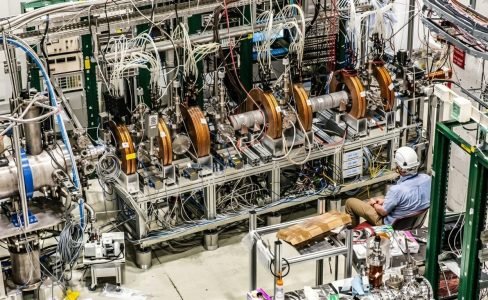
Pin Photo Courtesy of CERN
Synopsis: CERN’s Antimatter Factory, the world’s only facility dedicated to producing, trapping, and studying antimatter. It explains how scientists create antiprotons, slow them down, assemble antihydrogen atoms, and perform groundbreaking experiments to test gravity, compare matter with antimatter, and probe the fundamental laws of physics. It also examines how these experiments could help solve one of the greatest mysteries in cosmology—why the observable universe is dominated by matter despite the expectation that the Big Bang produced equal amounts of matter and antimatter.
Deep under the Swiss-French border, CERN’s Antimatter Factory does something almost unbelievable—it creates antimatter, the mirror twin of ordinary matter, and holds onto it long enough to study. Every atom made here vanishes in a flash if it touches normal matter, so trapping it takes some of the most precise engineering on Earth. This piece walks through how the facility works, why it matters, and what scientists hope to learn from particles that are extraordinarily rare in today’s universe.
There’s a room in Switzerland where physicists produce something so rare that a single wrong move destroys it instantly. That room sits on the same Geneva campus as the famous Large Hadron Collider, though it’s a separate facility entirely, running on a completely different kind of ambition. Its business is antimatter, and it has been chasing one particle at a time for nearly a quarter century.
Antimatter sounds like something dreamed up for a comic strip. It isn’t. It has sat at the edge of physics for almost a hundred years, and it drags along a question nobody has fully answered: matter and antimatter should have been created in equal amounts at the birth of the universe, yet only one of them stuck around. The other, for reasons still unexplained, went missing almost entirely.
The people working underground in Geneva are not chasing theories or chalkboard equations. They are making actual antimatter atoms, catching them, and studying them under conditions so exact that a stray magnetic field can wreck the whole experiment. What follows is a walk through how they pull it off.
Table of Contents
A Particle With a Grudge Against Its Own Reflection
Every particle of ordinary matter has a twin hiding in the rulebook of physics. An electron carries a negative charge; its twin, the positron, carries a positive one. A proton is positive; its twin, the antiproton, is negative. Same mass, same spin, opposite everything else. Put the two together and they don’t shake hands—they annihilate, converting entirely into a burst of energy.
This isn’t science fiction dressed up for a headline. Physicists have known about antimatter since 1932, when Carl Anderson spotted a positron streaking through a cloud chamber. What’s changed since then is the ability to actually build the stuff on demand, hold onto it, and run experiments on it rather than just catching a fleeting glimpse.
A few quick facts help set the scene:
- Antimatter particles carry opposite electric charge to their matter counterparts
- Contact with ordinary matter causes instant annihilation, releasing energy
- The first antiparticle (the positron) was discovered nearly a century ago
The Universe's Missing Half
Cosmology has a bookkeeping problem. The Big Bang, by every equation physicists trust, should have produced matter and antimatter in equal amounts. Add up all the stars, planets, and dust in the observable universe, and matter clearly won that lottery by a landslide. Antimatter, meanwhile, is almost nowhere to be found.
Nobody has a tidy answer for why. One leading suspect is a phenomenon called CP violation, a subtle difference in how matter and antimatter obey the laws of physics, first observed decades ago in other particle decays. It tips the scales slightly in matter’s favor, but by itself it’s nowhere near large enough to explain why the imbalance is so total. Something else was likely at work during the universe’s first fractions of a second, and finding it could rewrite a chapter of cosmology.
That’s the prize driving the underground work in Geneva. Every antiproton trapped, cooled, and measured is another data point in the hunt for whatever broke the tie between matter and its vanished twin.
Cooking Up Antiprotons from Scratch
Making antimatter starts with violence. A beam of protons, accelerated to tremendous speed, slams into a metal target. The collision throws off a shower of particles, and buried in that chaotic spray are a small number of antiprotons—the negatively charged mirror image of the proton.
Those antiprotons come out screaming fast and wildly disorganized, which is useless for an experiment that needs to study them calmly. So they get funneled into a ring called the Antiproton Decelerator, a machine built for exactly one job: taking a scattered stream of high-energy antiprotons and taming it into something usable.
The numbers involved are staggering and tiny at once:
- Only a handful of antiprotons survive from each burst of collisions
- The Decelerator slows them from close to light speed down to a fraction of that
- Cooling systems tighten the beam so it can be handled with precision
ELENA, the Ring That Slows Things Down Further
Even after the Decelerator does its work, the antiprotons are still moving too fast for most experiments to grab hold of them efficiently. That’s where a smaller ring named ELENA comes in—barely thirty meters around, tucked snugly beside its bigger sibling.
ELENA takes the antiprotons handed off by the Decelerator and slows them down roughly fifty times further, dropping their energy to a fraction of what it was. The slower an antiproton moves, the easier it becomes to trap and study, and ELENA’s arrival multiplied the number of usable antiprotons available to every experiment on site by a wide margin.
It sounds like a small tweak. In practice, it turned a research bottleneck into a steady supply line, letting seven separate experiments draw from the same source through their own dedicated beamlines.
Catching a Particle That Erases Itself
Here’s the puzzle that keeps antimatter scientists up at night: how do you hold something that destroys itself the instant it touches a container wall? The answer is a Penning trap, a cage built entirely from electric and magnetic fields rather than physical material.
No metal, no glass, nothing solid ever touches the antiproton. Instead, invisible fields box it in from every direction, letting it hover in a vacuum chamber colder and emptier than most of outer space. It’s an elegant workaround for a problem that would otherwise make the whole enterprise impossible.
The results have been remarkable. One experiment on site, called BASE, has held onto trapped antiprotons for over a year at a stretch—a record that would have sounded absurd to physicists working just a few decades earlier.
Building Whole Antimatter Atoms
Trapping a single antiproton is one kind of achievement. Building a complete antimatter atom is another altogether. That’s the job of the ALPHA experiment, which combines antiprotons with positrons to produce antihydrogen—the antimatter twin of the simplest, most common atom in the universe.
The process is delicate. Both particles have to be cooled to extremely low energies and brought together so gently that they bind rather than annihilate. When it works, the result is a genuine antihydrogen atom, held in place by magnetic fields inside a bottle with no physical walls at all.
Physicists can now produce and store these atoms routinely, a milestone that seemed almost fanciful when the facility first opened. What used to be a rare, one-off event has become something closer to a repeatable procedure.
Dropping Antimatter to See Which Way It Falls
A modified version of the same setup, named ALPHA-g, was built to answer a wonderfully simple question: does antimatter fall down, same as everything else, or could it possibly fall up? Einstein’s equations say gravity shouldn’t care whether a particle is matter or antimatter, but nobody had ever actually watched it happen.
The experiment trapped groups of roughly a hundred antihydrogen atoms, then slowly loosened the magnetic bottle holding them and watched which way they drifted as they escaped. After repeating the test with different magnetic settings to rule out interference, the team found antihydrogen accelerating downward within experimental uncertainty, consistent with the normal, attractive pull of gravity that ordinary matter feels.
It confirmed what most physicists expected, but expecting something and actually measuring it are very different things. This marked the first direct observation of gravity acting on neutral antimatter, opening a new branch of experimental physics that barely existed before.
Measuring Antimatter with Almost Absurd Precision
Not every experiment underground is chasing a dramatic first. Some are grinding away at precision, shaving uncertainty down decimal place by decimal place. The BASE experiment falls into that camp, comparing the antiproton’s properties against the proton’s with extraordinary exactness.
Its headline result compared the charge-to-mass ratio of the antiproton and the proton and found them equal to within sixteen parts per trillion—a level of agreement that’s difficult to even picture. Any measurable difference there would hint at a crack in one of physics’ most trusted symmetries.
So far, no crack has shown up. That’s frustrating for anyone hoping for a plot twist, but it’s exactly the kind of rigorous, repeatable check that keeps the entire field honest.
Opening the Doors to New Experiments
For years, access to antiproton beams was limited to a handful of established experiments with dedicated beamlines. That changed with the arrival of TELMAX, a new test beamline that officially opened to outside users in 2025 and holds the distinction of being the world’s first antiproton beamline available on open booking, rather than reserved for permanent residents of the facility.
The first group to use it, an experiment called PAX, has been studying the fine details of how antiprotons interact using quantum electrodynamics as its guide. Others have lined up behind it, treating the new beamline the way a shared laboratory bench gets passed from one project to the next.
It’s a small administrative change with a large scientific payoff: more scientists, more experiments, more chances to catch something unexpected, all without having to build an entirely new facility from the ground up.
Antimatter Goes for a Drive
If catching antimatter sounds hard, try moving it. That’s exactly what a team behind the BASE experiment attempted, loading ninety-two trapped antiprotons into a portable, one-tonne device called BASE-STEP and trucking them across roughly 7.5 kilometers of CERN’s campus, a journey that took about 24 minutes.
The device carries its own superconducting magnet, its own cryogenic cooling system running on liquid helium, and its own power supply, all packed tightly enough to fit through a standard laboratory door. Antimatter annihilates on contact with anything ordinary, so keeping ninety-two antiprotons alive through a bumpy truck ride was no small technical feat.
The trial worked, and the ambitions reach further than a short drive across Geneva. The long-term goal is shipping antiprotons to outside laboratories entirely, including one in Germany, so researchers elsewhere can run their own precision measurements without needing to build a facility of this scale themselves.
Why Any of This Matters
It would be easy to dismiss all this as an expensive way to study particles that vanish almost as soon as they’re made. But the questions being chased here sit at the foundation of physics itself: why matter outnumbers antimatter, whether gravity plays favorites, and whether the fundamental symmetries physicists rely on actually hold up under close inspection.
Every antiproton trapped, every antihydrogen atom built and dropped, every precision measurement squeezed a little tighter, chips away at those mysteries one experiment at a time. None of it has produced a plot twist yet. All of it narrows down where a plot twist could still be hiding.
The facility keeps expanding its reach, adding new beamlines, refining its traps, and even teaching antimatter to survive a truck ride. Whatever answer eventually turns up, it’s going to come from a small patch of underground tunnel in Geneva where scientists spend their days trying to hold onto something the rest of the universe would rather erase.
FAQs
Tiny amounts produce only tiny energy releases. Large explosions would need enormous amounts of antimatter, far more than we can currently produce.
Trapped in magnetic and electric fields inside vacuum chambers—never touching any solid container.
It tests whether the basic laws of physics apply equally to matter and its opposite twin.
No. Careful drop tests show it falls down, just like ordinary matter.
Not yet—producing even a speck takes enormous energy and equipment, far more than it could return.









 Login with Google