






















 Pin
Pin Japanese Traditional Fermented Tofu / Photo Courtesy of Horizon Dwellers
Synopsis: Japanese traditional fermented tofu making is a patient, unhurried business that takes plain soybean curd and turns it into a food closer to strong cheese than anything sitting in a supermarket tofu tub. Born on the islands of Okinawa and shaped by centuries of trade with China, it leans on drying, salt, rice mold, and local rice liquor to do the heavy lifting. Left alone long enough, the tofu changes its color, its texture, and frankly its whole personality. What follows is a walk through that transformation, one patient step at a time.
A block of tofu, left to its own devices in a jar for half a year, is not something most cooks would recommend. And yet in Okinawa, that is exactly the plan, and it has been the plan for a very long time. Rice mold and a strong local liquor go to work on it, and by the time anyone opens the jar again, the tofu inside has forgotten it was ever tofu at all.
The result carries a smell that arrives well before the flavor does, and a texture somewhere between soft cheese and something a wine cellar might produce by accident. It is not a dish for the timid, and the people who make it would probably agree, though they would say so with a shrug rather than a warning label.
This piece follows the process from a plain block of soybean curd through months of quiet fermentation, drawing on the work of Okinawan researchers who have studied the craft for decades, and on the households and small producers who never needed a study to know it worked.
Table of Contents
Step 1: What This Curious Food Actually Is
 Pin
Pin Photo courtesy of Horizon Dwellers
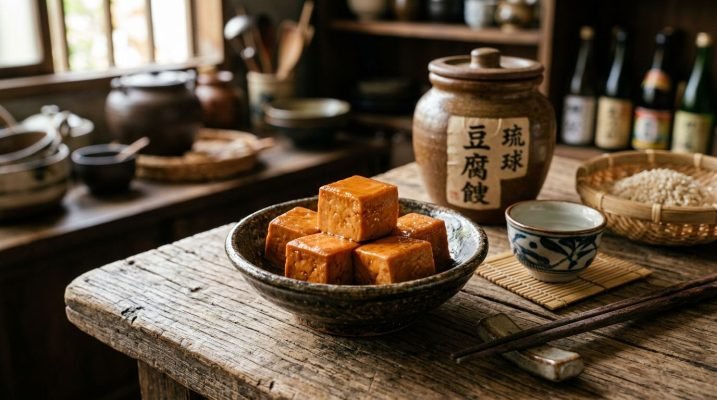
Fermented tofu, in its Okinawan form, goes by the name tofuyo, and it is a food that refuses to behave like tofu. Fresh tofu is mild, a little shy, happy to take on whatever flavor sits next to it. Tofuyo has opinions of its own. Aged in rice mold and liquor for months, it turns dense, faintly red, and startlingly strong, closer in character to a ripe European cheese than to anything found in a soy aisle.
It is eaten in small amounts, almost never as a main event. A sliver goes a long way, the way a spoonful of very old cheese goes a long way.
A few basics worth knowing before the rest of the process unfolds:
- Tofuyo is made from a firmer variety of tofu unique to Okinawa
- It ferments for several months, sometimes longer
- Its color and smell come from red rice mold, not additives
Step 2: A Long Trip From China
 Pin
Pin Photo courtesy of Horizon Dwellers
The story of this tofu does not begin in Japan at all. Fermented bean curd has a long history in China, where cooks were curing tofu with mold and brine long before Okinawa ever heard of it. Trade between China and the old Ryukyu Kingdom carried the idea across the water sometime around the 18th century, and Okinawan cooks gradually adapted it using their own awamori, along with plenty of other local customs.
An Englishman visiting Naha in 1816 wrote home about being served something at a royal feast that he could only describe as resembling cheese, though he admitted he had no idea what it actually was. Historians now suspect it was an early version of tofuyo, though the food would not be written down by name until 1832.
Okinawa took the idea and made it its own, swapping in local rice, local mold, and eventually a local liquor strong enough to season an entire dish by itself.
Step 3: The Island Tofu That Starts It All
 Pin
Pin Photo courtesy of Horizon Dwellers
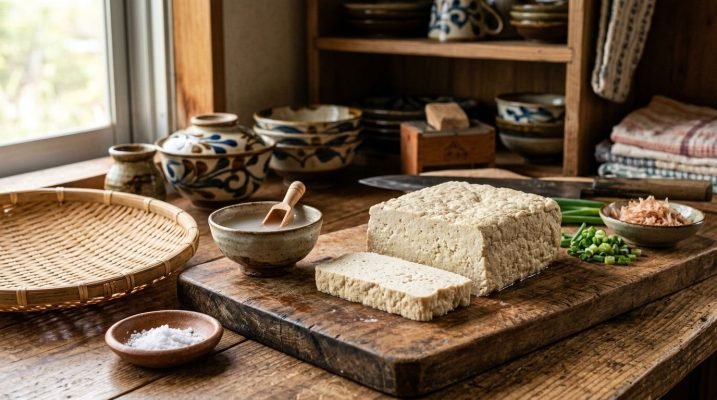
No ordinary tofu will do for this job. Okinawa makes its own variety, called shima-dofu, and it is built differently from the soft, delicate blocks found on the mainland. It is heavier and firmer, traditionally set with nigari, a mineral-rich coagulant drawn from seawater rather than the milder coagulants used on the mainland, a habit left over from a time before refrigeration, when island cooks needed tofu that could survive a hot climate without falling apart.
A single block can weigh close to a kilogram, and it holds its shape well enough to be cooked, stir-fried, or dropped straight into a simmering pot of miso soup.
That sturdiness matters enormously for what comes next, because the tofu is about to be dried, salted, and left to sit for a very long time, and a softer block simply would not survive the process.
Step 4: Salting and Drying, Day After Day
 Pin
Pin Photo courtesy of Horizon Dwellers
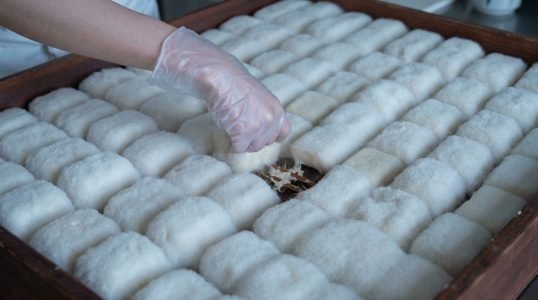
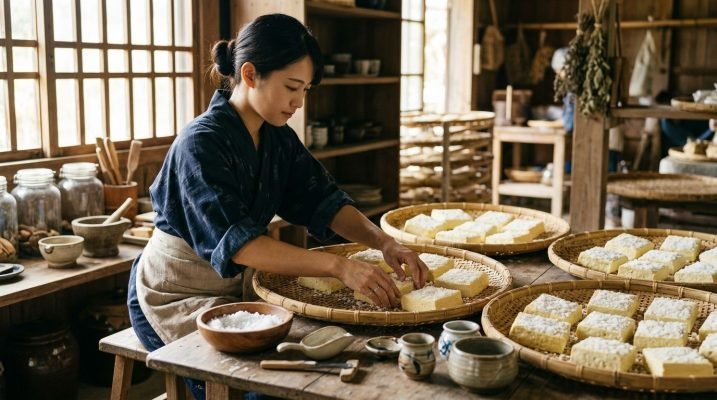
Before any mold or liquor gets involved, the tofu has to lose most of its water, and that takes patience rather than heat. The blocks are salted on the surface and left to dry out slowly over several days, sometimes as many as a week, until the outside turns firm and takes on a faint yellow tinge.
This step does two jobs at once. It removes the moisture that would otherwise let unwanted bacteria move in, and it toughens the surface enough to hold together once it is dropped into liquid again later on.
A few things happen during this stage:
- The surface dries and stiffens
- Salt draws out excess water
- The color shifts from white to pale yellow
Only once the tofu has dried properly does the next stage of the process begin, and skipping ahead tends to end badly.
Step 5: Enter the Rice Mold
 Pin
Pin Photo courtesy of Horizon Dwellers
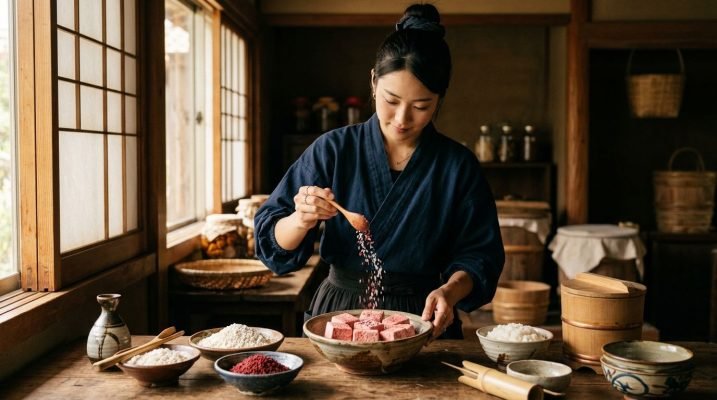
Here the process turns from cooking into something closer to brewing. Rice koji, a mold grown on steamed rice, gets mixed in, and tofuyo traditionally calls for two kinds at once: a white koji grown from Aspergillus oryzae, the same fungus behind miso and soy sauce, and a red one grown from a fungus called Monascus. Blended together, the two give the liquid a distinct pink tint that eventually becomes the tofu’s signature color.
Koji is no stranger to Japanese kitchens. It is the same mold responsible for miso, soy sauce, and sake, working quietly behind the scenes of half the country’s pantry. Its real talent lies in enzymes, particularly one called protease, which spends the following months slowly breaking down the tofu’s protein into amino acids and smaller peptides.
That breakdown is where the sharp, savory flavor eventually comes from, and it cannot be rushed by turning up the heat.
Step 6: A Splash of Local Liquor
 Pin
Pin Photo courtesy of Horizon Dwellers
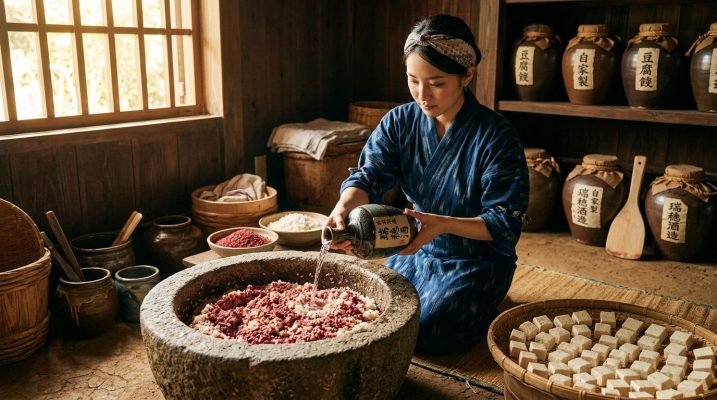
Alongside the koji goes awamori, a distilled rice liquor made only in Okinawa and considerably stronger than most drinks on a dinner table, often reaching forty percent alcohol or more. The koji is softened in this liquor for a couple of days before the tofu ever meets it, turning into a thick, ground paste the tofu will later sit inside.
The alcohol is not there for flavor alone, though it does contribute plenty. It also keeps unwanted microbes from taking over the jar while the slower, more deliberate work of fermentation gets underway. In a hot, humid climate like Okinawa’s, that kind of protection matters more than it might elsewhere.
Awamori also helps regulate enzyme activity, allowing proteins to break down gradually without the tofu turning into a paste. That slow, controlled pace is exactly what gives tofuyo its smooth, cheese-like texture instead of a mushy one.
Awamori gives tofuyo part of its bite, and part of the reason a small sliver goes further than expected.
Step 7: Packing the Jars With Patience
 Pin
Pin Photo courtesy of Horizon Dwellers
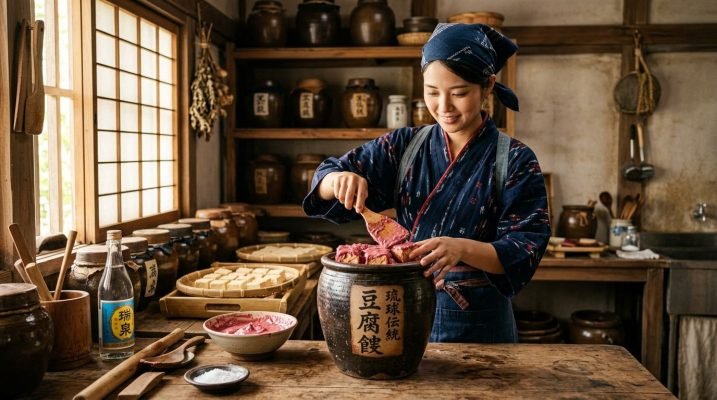
Once the tofu has dried and the koji-awamori paste is ready, the two finally meet. Cubes of tofu are layered into jars or crocks and covered entirely in the thick, pink paste, with a little added salt to help things along. Every cube needs to be fully surrounded, since any exposed surface risks drying out wrong or letting in the kind of mold nobody asked for.
Traditional producers packed these jars by hand, sealing them and setting them aside in a cool corner of the house, the same way a household might store pickles or preserved plums for the winter.
There is very little to do after this point besides waiting, and the temptation to check on the jars too often is one most patient makers learn to resist.
Step 8: Months of Sitting Still
 Pin
Pin Photo courtesy of Horizon Dwellers
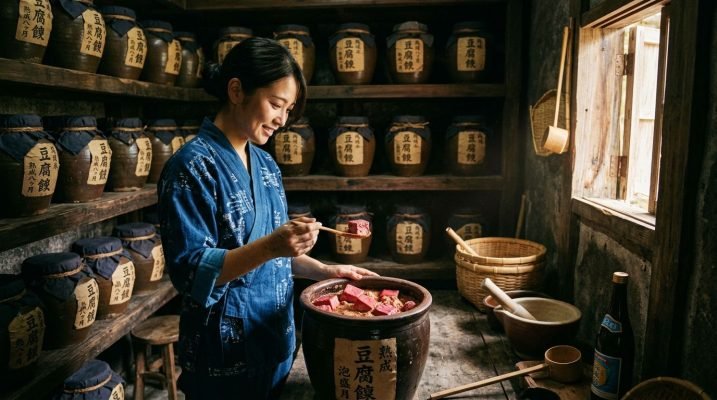
This is where the real transformation happens, and it happens slowly. The jars are left to ferment for three to six months, though some producers push well past that, having found the flavor keeps deepening the longer it sits. Traditional Okinawan researchers who studied the process in detail found the best flavor often showed up around the half-year mark, not sooner.
During this stretch, the tofu firms up further, deepens in color toward a reddish hue, and develops the strong smell that gives newcomers pause before their first bite.
A rough timeline for reference:
- 1 to 2 months: mild, still recognizably tofu-like
- 3 to 4 months: firmer texture, stronger aroma developing
- 5 to 6 months and beyond: deep flavor, soft interior, cheese-like character
Nobody rushes this part, and every attempt to do so tends to show up in the final taste.
Step 9: What the Enzymes Are Up To
 Pin
Pin Photo courtesy of Horizon Dwellers
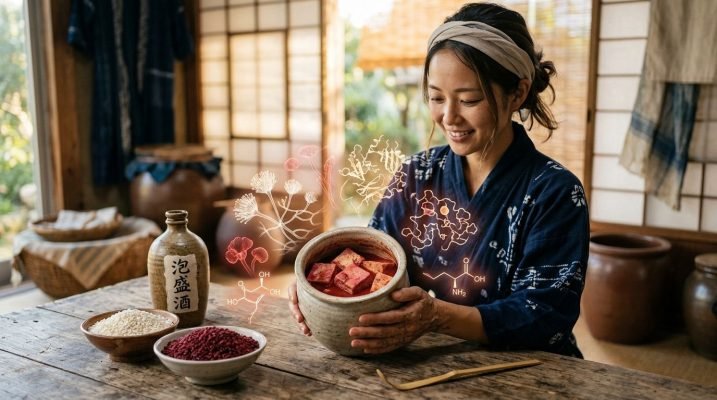
While the jars sit quietly on a shelf, something far busier is happening at the microscopic level. The protease enzymes from the koji mold spend months chewing through the tofu’s protein, breaking long chains down into individual amino acids and shorter peptides. This is the same basic chemistry that gives aged cheese its depth, and it explains why tofuyo tastes far more complex than the plain soybean curd it started as.
The red Monascus mold contributes its own pigments along the way, staining the tofu a deep rose color from the outside in. Together, the two molds and the alcohol create a small, contained ecosystem inside each jar, one that Okinawan food scientists have spent decades documenting in painstaking chemical detail.
The tofu that emerges bears only a passing resemblance to where it began.
Step 10: How the Locals Actually Eat It
 Pin
Pin Photo courtesy of Horizon Dwellers
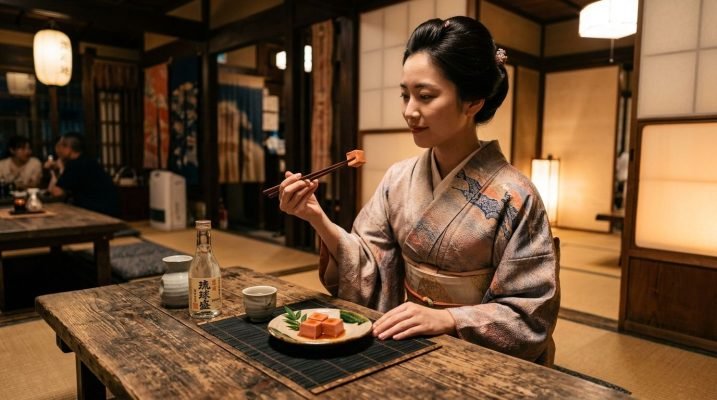
Given how intense the flavor becomes, tofuyo is never treated as an everyday snack. It is served in small cubes, often no bigger than a sugar cube, and eaten one sliver at a time using the tip of a chopstick or a small pick. Diving in with a whole spoonful would overwhelm most palates fairly quickly.
It typically shows up alongside drinks rather than as part of a regular meal, particularly awamori itself, since the two share enough flavor that they complement each other rather than compete. Restaurants specializing in traditional Okinawan cuisine often keep it on the menu as a specialty item rather than a staple.
A little goes a long way here, and most people who try it agree that a little is exactly the right amount.
Step 11: Why the Old Recipe Still Survives
Tofuyo could easily have faded into obscurity, the way plenty of regional specialties do once modern convenience food takes over. Instead, it has held on, helped along by researchers such as Dr. Masaaki Yasuda, whose studies through the 1980s and beyond gave the world its first detailed scientific record of how the process actually works.
Small producers in Naha and across Okinawa continue making it by hand, some using recipes passed down for generations rather than written formulas. It has even found its way onto international lists of unusual and delicious foods, introducing curious eaters far beyond Japan to a flavor most had never encountered.
The process has not changed much in over a century, and that, more than anything, seems to be the whole point.
A Note on Health Benefits
Beyond flavor, tofuyo has drawn some scientific curiosity of its own. Laboratory studies out of Okinawa have identified peptides formed during fermentation that show ACE-inhibitory activity, the kind linked to modest antihypertensive effects, though these findings come from lab settings rather than large human trials.
The long fermentation also builds up glutamic acid, the amino acid responsible for a food’s umami punch, which explains why a sliver this small can taste so disproportionately strong.
None of this makes tofuyo a health food in the everyday sense, given how salty and alcohol-forward it is. But it does mean the fermentation is doing more than just building flavor behind the scenes.
FAQs
Related, not identical. Tofuyo traces back to Chinese fermented bean curd but developed its own character in Okinawa using local koji and awamori liquor.
Typically three to six months, though some producers age it even longer, saying the flavor keeps improving well past the half-year mark.
Not remotely. Expect something closer to a strong, aged cheese, with a pungent smell and a rich, savory bite from months of fermentation.
Red koji, made from a mold called Monascus, gives tofuyo its rosy tint along with much of its distinctive fermented flavor.
In tiny slivers, usually with a pick or chopstick tip, alongside awamori or sake rather than as part of a full meal.









 Login with Google