






















 Pin
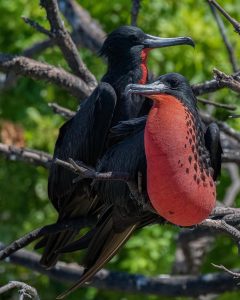
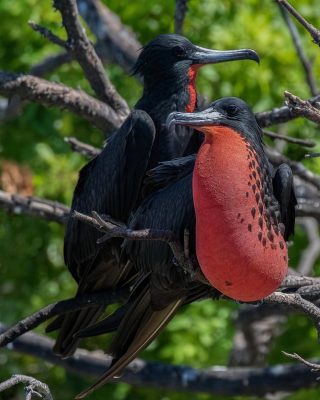
Pin Magnificient Frigatebird / Photo Courtesy of Andrea Pico Estrada
Synopsis: Top 10 birds that can fly for days without landing — a list that includes the Arctic Tern, Bar-tailed Godwit, Common Swift, Sooty Tern, Alpine Swift, Great Frigatebird, Magnificent Frigatebird, White-throated Needletail, Wandering Albatross, and Sooty Shearwater. These birds use thermal soaring, dynamic gliding, and mid-air micro-sleep to stay airborne for days, months, or even years. Some don’t touch land for the first several years of their lives. Nature, it turns out, built a few creatures that treat the sky like permanent address.
Most birds land to sleep, eat, drink, and rest. They need the ground the way most living things need oxygen — habitually, urgently, without question. But somewhere along the long chain of evolution, a handful of species quietly rewired that instinct.
The birds on this list treat the sky not as a route, but as a residence. A few of them are airborne for so long — months, sometimes years — that landing starts to feel like the exception, not the rule. Scientists tracking these creatures with GPS tags and data loggers have come back with findings that make biologists do a second take.
Some of these birds sleep in mid-flight. Some eat without ever descending to water level. In some species, juveniles don’t return to land for the better part of a decade. The rankings below go from remarkable to genuinely unbelievable — and the #1 entry earns that title fair and square.
Table of Contents
#10 — Sooty Shearwater
 Pin
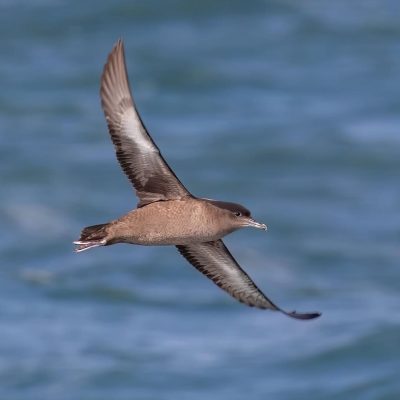
Pin Photo courtesy of Marcel Klootwijk
The Sooty Shearwater breeds in New Zealand and then does something that would exhaust any atlas: it migrates to the North Pacific and back, logging nearly 40,000 miles every single year. That number isn’t a rough estimate — electronic tagging studies confirmed it. The bird traces a massive figure-eight loop across the Pacific, chasing productive feeding grounds across two hemispheres.
What makes the Sooty Shearwater a serious endurance machine is its mastery of a flight technique called dynamic soaring — the same trick used by albatrosses. It skims close to the ocean surface, rises into the wind layer, banks hard, and uses that speed differential between the slow air near the water and the fast air above it to generate lift for free. The wings barely flap. The ocean does most of the work.
During its non-breeding season, a Sooty Shearwater can travel thousands of miles largely without touching land. Individuals logged around 50,000 km of flight in a single non-breeding season — typically without touching the ground the entire time.
QUICK FACTS
- Annual migration circuit: ~40,000 miles (64,000 km)
- Flight technique: dynamic soaring — energy-efficient, nearly continuous
- Breeds in New Zealand; migrates to the North Pacific
- Can live up to 30 years
#9 — White-throated Needletail
 Pin
Pin Photo courtesy of Fumiya
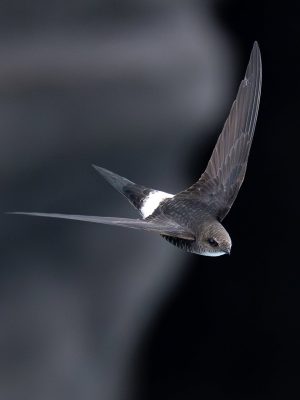
The White-throated Needletail — also called the spine-tailed swift — is among the fastest birds in level, powered flight, with recorded speeds of 111.6 km/h and unofficial estimates pushing toward 170 km/h, though speed records in this category remain debated across swift species. The Peregrine Falcon dives faster, but that involves gravity doing most of the heavy lifting. The Needletail achieves its speed purely through wing-power, flying flat-out with almost no assistance from wind or elevation.
These birds breed in the rocky hills of Central Asia and southern Siberia, and their legs are so small and underdeveloped that they almost never voluntarily land on the ground. They cling to vertical surfaces — cliff faces, hollow trees — when they must, but most of their lives happen entirely in the air. They catch insects on the wing, drink by skimming over water surfaces, and spend their days slicing through the sky at speeds that blur the distinction between bird and projectile.
During migration, White-throated Needletails cover enormous distances with that characteristic high-speed efficiency, spending days continuously airborne as they move between their breeding grounds and their wintering areas across Southern and Southeast Asia.
QUICK FACTS
- Confirmed level-flight speed: 111.6 km/h; reported up to 170 km/h
- Legs almost non-functional for walking — built purely for flight
- Breeds in Central Asia and Siberia; winters across South and Southeast Asia
- Catches all food in mid-air
#8 — Magnificent Frigatebird
 Pin
Pin Magnificient Frigatebird / Photo Courtesy of Andrea Pico Estrada
The Magnificent Frigatebird has earned two names over the centuries — the Man O’ War, borrowed from the fast warships of the Age of Sail, and the pirate bird, earned from its habit of harassing other seabirds mid-flight until they drop their catch. It then swoops down and snatches the stolen meal before it hits the water. This is a bird that has turned aerial robbery into a survival strategy, and it does all of it without ever landing on the ocean.
Frigatebirds cannot land on water. Their feathers aren’t waterproof — if they get too wet, they can’t take off again. So they have evolved to stay airborne almost indefinitely, soaring on tropical thermals and trade winds with one of the lowest wing-loading ratios of any bird species. That combination of enormous wingspan and featherlight frame means they can glide for hours without a single flap.
Records show Magnificent Frigatebirds remaining aloft for extended periods. They spend days and nights on the wing continuously, covering large stretches of ocean in search of food — or someone else’s food. Their deeply forked tail gives them pinpoint aerial control that’s almost theatrical to watch.
QUICK FACTS
- Cannot land on water — feathers are not waterproof
- Lowest wing-to-body-weight ratio of any bird
- Notorious kleptoparasite — steals food from other birds mid-air
- Named after British frigate warships for its speed and aggression
#7 — Arctic Tern
 Pin
Pin Photo courtesy of Artysnowy1
The Arctic Tern covers more distance in a single year than almost any animal alive. One individual, tracked with a geolocator from its breeding grounds near England, logged 59,650 miles on a single annual journey to Antarctica and back — the longest migration ever recorded for any animal. The bird’s round-trip can exceed 71,000 km, and over its 30-year lifespan, a single tern may fly the equivalent of three return trips to the Moon.
The Tern doesn’t follow a straight line. It reads wind patterns the way a seasoned sailor reads weather, zig-zagging across ocean basins to ride the most favorable air currents. It leaves the Arctic in late summer, dips toward South Africa, swings through the Indian Ocean, descends to Antarctica for the southern summer, and then reverses the whole sequence heading north again. By following summer around the globe, the Arctic Tern spends more time in sunlight than any other creature on Earth.
The birds don’t stop for weeks during the ocean-crossing legs of the journey. They plunge-dive for fish on the move, and individual flight segments over open water can last several days without rest.
QUICK FACTS
- Longest recorded single migration: 59,650 miles (one individual, UK to Antarctica and back)
- Annual roundtrip: commonly exceeds 71,000 km
- Lifespan: up to 30 years; total lifetime distance can exceed 2.4 million km
- Experiences more daylight per year than any other animal
#6 — Sooty Tern
 Pin
Pin Photo courtesy of Aurelien Audevard
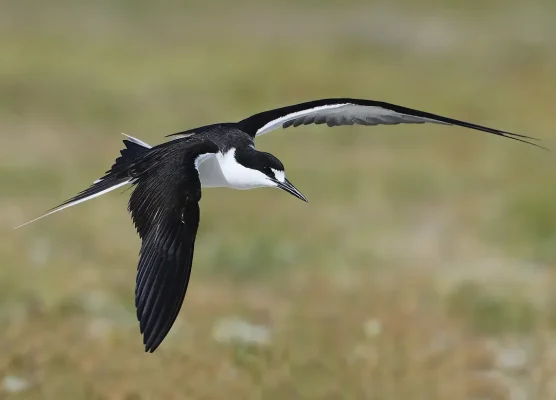
The Sooty Tern faces a remarkable constraint: its plumage is poorly adapted for resting on water for extended periods. Unlike most seabirds, the Sooty Tern’s feathers aren’t water-repellent enough to allow comfortable sitting on the ocean surface for long. If it lingers too long on the water, it risks becoming waterlogged and unable to take off. So it feeds by skimming the surface in flight, snatching small fish and squid without ever actually landing. It takes one- to two-second micro-naps while airborne, keeping itself going through what amounts to the bird equivalent of blinking and hoping for the best.
After fledging, young Sooty Terns spend between two and five years almost entirely at sea — research suggests they may remain airborne for extended periods during this time, though direct evidence remains difficult to gather. They return only when it’s time to breed, typically between ages four and ten. In the interim, they log extraordinary distances: adults tracked from breeding colonies in the Seychelles flew as far as 8,700 km from their nesting sites, and individual birds were recorded covering around 50,000 km during a single non-breeding season.
In tropical and subtropical oceans, Sooty Terns number between 60 and 80 million — making them the most abundant seabird in the tropics. Their numbers don’t diminish the feat. Each one is carrying out the same wild marathon, day after day, season after season.
QUICK FACTS
- Plumage is poorly adapted for extended rest on water — pushes it toward an almost entirely aerial lifestyle
- Young birds stay airborne for 2–5 years after fledging before returning to land
- Feeds entirely in flight — skims the water surface for fish and squid
- Most abundant seabird in the tropics: 60–80 million individuals
#5 — Bar-tailed Godwit
 Pin
Pin Photo courtesy of Studebaker Photo Tours
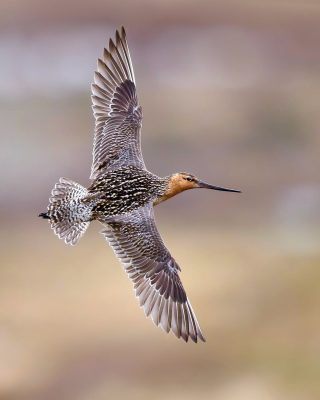
The Bar-tailed Godwit holds the record for the longest nonstop flight of any bird — and it’s not close. The subspecies that breeds in Alaska winters in New Zealand and Australia, and to get there it flies more than 7,500 miles (12,000 km) across open ocean without landing once. The journey takes between eight and eleven days of continuous flying, over nothing but the Pacific — no islands, no rest stops, no options.
To prepare for this flight, the Godwit does something dramatic: it essentially eats itself. It gorges on food in the weeks before departure, roughly doubling its body weight in stored fat. Then, before takeoff, it begins shrinking its own organs — the liver, kidneys, intestines all reduce in size — to save weight and redirect energy toward the muscles that matter. By the time it lands in New Zealand, it has lost more than half its body weight.
Scientists use tiny GPS trackers to follow Godwits across the Pacific. The tracking data confirm what was once considered biologically impossible: nonstop flight lasting over a week without feeding or landing, though how much sleep occurs during that time remains an open question. The bird navigates using the sun, stars, and Earth’s magnetic field, with an accuracy that would humble most instruments.
QUICK FACTS
- Longest nonstop flight of any bird: 7,500+ miles (12,000 km)
- Flight duration: 8–11 days continuous, no landing
- Loses more than half its body weight by the time it arrives
- Shrinks its own organs before departure to save energy
#4 — Great Frigatebird
 Pin
Pin Photo courtesy of Michael Schmid
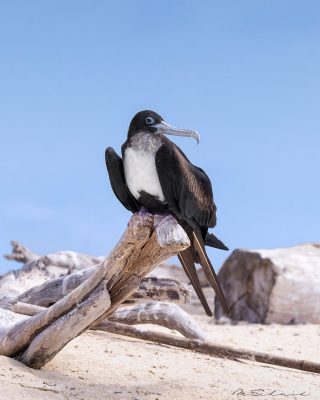
The Great Frigatebird (Fregata minor) caught the attention of neuroscientists and ornithologists in equal measure when a research team from the Max Planck Institute fitted fourteen of them with tiny EEG monitors and sent them out to sea. What came back was surprising even to the researchers who designed the study. These birds, which stay aloft for up to two months over the Indian Ocean during foraging trips, sleep while flying — but only about 42 minutes per day, usually in 10-to-12-second bursts.
The sleep itself comes in two forms. In the first, the bird keeps one brain hemisphere awake while the other rests — unihemispheric sleep, the same trick used by dolphins and certain ducks. In the second, and this is the part that raised eyebrows, researchers observed brief periods where both hemispheres showed sleep-like activity simultaneously. The bird appears to catch brief REM sleep — the deep, restorative kind — while still airborne, staying aloft on rising air currents and gliding through the sky during those intervals.
Juvenile Great Frigatebirds, on their first ocean crossings from their birth islands, can travel thousands of kilometers across the Indian Ocean to Indonesia — sometimes staying airborne for over two months before touching ground.
QUICK FACTS
- Documented to stay airborne for up to two months over the Indian Ocean
- Sleeps only 42 minutes per day while flying — in 10–12-second bursts
- Can sleep with one or both brain hemispheres simultaneously
- Like all frigatebirds, cannot land on water — feathers are not waterproof
#3 — Alpine Swift
 Pin
Pin Photo courtesy of Mustafa Sozen
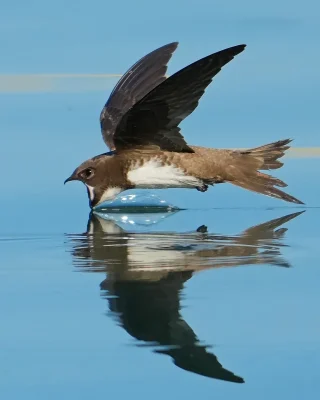
Before the Common Swift came along and broke everything, the Alpine Swift held the record for the longest uninterrupted flight of any bird species. A research team using geolocators documented individual Alpine Swifts staying airborne for more than 200 consecutive days — over six months — during their non-breeding season spent in the skies over West Africa. The birds were feeding on flying insects the entire time, aloft in a continent they’d never settled on.
Published in Nature Communications, the research concluded that all vital physiological processes — including sleep — can be sustained in flight. The birds aren’t just surviving up there; they’re genuinely living. Eating, drinking, sleeping, and moving through the world entirely without land for half the year. Their wings are long and swept-back, built for gliding efficiency. Their bodies are lightweight. Their metabolisms are finely tuned to manage the energy demands of constant motion.
The Alpine Swift is smaller than many birds on this list and less immediately dramatic than the albatross or frigatebird. But 200 days in the air, documented and verified, is a number that earns real respect.
QUICK FACTS
- Former record holder for longest uninterrupted flight: 200+ consecutive days
- Spends non-breeding season entirely airborne over West Africa
- Published record in Nature Communications — scientifically verified
- All vital processes, including sleep, confirmed to continue during flight
#2 — Wandering Albatross
 Pin
Pin Photo courtesy of Rodrigo Wildlife Photo
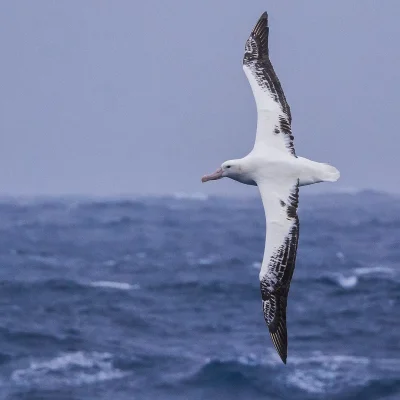
The Wandering Albatross has the largest wingspan of any living bird — up to 11.5 feet, nearly four metres tip to tip. That wingspan is its entire philosophy. The bird barely flaps. Instead, it uses a technique called dynamic soaring: it descends toward the ocean surface gathering speed, banks sharply into the wind, converts that speed into altitude as it climbs back into faster air, then loops around and descends again. This wave-like zigzag allows it to cover nearly 1,000 kilometres per day with almost no muscular effort whatsoever.
A shoulder-locking mechanism — a specialized tendon that passively holds the wings fully extended without muscle contraction — makes this possible. The albatross can glide for hours without spending energy on keeping its wings open. GPS tracking has confirmed that one Wandering Albatross covered over 13,000 miles in just 46 days. Researchers have documented individual birds circumnavigating the entire Southern Ocean.
Juvenile albatrosses, once they fledge from their nesting colonies, can remain at sea for five to ten years without ever returning to land. During those years, they circle the Southern Ocean continuously, landing only on the water’s surface occasionally to feed or rest — but never touching terra firma. Adults live up to 60 years and breed on remote subantarctic islands.
QUICK FACTS
- Largest wingspan of any living bird: up to 3.5 metres (11.5 feet)
- Juveniles can remain at sea — without returning to land — for 5 to 10 years
- Dynamic soaring covers ~1,000 km per day with minimal wing-flapping
- Shoulder-locking tendon holds wings open without muscle effort
- One individual recorded: 13,000+ miles in 46 days
#1 — Common Swift
 Pin
Pin Photo courtesy of Lennart Verheuvel
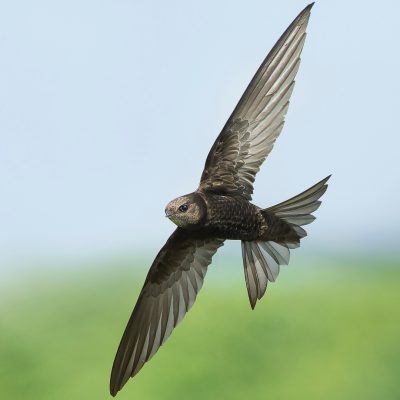
In 2016, a team of researchers at Lund University in Sweden published findings that stopped ornithologists in their tracks. Using a new generation of lightweight data loggers that detect both light and movement, they tracked Common Swifts across their entire non-breeding migration — and discovered that most individuals appeared to remain airborne for more than 99% of that period, with some appearing to stay aloft almost continuously for up to ten months.
Ten months. This is not a stretch or an approximation. It represents the longest aerial endurance of any bird species on record. The Common Swift (Apus apus) lands for approximately two months each year — its breeding season. The remaining ten months, it lives almost entirely in the sky. It eats up there, catching insects in its wide, gaping bill. It drinks up there, skimming over water without landing. Aerial copulation has been observed in this species. And according to the data, it sleeps up there — though exactly how remains one of the more tantalizing open questions in biology.
What makes this particularly striking is that the Common Swift’s flight requires almost constant wing-flapping. It is not an effortless glider like the albatross. It works for every hour aloft, and it does it for ten months. Dr. Anders Hedenström of Lund University called it simply: ‘The longest we know of any bird species — it’s a record.’ The Common Swift can reach altitudes of 10,000 feet during these marathon flights. Its body weighs barely 40 grams. It has, by almost any measure, the most extraordinary relationship with sustained flight of any creature alive.
QUICK FACTS
- Longest continuous flight of any bird: up to 10 months without landing
- Lands only during its 2-month breeding season each year
- Eats, drinks, and sleeps in the air; aerial mating has been observed in this species
- Verified by data loggers at Lund University, Sweden — published 2016
- Body weight: approximately 40 grams — less than a handful of coins
- Can reach altitudes of up to 10,000 feet during flight
The Sky as a Way of Life
There’s a certain humbling quality to this list. These ten birds didn’t evolve their endurance for spectacle — they evolved it because landing was dangerous, costly, or simply unnecessary. The ocean offered no safe footing. The thermals were always available. The food was up there. And so, across millions of years, they rewired their biology to suit a world with no ground in it.
The Common Swift sitting at #1 is perhaps the most astonishing example of all precisely because it looks so ordinary. A small, dark bird with a forked tail and a screech like a tiny jet engine. Nothing about its appearance suggests that it’s running the longest continuous flight show on the planet for most of its life. But the data doesn’t lie, and the data says that bird is living proof that the sky, given the right set of tools, can be home.
FAQs
The Common Swift holds the record, appearing to remain airborne for up to 10 months straight — eating, sleeping, and mating in the air. It lands only during its 2-month breeding season.
The Bar-tailed Godwit flies 7,500+ miles from Alaska to New Zealand without stopping — a journey of 8 to 11 days over open ocean, with no feeding or landing, and how much sleep occurs during that time remains uncertain.
Yes. Great Frigatebirds have been documented sleeping mid-flight using EEG monitors — about 42 minutes per day, in bursts as short as 10 seconds, sometimes with both brain hemispheres simultaneously.
It uses dynamic soaring — alternating between fast low-level descents and wind-assisted climbs. A shoulder-locking tendon holds its wings extended without muscle effort, covering nearly 1,000 km per day almost effortlessly.
Young Sooty Terns spend 2 to 5 years almost entirely at sea after fledging before returning to land. Research suggests they remain airborne for much of this period — feeding in flight and taking 1-to-2-second micro-naps, since their plumage is poorly suited to resting on the water for extended periods.










 Login with Google