
























 Pin
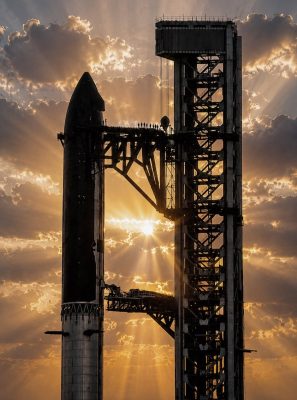
Pin Photo Courtesy of SpaceX
Synopsis: SpaceX, Starlink, and AI Satellites have become one of the biggest stories in tech this year. Some analysts believe this trio could unlock a $28 trillion opportunity over the coming decades, while skeptics call the whole idea overhyped. This article looks at what’s really happening above our heads, why companies are racing to put AI computers in orbit, what Starlink already does for millions of people on the ground, and whether the hype matches reality. By the end, readers will have a clear, grounded picture of where this space race stands today and where it might be heading next.
Elon Musk has never been shy about big numbers, but even by his standards, the figures floating around SpaceX right now are enormous. According to SpaceX’s own IPO filing from May 2026, the company is targeting a valuation between \$1.75 and \$2 trillion, and tucked inside that prospectus is a phrase that caught everyone’s attention: a self-estimated total addressable market of \$28.5 trillion.
That number isn’t about rockets or even internet dishes. It’s about something far stranger — putting AI data centers in orbit. The plan, as SpaceX has proposed it, involves Starlink’s existing network as the backbone for a future constellation of up to one million new satellites built specifically to run artificial intelligence — a proposed network, not yet an approved or funded build-out.
It sounds like the kind of thing a person reads twice to make sure they read it right. But the money behind it is real, and so is the engineering work already underway. Whether the dream matches the spreadsheet is the question this whole article tries to answer.
Table of Contents
Starlink, The Quiet Cash Cow
 Pin
Pin Photo courtesy of Ed Piotrowski
Before anyone gets distracted by satellites full of computer chips, it helps to understand what’s already up there and working. Starlink began in 2019 as a long-shot experiment — sixty satellites launched to prove that internet from space could actually function. By early 2026, that experiment had grown into the largest satellite constellation ever built, with more than 10,000 satellites circling the planet.
This isn’t a side project anymore. Starlink brought in over $11 billion in 2025, which made up more than half of SpaceX’s total revenue and appears to be the company’s most profitable segment by far. More than 10 million subscriptions now connect through Starlink across over 100 countries, reaching households, businesses, ships, and aircraft in places where fiber or cable never reached.
A few numbers worth knowing:
- Over 10,000 satellites in low Earth orbit, about 340 to 570 km up
- More than 10 million subscribers across 100+ countries
- $11.4 billion in 2025 revenue, with around 39% profit margins
From Wi-Fi in the Wilderness to Phones That Just Work
 Pin
Pin Photo courtesy of SpaceX
The clever part of Starlink isn’t just that it beams internet down from space — it’s how ordinary it has made the experience feel. The dish, nicknamed Dishy McFlatface by users, points itself at the sky automatically. No technician, no ladder, no fuss. Most setups take under an hour from box to browsing.
More recently, Starlink has pushed into something even bigger: connecting regular smartphones directly, without any extra hardware. Text messages already work in dead zones for some carriers, and voice calls are expected to roll out more widely through 2026. For the roughly one-third of the world’s population still without reliable internet, this isn’t a luxury upgrade — it’s the first real connection many of them will ever have.
Ships at sea, planes in the air, research stations in places where the nearest town is a memory — all of it now sits inside Starlink’s reach. That global footprint is exactly why SpaceX believes it has the foundation to attempt something far more ambitious.
Enter the AI Satellite
Here’s where the story takes a sharp turn. SpaceX isn’t content with just selling internet access. According to SpaceX’s IPO materials, the company moved to integrate Elon Musk’s AI venture, xAI, more closely with its operations around February 2026 — bringing rockets, satellites, and artificial intelligence development under one roof.
The plan calls for satellites that don’t just relay internet signals but actually run AI computing tasks themselves — training and operating AI models while floating hundreds of kilometers above the ground. Reporting on SpaceX’s early AI1 satellite design points to power output in the range of 100 to 150 kilowatts per unit, generated through solar arrays, with cooling systems built to handle the intense heat that AI hardware produces.
To put it plainly: SpaceX says it intends to build data centers that orbit the Earth instead of sitting in warehouses on the ground. It’s an idea that sounds almost too big to be real, yet the company has proposed plans for up to one million of these satellites and is reportedly building a factory in Texas to manufacture early units.
Why Space, of All Places?
AI computing on Earth has run into a wall. Training and running today’s AI models takes staggering amounts of electricity and water for cooling, and data centers are getting harder to build because of energy shortages, land costs, and neighbors who don’t want a humming warehouse next door.
Space offers two things Earth can’t: sunlight that never stops, and a cooling method that doesn’t depend on water at all. In orbit, solar panels can generate power around the clock without clouds, weather, or nightfall getting in the way. Heat, meanwhile, can be radiated away into the cold of space using large panels designed almost like wings, angled edge-on to the sun.
Researchers studying space-based computing, including engineers at the University of Pennsylvania, have pointed out that this constant solar power really is a genuine advantage worth taking seriously. But advantages on paper and advantages in practice are two very different things, and that gap is where most of the skepticism lives.
The Heat Problem Nobody Can Wave Away
Of all the challenges facing orbital AI, heat is the one engineers talk about with the most respect. On Earth, a data center can dump its waste heat into the air or into a river. In space, there is no air and no river — heat can only leave as infrared radiation, which is a slow and inefficient way to get rid of it.
SpaceX’s answer, according to reporting on its AI1 satellite design, involves enormous radiator panels engineered to handle around 1,400 watts of heat per square meter, oriented edge-on to the sun so they can release heat from both sides while soaking up as little new heat as possible from sunlight. A single satellite carrying a 150-kilowatt AI payload would produce a genuinely massive amount of heat, and getting rid of it is, by most accounts, the hardest part of the whole project.
Quick facts on the engineering challenge:
- Solar arrays targeted at roughly 250 watts per square meter
- Radiators designed for about 1,400 watts of heat per square meter
- First prototype satellites targeted for early 2027 launch
The Skeptics Have a Point Too
Not everyone is convinced, and some of the loudest doubts come from inside the AI industry itself. OpenAI’s Sam Altman has been widely quoted calling the idea of orbital data centers “ridiculous,” and he’s not alone in thinking the economics simply don’t add up yet.
The core concern isn’t whether the physics works — it’s whether the costs make sense. Launching hardware into orbit is expensive, and once it’s up there, fixing a broken part isn’t as simple as sending a technician with a screwdriver. Industry analysts have noted that the real barriers are affordability, construction logistics, and long-term reliability, not the basic science.
There’s also the question of flexibility. Cloud computing on Earth can scale up or down in minutes depending on demand. A satellite, once launched, is stuck with whatever hardware it carries. Some experts worry this rigidity could make orbital AI a poor fit for the kind of fast-changing demand that defines the AI business today.
SpaceX Isn't Alone Up There
If this all sounds like one company’s wild idea, it’s worth knowing that some of the biggest names in tech are chasing the same dream. Google announced Project Suncatcher in late 2025, a research effort to launch solar-powered satellites carrying its own AI chips, with prototype satellites planned for 2027. A startup called Starcloud has already sent a small satellite carrying an NVIDIA GPU into orbit as an early proof of concept.
Another company, Orbital, is designing a constellation built around clusters of GPUs, betting that orbital solar power and natural cooling could eventually undercut the cost of running data centers on the ground. The competition isn’t just about who gets there first — it’s about who can prove the model actually works at a scale that matters.
On the connectivity side, the picture looks different. Starlink’s nearest rival, Amazon’s Project Kuiper, has only deployed a fraction of the satellites Starlink has, and Europe’s OneWeb generates a small slice of the revenue Starlink does. For now, SpaceX holds a lead that’s hard to ignore, even if the AI satellite race is wide open.
What This Means for Everyday Internet Users
While the AI satellite story grabs headlines, the more immediate impact for most people will come from Starlink’s continuing upgrades. New satellites with laser links are being rolled out, allowing satellites to pass data between each other in orbit without needing as many ground stations. That means better coverage over oceans, remote regions, and places where ground infrastructure has never existed.
Speeds are also climbing. SpaceX has stated that future Starlink upgrades could push download speeds past 1 gigabit per second under good conditions, which would put it in the same league as home fiber connections — a remarkable claim for a service beamed down from orbit, though actual speeds will vary by location and congestion. Combined with phone-based satellite messaging and eventually voice calls, the gap between “connected” and “not connected” is shrinking faster than most people realize.
For rural communities, remote workers, and travelers, this isn’t abstract finance talk — it’s a real shift in what’s possible from a backpack, a boat, or a back porch with no cable line in sight.
The Money Question — Profit Today, Promise Tomorrow
Numbers tell an interesting story here. According to figures disclosed in SpaceX’s IPO prospectus, Starlink turned a profit of roughly $1.19 billion in a single quarter, while the AI division lost about $2.5 billion over that same period. Nearly 60% of SpaceX’s 2025 capital spending — around $12 billion — reportedly went toward AI development for a technology that, as of this writing, hasn’t launched a single working satellite.
That’s a striking gap between a business that already works and one that’s still mostly a blueprint. Essentially, the cash Starlink generates is funding the AI satellite bet, almost like a successful shop owner using today’s earnings to gamble on a much bigger storefront down the street.
This is exactly why the $28.5 trillion figure needs context. It’s a forecast of what the market could be worth someday, not a number anyone has banked yet. Investors weighing the upcoming IPO are essentially being asked to believe in two different companies at once — one that’s profitable today, and one that might be transformative tomorrow.
So, Opportunity or Overhype?
The honest answer sits somewhere in the middle, and that’s not a cop-out — it’s just where the evidence points. Starlink is real, profitable, and already changing how millions of people get online. That part of the story isn’t hype; it’s already happened.
The AI satellite dream is a different animal. The physics behind it has genuine merit — endless sunlight and a cooling method that doesn’t fight with neighbors over water usage. But the engineering hurdles are steep, the costs are unproven, and even some of the sharpest minds in AI think the timeline is far too optimistic.
Maybe the fairest way to look at it is this: the internet-from-space chapter has already been written and it has a happy ending so far. The AI-from-space chapter is still being drafted, with plenty of red ink, big ambitions, and a launch pad in Texas waiting to find out which version of the future actually shows up.
FAQs
Yes — it earned about $11.4 billion in 2025 with roughly 39% profit margins, making it SpaceX’s most reliable moneymaker.
It’s a satellite built to run AI computing tasks in orbit, using solar power and space-based cooling instead of ground data centers.
SpaceX targets early prototype launches in 2027, with a full commercial constellation planned for later years.
Mainly cost and heat — launching and cooling hardware in orbit is far harder and pricier than on Earth.
Yes — Google’s Project Suncatcher, Starcloud, and Orbital are all testing similar orbital AI computing ideas.










 Login with Google