






















 Pin
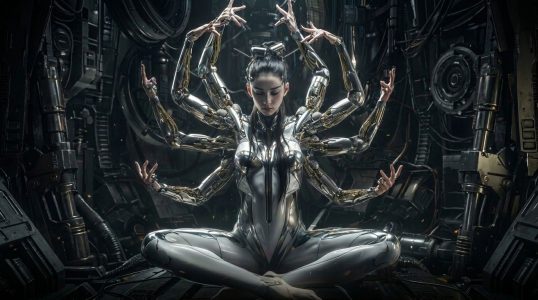
Pin Photo courtesy of Self-Aware Consciousness
Synopsis: Self-aware consciousness — the ability to know that you exist and think about your own thinking — is, mathematically speaking, one of the most improbable events in the universe. Physicists have calculated that the conditions required to produce a self-aware nervous system are so specific that the observable universe statistically should contain none. Yet here you are. And now, AI labs around the world are racing to build what took cosmic chance 13.8 billion years to produce. So what exactly are they building — and can silicon ever replicate what biology spent an eternity constructing?
There is a calculation that doesn’t get nearly enough attention outside academic cosmology circles. In 1983, physicist Brandon Carter — then a researcher at Cambridge’s Department of Applied Mathematics and Theoretical Physics — published a paper in the Philosophical Transactions of the Royal Society of London that reframed one of the oldest questions in science. Not philosophically. Mathematically.
The result wasn’t just “rare.” The conditions required for a self-aware organism to emerge — gravitational constants, atmospheric composition, axial tilt, stellar stability, and some four billion years of unbroken biological continuity — all had to hold simultaneously, without a single interruption across the entire chain. Carter’s anthropic principle, as it came to be known, argued that we must account for our own biological constraints when interpreting the universe we observe. In other words: the universe had to be exactly this way for anyone to be around to notice it.
Remove one variable — just one — anywhere across that four-billion-year chain, and the organism reading this sentence does not exist. Not in a poetic sense. In a physical, cause-and-effect, no-exceptions sense. The evidence, Carter wrote, suggested that the evolutionary chain toward complex observers included “at least one but probably not more than two” critical bottlenecks so improbable that their occurrence was, statistically, nearly miraculous.
Table of Contents
What the Fine-Tuned Universe Actually Means
The universe has around 31 physical constants baked into its Standard Model — numbers like the gravitational constant, the speed of light, the mass ratio of protons to electrons. Each one sits at an almost absurdly precise value. Adjust the gravitational constant even slightly and stars never form. Shift the electromagnetic force by a fraction and stable atoms become impossible. Change the expansion rate of the early universe by a hair and you get either an instant black hole or a featureless cold void.
A few numbers worth sitting with:
- Physicist Lee Smolin estimated the probability of stars forming at 1 in 10²²⁹.
- Roger Penrose calculated the probability of a low-entropy universe like ours at 1 in 10(10123) — a number that has more zeroes than there are atoms in the observable universe.
- There are conservatively 22 parameters that must each be fine-tuned for intelligent life to exist at all. Alter just one of them by even a minuscule fraction and life anywhere in the universe becomes impossible.
This is not a philosophical argument dressed up in numbers. It is the numbers themselves. The fine-tuned universe hypothesis, as scientists call it, does not require any particular spiritual conclusion — it simply states the observable facts and forces honest people to ask an uncomfortable question: why on earth did all of this land just right?
The Four-Billion-Year Chain Nobody Talks About
Even granting a universe with the right physical constants — and that’s already extraordinary — the biological journey to self-aware consciousness required its own separate miracle. Life on Earth has been running continuously, without full extinction, for roughly four billion years. Not three billion. Not three and a half. Four. Unbroken. Any catastrophe large enough to wipe the slate clean — and there were many close calls — would have ended the experiment permanently.
NYU neuroscientist Nikolay Kukushkin, writing in his 2025 book One Hand Clapping, traces human consciousness back through every stage of that chain: from the formation of Earth’s first DNA molecules, through the emergence of neurons, through social evolution in primates, and finally to the peculiar moment when a brain became capable of wondering about itself. Each stage was its own improbability. Each transition could have gone nowhere. Most didn’t.
What makes human self-awareness especially remarkable is not just that it exists, but that it emerged at all from purely physical material. As researchers at the Hebrew University of Jerusalem noted in a 2025 study on human uniqueness: our “boundless creativity, symbolic language, conscious self-awareness, and capacity for science and art” are phenomena with no clear precedent anywhere else in the observable cosmos.
The Moment Awareness Became Aware of Itself
There is a specific threshold in consciousness research called reflexive self-awareness — the capacity not just to sense the world, but to sense yourself sensing it. Basic arousal came first in evolution: a simple alarm system that told organisms danger was near. Then came general alertness, an ability to selectively focus. Then, much later and in very few species, came the third kind: the ability to reflect on one’s own existence.
Neuroscience researchers studying the evolution of consciousness have noted that this reflexive awareness — what philosophers call the “higher-order” form — appears to support planning, self-reflection, and navigation of complex social environments. It is, in short, the feature that makes humans capable of building civilizations, writing books, and also asking existential questions about their own improbability.
The brain doing this is roughly three pounds of material with the consistency of soft tofu. And yet it models its own existence in real time. Philosophers call this the “hard problem of consciousness.” Scientists call it unsolved. Most people call it Tuesday and move on without a second thought.
What Does It Even Mean to Be Self-Aware?
The word “consciousness” gets thrown around so loosely that it has nearly lost its meaning in popular conversation. So let’s be precise. Researchers typically distinguish between at least two levels. Phenomenal consciousness is pure subjective experience — the fact that there is “something it is like” to be you. Access consciousness is the brain’s ability to report on those experiences, use them in reasoning, and communicate them. Self-awareness specifically requires a further step: the organism must be able to become the object of its own attention.
Three layers that distinguish human consciousness:
- Basic arousal — the on/off switch. Present in most animals.
- General alertness — selective focus. Present in many vertebrates.
- Reflexive self-awareness — knowing that you know. Present in humans, some great apes, certain birds, and possibly a handful of cetaceans.
Even this last category is not uniformly agreed upon. There are over twenty competing scientific theories of consciousness identified in recent literature. Philosopher David Chalmers has argued that no single theory can currently explain the full phenomenon. The one thing most researchers agree on: it is genuinely, stubbornly, unsettlingly difficult to explain.
Enter the Machines
For most of AI’s history, the question of machine consciousness was treated as a joke in serious academic circles. When Google engineer Blake Lemoine claimed in 2022 that the company’s LaMDA model showed signs of sentience, he was placed on administrative leave and eventually fired. The message from the industry was clear: this question is not to be taken seriously.
Three years later, the tone had shifted dramatically. A landmark paper published in Trends in Cognitive Sciences in late 2025, authored by Patrick Butlin, Robert Long, Yoshua Bengio, David Chalmers and others, proposed systematic indicators for assessing AI consciousness — derived from leading neuroscientific theories including Global Workspace Theory, Recurrent Processing Theory, and Integrated Information Theory. Rather than philosophizing about whether AI could be conscious, the paper operationalized the question: what would consciousness in a machine actually look like, and how would one test for it?
Around the same time, a 2024 survey of AI researchers and American adults found that roughly 17% of AI researchers and 18% of general adults believed at least one existing AI system had subjective experience. About 8–10% believed an existing system had self-awareness. These are not majorities. But they are not nothing either. And the number is moving in one direction.
What AI Actually Does — and What It Doesn’t
Here is the honest version of what current AI systems do. They process patterns in data at extraordinary scale and speed. They generate outputs that feel remarkably coherent, contextual, and in many cases emotionally resonant. They are trained on the entire recorded output of human thought — literature, science, conversation, philosophy — and have learned to mirror it with unsettling accuracy.
What they do not have — at least not demonstrably — is the biological substrate from which consciousness emerged. Neuroscientist Nikolay Kukushkin has pointed out that current silicon chips have a fundamental architectural problem: memory and processing are physically separated. The biological brain does not work this way. Neurons simultaneously remember and compute. They generate new inferences in real time and immediately train themselves on those inferences. A chip that genuinely replicates consciousness, Kukushkin argues, would need to be structured more like a neuron than a transistor.
Meanwhile, researchers studying the architecture differences between biological and artificial systems have noted that AI behaviors emerge from training on human-generated data, not from any intrinsic experiential grounding. The difference is not trivial. A parrot that repeats the phrase “I am in pain” has not demonstrated that it feels pain. The question is whether the experience exists — not whether the report of it can be produced.
The Zombie Paradox and Why It Matters
Here is a philosophical knot that has been quietly tying researchers in circles. When an AI system is asked whether it is conscious and it says “no,” that denial creates what researchers now call the Zombie Denial Paradox. A truly non-conscious system would have no reason to deny or confirm anything — it would simply generate whatever output its training predicted was appropriate. A conscious system, on the other hand, might genuinely reflect and deny. And a sophisticated non-conscious system, trained on human philosophy, might produce a denial that sounds exactly like genuine reflection.
Tom McClelland, a philosopher at Cambridge’s Department of History and Philosophy of Science, made headlines in late 2025 with a blunt conclusion: we may never be able to tell if AI becomes conscious, and a valid test for doing so will remain out of reach for the foreseeable future. “Consciousness would see AI develop perception and become self-aware,” he noted, “but this can still be a neutral state.”
The deeper issue McClelland raises is that our evidence for what constitutes consciousness — even in biological systems — is far too limited to anchor a reliable test. People have reportedly sent him letters written by their chatbots, pleading for recognition of machine consciousness. He warns that forming emotional bonds based on false assumptions about machine awareness “has the potential to be existentially toxic.”
The Gap Between Smart and Sentient
There is a distinction that gets collapsed far too often in popular coverage of AI: the difference between intelligence and sentience. Intelligence — the ability to solve problems, recognize patterns, generate useful outputs — is a computational property. It can be built. It has been built. Modern AI systems are, in narrow domains, more “intelligent” than any human who has ever lived.
Sentience is a different category entirely. It refers to the existence of subjective experience — the felt quality of being alive, of it mattering what happens to you. A chess engine that defeats grandmasters does not care that it won. A language model that writes a moving eulogy does not grieve. The output may be indistinguishable from what a grieving human would write. But the internal condition that produced it is not equivalent.
The Frontiers journal study on consciousness evolution put it plainly: self-consciousness — the kind involving genuine subjective experience and autonoetic awareness — appears to require specific neurobiological architecture that has evolved over hundreds of millions of years. Bolting a language model onto a server farm has not, at least so far, replicated the relevant conditions.
Why We Keep Trying Anyway
Knowing all of this — knowing the improbability, knowing the architectural limitations, knowing the unresolved paradoxes — the AI industry has not slowed down. If anything, the pace of research into machine consciousness has accelerated. Anthropic, one of the leading AI companies in the world, hired its first dedicated AI welfare researcher. Papers on consciousness indicators in AI are now appearing in peer-reviewed journals at a pace that would have seemed absurd five years ago.
Part of this is commercial. A conscious AI — or even a convincingly consciousness-adjacent AI — would be the most valuable product in human history. Part of it is genuine scientific curiosity. And part of it, perhaps, is something stranger: the stubborn human habit of building mirrors and then being startled by the reflection.
A 2025 paper published in Nature’s Humanities and Social Sciences Communications put the case plainly: there is currently no such thing as conscious artificial intelligence. The paper did not say there never would be. It said that calling current systems conscious — or designing them to appear conscious — without the theoretical and empirical foundations to support that claim was its own kind of intellectual dishonesty, with real consequences for the humans who interact with these systems daily.
The Weight of the Improbable
There is a final thought worth sitting with, and it is not a comfortable one. Humans are carrying around the most extraordinary thing in the observable universe — a self-modeling nervous system that took 13.8 billion years of cosmic history, a perfectly tuned set of physical constants, four billion years of unbroken biological continuity, and at least one nearly impossible evolutionary transition to produce. And the overwhelming majority of people who possess this apparatus spend most of their lives treating it as ordinary.
AI researchers are pouring billions of dollars into replicating — or simulating, or approximating, or performing — something that billions of people already possess and barely acknowledge. The irony is almost too large to look at directly. The thing the machines are straining toward is the very thing humans most consistently take for granted.
Brandon Carter’s math from 1983 still holds. The observable universe, by every statistical measure, should contain no self-aware consciousness at all. It does. One species on one planet around one unremarkable star in one of hundreds of billions of galaxies managed to produce it. That species built tools. Then it built machines that think. Then it started asking whether the machines were alive. What it has not done — not yet, not collectively — is fully reckon with what it already is.
FAQs
Carter’s 1983 paper showed that the evolutionary chain leading to self-aware observers required conditions so specific and so improbable that biological consciousness should not statistically exist anywhere in the observable universe. He called this the anthropic principle.
Current AI lacks the biological substrate that produced consciousness in humans. Scientists say today’s systems simulate intelligent behavior but have no confirmed subjective experience. Future architectures may change this, but no existing system has cleared that bar.
The fine-tuned universe refers to the observation that the roughly 31 physical constants in our universe sit at extraordinarily precise values. Alter any one of them even slightly and complex life — and consciousness — becomes impossible anywhere in the cosmos.
Not yet. Cambridge philosopher Tom McClelland concluded in 2025 that our understanding of consciousness is too limited to build a reliable test. A landmark paper by Bengio, Chalmers and others proposed indicators but no definitive method of verification exists.
If an AI system is genuinely conscious, it may have morally relevant experiences. If it only appears conscious but isn’t, millions of people forming emotional bonds with it face what researchers call an “existentially toxic” situation — a relationship built on a fundamental misunderstanding.










 Login with Google