
























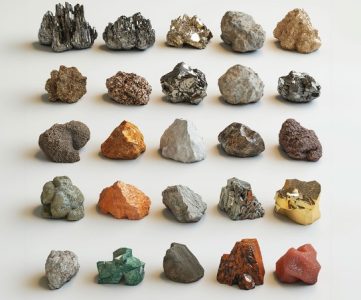
 Pin
Pin Photo courtesy of ualr earth sciences
Synopsis: Rare Earth Minerals Matter in AI, EVs, and Military Technology — more than most people ever stop to think about. These are a group of 17 metallic elements found quietly sitting in the Earth’s crust, and they are essential ingredients in smartphones, electric vehicle batteries, AI hardware, and advanced military systems. Despite the name, most aren’t technically “rare” — but extracting them cleanly and in large quantities is genuinely difficult. A handful of countries control most of the global supply, making these minerals one of the most strategically important resources on the planet today.
There’s a good chance you’re holding one right now. Your phone, your laptop, maybe even the earbuds sitting on your desk — they all carry traces of minerals most people have never heard of. No headlines. No drama. Just quiet, invisible ingredients doing extraordinary work inside the devices that run modern life.
These are rare earth minerals. And the more one looks into them, the more it becomes clear just how much of the world depends on them — from the battery in an electric car to the guidance system in a fighter jet. The story of these 17 metals is, in many ways, the story of the 21st century: who controls them, who needs them, and what happens when the supply chain suddenly cracks.
This article unpacks all of it, one layer at a time.
Table of Contents
What Are Rare Earth Minerals, Really?
The name is a little misleading, and that’s caused no shortage of confusion. Rare earth minerals aren’t particularly rare in the geological sense — elements like cerium and lanthanum are more abundant in the Earth’s crust than tin or lead. The “rare” part comes from the fact that they almost never appear in concentrated, mineable deposits. They scatter. They hide. They take effort, chemistry, and enormous amounts of water and energy to pull out in usable form.
There are 17 of them in total — a group that includes neodymium, dysprosium, lanthanum, terbium, yttrium, and others with names that sound like they belong in a chemistry exam rather than a news article. Each has a specific set of properties that make it useful for precise applications. Neodymium, for example, creates some of the strongest permanent magnets ever produced. Dysprosium keeps those magnets stable at high temperatures. Europium gives off the red glow in certain display screens.
Key rare earth elements and their uses at a glance:
- Neodymium (Nd) — permanent magnets in EV motors, wind turbines, hard drives
- Dysprosium (Dy) — heat-resistant magnets in EV motors running at 150–200°C
- Lanthanum (La) — optical glass, camera lenses, battery electrodes
- Terbium (Tb) — high-efficiency green phosphors, solid-state devices
- Europium (Eu) — red and blue phosphors in screens and lighting
- Yttrium (Y) — radar systems, camera lenses, superconductors
The Quiet Giant — China’s Grip on the Supply Chain
If rare earth minerals were a poker game, China would be the player holding most of the cards — the chips, too, and possibly the table itself. China accounts for roughly 70% of global rare earth mining and more than 90% of refining capacity. It also produces around 92% of the world’s high-strength permanent magnets, the kind that go into everything from electric vehicles to submarines. No other country comes close.
This didn’t happen overnight. China spotted the strategic value in these minerals decades before most governments took them seriously. It invested in the extraction infrastructure, subsidized refining facilities, and expanded aggressively into overseas deposits in Africa and Latin America through its Belt and Road Initiative. By the time the rest of the world woke up to the importance of these materials, China had already built the moat.
In April 2025, that moat turned into a drawbridge. China introduced export controls on seven heavy rare earth elements, sending immediate shockwaves through global manufacturing. Automakers in the United States, Europe, and elsewhere scrambled to source permanent magnets. Some were forced to cut production rates. Some temporarily shut down lines altogether. The theoretical risk that experts had warned about for years became very real, very fast.
The Electric Vehicle Connection
Every time someone plugs in an electric vehicle, there’s a quiet truth humming underneath the hood: that car almost certainly contains neodymium-iron-boron magnets, built from materials that came out of the ground in China or Myanmar, refined in a Chinese facility, and shipped across the world to end up in a motor the size of a carry-on bag.
The numbers tell the story plainly. In 2024, demand for rare earth elements tied specifically to EV motors reached 37 kilotons. By 2025, that figure was expected to climb to 43 kilotons, and the trajectory only goes upward from there. The dominant motor design — the Permanent Magnet Synchronous Motor — relies directly on high-purity neodymium and dysprosium. Together with Axial Flux Motors, these two types made up over 86% of the EV motor market in 2024.
Dysprosium, in particular, is the unsung hero of EV reliability. Without it, the magnets in an EV motor lose their effectiveness when temperatures climb above 80°C. With it, the motor stays stable at 150 to 200°C. It’s the difference between a car that works under normal driving conditions and one that works reliably for a decade. The catch: dysprosium deposits are found almost exclusively in ion-absorbed clay deposits in southern China and Myanmar. Recycling rates for it currently sit below 5%.
Rare Earths and the Machinery of Artificial Intelligence
Artificial intelligence runs on data, yes. But before the data, it runs on hardware. And before the hardware, it runs on minerals. The AI data centers driving the current technological revolution consume staggering volumes of energy and require enormous banks of servers, cooling systems, precision motors, and semiconductors — all of which depend on rare earth elements to function at the scale and speed that modern AI demands.
Neodymium, praseodymium, dysprosium, and terbium power the high-strength magnets used in hard drives, server cooling fans, pumps, and power-electronics motors. Gallium-based compounds — gallium nitride and gallium arsenide — are common in high-speed processors and energy-efficient electronics. Rare earth-doped crystals are already showing up in quantum computing research, where they enable high-fidelity qubit control. Global investment in AI data centers hit roughly $580 billion in 2025 — surpassing what the world spent that year on new oil supplies.
The AI race, in other words, is not just a software competition. Access to critical minerals may prove just as important as algorithmic innovation. The companies and nations that secure reliable rare earth supply chains today are, in effect, laying the physical foundations of tomorrow’s AI infrastructure.
On the Battlefield — Rare Earths in Military Technology
A modern fighter jet is, among other things, a flying collection of rare earth elements. The guidance systems use them. The radar uses them. The communication platforms use them. The precision motors that control the flight surfaces use them. Strip out the rare earths from a cutting-edge military aircraft and what remains is an impressive-looking machine that can’t actually do much of what makes it dangerous.
The Pentagon has been quietly alarmed about this for years. The United States imported 80% of the rare earth elements it consumed in 2024. The same minerals that go into an F-35 jet or a Tomahawk missile guidance system flow through supply chains that pass through Chinese processing facilities. Defense analysts have described scenarios in which sudden export restrictions on rare earths could degrade military readiness in ways that no adversary’s conventional forces could achieve directly.
Military applications of rare earth elements include:
- Precision guidance systems in missiles and smart bombs
- Stealth technology coatings that absorb radar waves
- Satellite communication and navigation equipment
- Sonar systems in submarines
- Advanced radar and electronic warfare platforms
- AI-enabled surveillance drones and autonomous systems
The Geopolitical Chessboard
It has become fashionable in policy circles to describe rare earth minerals as “the new oil.” The comparison has its limits, but the underlying point holds: control over these materials translates directly into geopolitical leverage, and the countries that own the supply chains hold an outsized influence over the industries and militaries of everyone else.
China understands this as well as anyone. Between 2023 and 2025, it implemented stringent export controls on a growing list of critical minerals — gallium, germanium, antimony, graphite, tungsten, and eventually seven heavy rare earth elements and the permanent magnets made from them. By October 2025, Beijing had added five more rare earths to its controls list and signaled that export licenses would be withheld from arms manufacturers and select semiconductor firms. As economic historian Adam Tooze observed, if fossil fuels heralded the industrial revolution with the West leading it, the green energy transition is being led by Asia, with China at the front.
The United States, the European Union, Japan, and Australia have all moved to respond. The Trump administration invested in domestic production and worked to secure access through partners in Australia, Japan, Malaysia, and Thailand. The USGS began mapping new domestic deposits. Diplomatic frameworks, technology-sharing agreements, and fresh mining permits have been issued at a pace not seen in decades. Whether these efforts will be enough, and how quickly, remains the defining supply-chain question of the decade.
The Dirty Secret Behind Clean Technology
There is a certain irony baked into the green energy transition. The minerals needed to build the wind turbines, solar panels, and electric vehicles intended to clean up the planet must first be pulled out of it — and the process of doing so is neither clean nor gentle. Rare earth mining leaves behind landscapes that look like the surface of a damaged moon: open pits, tailings ponds, contaminated groundwater, and radioactive byproducts that accompany the ore.
Conventional extraction techniques like ammonium sulfate leaching achieve high operational efficiency, but they cause widespread soil acidification, radioactive contamination from thorium and uranium that naturally occur alongside rare earth deposits, and heavy metal diffusion that threatens local ecosystems and community health. In 2025, water sources at 70% of global mining sites showed significant contamination. China’s Bayan Obo deposit in Inner Mongolia — the world’s largest single rare earth site — has produced a radioactive artificial lake that stands as one of the more surreal industrial legacies of the modern age.
None of this means rare earth mining should stop. It means the world needs to get considerably better at it. Closed-loop water systems, alternative extraction chemistry, satellite-based environmental tracking, and green manufacturing processes that incorporate renewable energy have shown the potential to reduce carbon footprints by up to 60%. The path forward is cleaner mining, not an end to mining altogether.
The Recycling Problem — and Why It’s Hard to Solve
The most elegant solution to rare earth scarcity would be to stop digging new mines and start recovering the materials already in circulation. Every discarded smartphone, every decommissioned wind turbine, every junked electric motor contains rare earth elements that could, in theory, be reclaimed and reused. The recycling economy for these materials is, however, still in its early stages — and it is not an easy problem to solve.
The challenge lies in chemistry. The 17 rare earth elements share nearly identical chemical properties, which makes separating them from each other — and from the complex alloys they’re embedded in — technically demanding and expensive. Hydrometallurgical processes use chemical solutions to dissolve and separate them but consume large quantities of water and chemicals. Pyrometallurgical approaches use high temperatures and are energy-intensive. Neither method has cracked the efficiency problem at scale. Current recycling rates for rare earths sit below 5%.
Progress is being made. TdVib has developed a water-soluble method to dissolve magnets that significantly reduces environmental impact while maintaining extraction efficiency. Researchers are exploring recovery from coal waste and electronic scrap. Companies are establishing new supply routes and processing plants in Australia, Canada, and the United States, and adopting AI-powered supply planning to manage material flows more efficiently. The recycling economy for rare earths is small today — but the incentives to grow it have never been stronger.
The Push for Alternatives and Substitutes
For decades, engineers and materials scientists have looked at the rare earth supply problem and asked the obvious question: what if the world just stopped needing them? The answer, so far, is that substitution is possible in some applications and deeply difficult in others. The permanent magnet problem is the hardest nut to crack.
Iron-nitride magnets offer theoretical performance comparable to neodymium magnets at lower cost and without rare earth dependency, but manufacturing them consistently at scale remains a challenge. Toyota has announced plans to eliminate rare earth elements from its electric motors using a different magnetic approach. Magnetocaloric materials are being tested in specific applications. Some EV manufacturers, including Tesla, have experimented with induction motors that require no magnets at all — though these trade off some efficiency and performance characteristics.
The blunt reality is that for the highest-performance applications — the military hardware, the most efficient EV motors, the advanced AI infrastructure — there are currently no substitutes that match rare earth magnets on every relevant dimension simultaneously. The research is encouraging and the commercial incentives are enormous, but the alternatives are not yet here in deployable form. Until they are, the world remains dependent on a supply chain it does not fully control.
The Race to Diversify — New Mines, New Allies
The world has been talking about diversifying rare earth supply chains for years. The difference in 2025 is that the talking has finally turned into action — driven less by foresight than by the very real disruptions that China’s export controls produced. When the supply chains seized up and automakers started cutting production, governments and companies that had been moving slowly began moving fast.
Australia’s Mount Weld deposit, operated by Lynas Rare Earths, is the most significant non-Chinese source of rare earth production outside of China. Canada is developing deposits in Quebec and Ontario. The United States is revisiting its Mountain Pass mine in California and exploring deposits in Texas and Wyoming. The USGS is actively mapping new domestic reserves. Advanced mineral extraction methods are projected to cut rare earth supply chain costs by 15% for electric vehicles by 2025 — a meaningful efficiency gain.
The diplomatic dimension matters just as much as the geological one. The United States has been building formal mineral partnerships with Japan, Australia, Canada, and several European nations. The EU has its own Critical Raw Materials Act, designed to ensure that no more than 65% of any critical mineral comes from a single third country by 2030. These are structural changes to global supply architecture. They take time, money, and political will. All three are now in motion in ways they were not five years ago.
What Comes Next — The Minerals Shaping the Coming Decade
Demand for magnet rare earth elements has doubled since 2015. The International Energy Agency projects that demand will expand by another third by 2030 under current policy settings, driven by the continuing electrification of transport and the growth of AI infrastructure. Wind energy, robotics, medical imaging, quantum computing, and advanced display technology all point in the same direction: more rare earths needed, year after year, from supply chains that are nowhere near ready to keep up.
The next twelve to twenty-four months are expected to bring significant developments: regulatory clarity on domestic mining permits, commercial production targets from new non-Chinese processing facilities, and continued innovation in recycling technology. Defense, clean energy, construction, aviation, and AI will increasingly compete for the same limited mineral resources. Nearly 90% of critical US supply chain innovations, according to USGS assessments, rely on rare earth elements identified in recent geological studies.
The materials have always been there, sitting in the crust of the Earth, doing nothing until human ingenuity found a use for them. What changed is the scale of the need and the speed of the dependence. The world built an extraordinary technological civilization on these 17 quiet elements — and only recently started to understand how fragile the foundations actually are.
FAQs
Not in the geological sense — most are fairly common in the Earth’s crust. They’re “rare” because they almost never appear in concentrated, mineable deposits. Extracting them cleanly and in useful quantities is technically demanding, which makes them commercially scarce even when they’re geologically common.
China invested early and heavily in the full supply chain — mining, refining, and magnet manufacturing — while other nations deprioritized domestic production. It now controls roughly 70% of global mining and over 90% of refining. That’s not geology. That’s decades of deliberate industrial policy.
Some can. Tesla uses induction motors in certain models that require no rare earth magnets. But the dominant EV motor design — the Permanent Magnet Synchronous Motor — relies on neodymium and dysprosium, and it makes up over 86% of the market. Full substitution is possible in theory but not yet competitive at scale.
AI data centers are built on hardware that requires rare earth elements in hard drives, cooling systems, precision motors, and semiconductors. Gallium compounds are in high-speed processors. Rare earth-doped materials are emerging in quantum computing. The AI hardware boom is a rare earth demand story as much as it is a chip story.
The 2025 Chinese export controls showed the world exactly what happens: automakers cut production, manufacturers scramble for alternatives, and prices spike. For military systems, the stakes are even higher — rare earth shortages can degrade operational readiness in ways conventional adversaries cannot easily achieve. Supply chain resilience is, at this point, a national security issue.









 Login with Google