

























 Pin
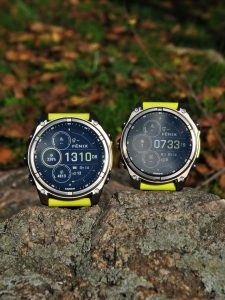
Pin Garmin Fenix 8 Solar / Photo courtesy of TriaSport
Synopsis: The 10 best AI gadgets for travel, camping, and hiking in 2026 are no longer just cool extras — they’re practical tools that keep adventurers safer, more connected, and surprisingly comfortable in the wild. From satellite communicators and solar-powered lanterns to AI translation earbuds and smart GPS watches, this list covers gear that’s genuinely worth carrying. Whether someone is a weekend camper or a long-distance trekker, these gadgets fit real adventures without the bulk or the gimmicks. We’ve also included a bonus pick for the most exciting emerging tech on the horizon.
A hiker packs light. Plans ahead. And then the trail throws something at them that no paper map could have warned about — a sudden language barrier at a remote trailhead, a dead phone three miles from camp, or a storm rolling in faster than the weather app predicted.
That’s where smart gear earns its place in the pack. In 2026, AI-powered gadgets have quietly moved past novelty. They’ve become genuinely useful in the field — not just for tech lovers, but for regular hikers, road-trippers, and anyone who’s ever wished their gear could think a little faster in a pinch.
This article walks through the best options out there right now — tested, trusted, and worth the weight. Each one solves a real problem on the trail, at the campsite, or in transit. No fluff, no futuristic hype. Just solid gear that makes the next adventure a little smarter and a whole lot smoother.
Table of Contents
1. Garmin inReach Mini 3 Plus
 Pin
Pin Photo courtesy of Ultralight Outdoor Gear
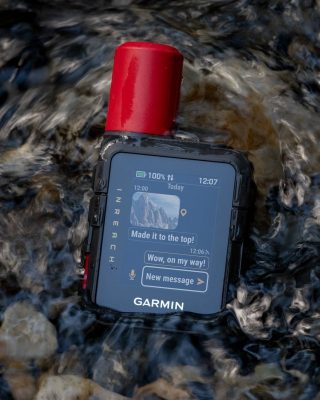
Deep in the backcountry, cell towers are a distant memory. That’s precisely where the Garmin inReach Mini 3 Plus earns its place — a compact, rugged satellite communicator that weighs just 4.4 ounces and runs on the Iridium satellite network’s 66 low-earth orbit satellites, ensuring global coverage where no phone signal dares to follow.
The Mini 3 Plus handles two-way messaging via text, email, voice notes, and photos — all without cellular service. A 1.9” scratch-resistant color touchscreen replaces the old monochrome display, and a built-in speaker and microphone enable 30-second voice messages that can be transcribed directly on-device. Battery life reaches up to 330 hours at 10-minute tracking intervals. SOS alerts route to the 24/7 Garmin Response center, and the companion Garmin Explore app handles route planning, map downloads, and weather updates. Detailed topo navigation still relies on the app rather than on-device storage, so plan accordingly.
Trail runners and mountaineers rate it highly for its small footprint. Landscape photographers clip it to their camera bag shoulder straps and head into the wild with quiet confidence. For solo adventurers especially, this is the gadget that gives worried families peace of mind — and gives the hiker something rarer: freedom without recklessness.
Quick specs:
- Weight: 4.4 oz | Battery: up to 330 hours at 10-min tracking
- Network: Iridium global satellite
- Features: Two-way messaging (text, email, voice, photo), SOS, GPS tracking
- Rating: IPX7 waterproof
- Pairs with: Garmin Explore app (iOS & Android)
- Price: ~$349.99
2. Timekettle W4
 Pin
Pin Photo courtesy of Timekettle
Douglas Adams invented the Babel fish in 1979 — a tiny creature that sat in a person’s ear and translated any language in real time. In 2026, Timekettle built the real version. The W4 Interpreter Earbuds, unveiled at CES 2026, use bone-conduction voice technology to pick up speech in 42 languages and around 95 accents, even in crowded, noisy environments like airports, train stations, and busy market streets.
At the heart of the W4 is an AI-powered translation engine that automatically selects the best large language model for each language pair. Because grammar, sentence structure, and linguistic quirks vary wildly between tongues, using the same model for Japanese and Portuguese was always a recipe for awkwardness. The result is translations that arrive faster, sound more natural, and handle accents far better than earlier generations.
The earbuds offer three modes: Simul Mode for real-time two-way conversation, Touch Mode for group turn-taking, and Speaker Mode for broadcasting translations aloud. Battery runs up to 6 hours of continuous translation on a single charge, with the charging case extending total usage to around 18 hours — enough for a full day of navigating foreign cities. When translation isn’t needed, the buds double as regular wireless earphones. Translation accuracy is rated at around 95%, with a roughly 0.2-second lag — solid performance, though results vary with rare language pairs and heavy background noise.
Quick specs:
- Languages: 42 languages, around 95 accents
- Modes: Simul, Touch, Speaker
- Battery: up to 6 hours translation / up to 18 hours total with case
- Tech: Bone voiceprint + AI-powered LLM translation engine
- Price: ~$449 (W4 Pro)
3. Garmin Fenix 8 Solar
 Pin
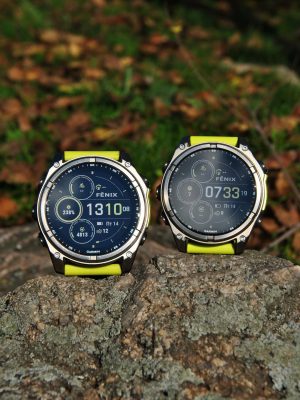
Pin Photo courtesy of TriaSport
The Garmin Fenix 8 Solar is the flagship outdoor smartwatch of 2026, and it earns that title by doing considerably more than tracking steps. It reads altitude, atmospheric pressure, compass bearing, heart rate, sleep patterns, and blood oxygen levels — then cross-references that data to deliver adaptive training recommendations and recovery insights directly on the wrist.
Battery life reaches 48 days in smartwatch mode, or 65 hours when the multi-band GPS is running. The solar panel on the crystal face supplements charging during long days above the treeline. Offline topo maps come preloaded, Garmin Connect IQ allows deep customization, and the watch tracks everything from trail running to scuba diving. There’s even onboard music storage so a favorite playlist doesn’t require a phone.
For hikers and backpackers who want one device to rule the rest, the Fenix 8 Solar is the serious answer. It replaces a handful of single-purpose instruments and wraps them into something rugged enough to survive whatever the trail delivers. The price is steep — but so is the mountain, and neither apologizes.
Quick specs:
- Battery: 48 days smartwatch / 65 hours GPS mode
- Features: Multi-band GPS, heart rate, blood oxygen, altimeter, barometer, compass
- Solar charging: supplemental via crystal panel
- Maps: Preloaded offline topo maps
- Music: Onboard storage
- Price: ~$999+
4. Gaia GPS
 Pin
Pin Photo courtesy of Gaia GPS
Not every smart outdoor tool comes in a physical package. Gaia GPS is an app that has quietly become one of the most trusted trail companions for serious hikers and backpackers. What separates it from a standard mapping tool is its depth: detailed offline topo maps, advanced route planning, real-time GPS tracking without cell service, and weather overlays that pull from multiple forecasting sources to flag localised storm conditions with far more precision than a standard weather app.
Users can pre-download detailed topo maps for offline use, record waypoints, track real-time GPS position without cell service, and sync routes across devices. The app integrates weather forecasting tools that analyze multiple variables and predict localised storm conditions — the kind of localised accuracy that generic weather apps simply can’t match at altitude. Hikers have credited this feature with keeping them off exposed ridgelines when surprise storms rolled in.
For a standalone app, the depth of Gaia GPS is remarkable. It functions as a route planner, a safety tool, and a post-hike logbook all in one. The premium tier unlocks the full offline map library and the more advanced weather overlays — a small annual investment for the peace of mind it provides in genuinely remote country.
Quick specs:
- Platform: iOS & Android
- Maps: Downloadable offline topo, satellite, and hybrid layers
- Navigation: Advanced offline topo maps, waypoints, route planning, cross-device sync
- Weather: Localised multi-variable forecast overlays
- Price: Free basic / ~$39.99 per year premium
5. BioLite Luci Charge 360
 Pin
Pin Photo courtesy of Ecomondo
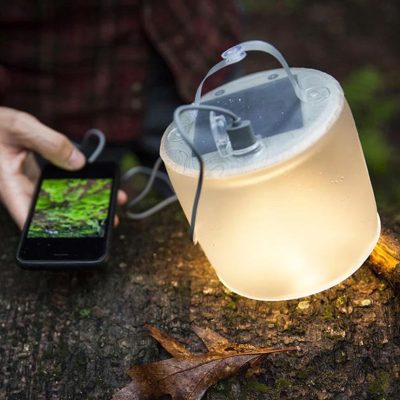
The campsite problem is universal: darkness comes fast, and power goes faster. The BioLite Luci Charge 360 solves both with an elegance that feels almost too simple. It’s an inflatable solar lantern — fully deflated, it slips flat into a pack pocket; inflated, it sits on a picnic table or hangs from a tent ridgeline, throwing 360 lumens of warm light across the whole campsite.
The built-in 4,000 mAh battery powers the lantern for up to 110 hours on a single charge, and both USB-C and USB-A ports let it moonlight as a phone charger. Recharging happens either via USB-C or by leaving the lantern solar-side-up in direct sunlight — a full charge takes around 28 hours of sun, but half a day outside in strong conditions pushes it past 50%. The IP67 waterproof rating means it handles rain, a river splash, or an accidental dunking without complaint.
At just 10.1 ounces, the Luci Charge 360 is genuinely packable without the weight compromise that usually comes with camp luxury items. BioLite also runs a humanitarian program where every product sold provides safe lighting access to someone living in energy poverty — so the purchase does something useful on both sides of the trail. While not AI-driven itself, the Luci Charge 360 complements smart outdoor setups as an essential piece of solar-powered camp infrastructure.
Quick specs:
- Weight: 10.1 oz | Brightness: 360 lumens
- Battery: 4,000 mAh | Runtime: up to 110 hours
- Charging: Solar panel + USB-C
- Waterproof: IP67 rated
- Ports: USB-C + USB-A output
- Price: ~$59.95
6. Apple AirTag 2
 Pin
Pin Photo courtesy of Telefon28store
Lost luggage is one of travel’s most reliably infuriating experiences. Apple’s AirTag — with recent revisions improving Precision Finding responsiveness and speaker audibility — has become the quiet fix that millions of travelers now rely on. Drop one in a checked bag, one in a camera case, and the Find My network handles the rest, pinpointing location down to a few feet using Ultra Wideband technology.
AirTag 2, launched in early 2026, brings a speaker rated up to 50% louder than the original — a practical improvement for anyone trying to locate a tag buried in a bag. Apple has also continued strengthening anti-stalking protections: the Find My ecosystem now alerts iPhone users when an unknown tag has been travelling with them, guides them to its location via Precision Finding, and lets them disable the tag remotely. The battery is a standard CR2032 coin cell that lasts about a year and costs almost nothing to replace. Pricing remains accessible, typically around $29 for a single tag.
For camping and hiking, hikers clip a tag to a bear canister left at base camp, tuck one into a resupply box, or tag a vehicle parked at a remote trailhead. The practical value is less about high-tech drama and more about that quiet reassurance that, if something gets lost, there’s a way to find it again.
Quick specs:
- Network: Apple Find My (encrypted, crowd-sourced)
- Technology: Ultra Wideband Precision Finding
- Battery: CR2032 (~1 year life)
- New in AirTag 2: Up to 50% louder speaker, enhanced anti-stalking protections, improved Precision Finding
- Price: ~£29 / $29 each
7. GRAYL GeoPress
 Pin
Pin Photo courtesy of Linda Bjork
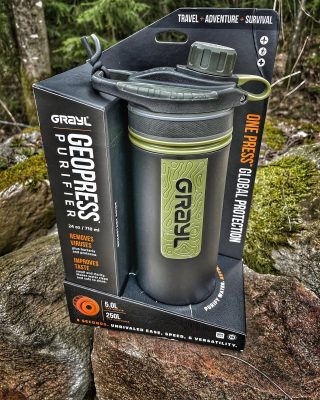
Access to clean water is the non-negotiable of any wilderness trip. The GRAYL GeoPress is the smart traveler’s answer to that basic need — a purifier bottle that filters and purifies in a single press, taking 8 seconds to turn questionable water from any lake, river, or tap into something safe to drink. No pumping, no waiting, no chemical tablets leaving a faint aftertaste.
Each cartridge purifies 350 uses — roughly 87.5 liters — before it needs replacing. The filter removes viruses, bacteria, protozoa, and particulates, meeting EPA and NSF standards for water treatment. It also reduces heavy metals, chemicals, and microplastics, which is a meaningful advantage in areas with industrial runoff or questionable municipal water. At 450ml capacity per press, it keeps a hiker or traveler hydrated through a solid stretch of the day.
What makes the GeoPress practical beyond its specs is how naturally it fits into the flow of a hike. Fill from a stream, press down, and drink. There’s no assembly, no extra gear, and no waiting period. It’s carried like any regular water bottle. For international travelers hitting regions with unreliable tap water, it’s equally indispensable — no hunting for sealed bottles at airports, no plastic waste. The GeoPress is not an AI gadget in the traditional sense, but it belongs on any smart packing list as a non-negotiable safety tool.
Quick specs:
- Purification time: 8 seconds per 450ml
- Filter lifespan: 350 uses (87.5L)
- Removes: Viruses, bacteria, protozoa, chemicals, microplastics
- Standards: EPA & NSF certified
- Weight: ~410g full
- Price: ~$89.95
8. SPOT X
 Pin
Pin Photo courtesy of SPOT LLC
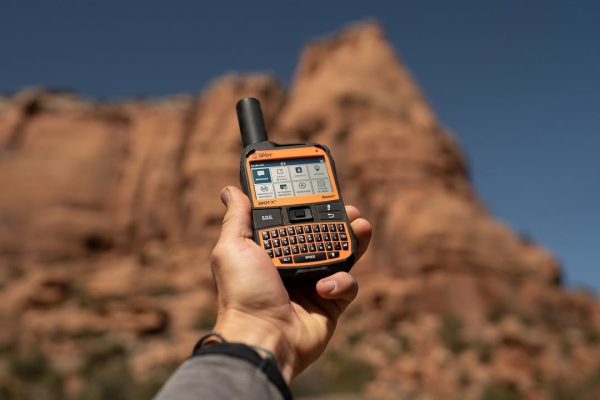
The SPOT X fills a specific gap that the Garmin inReach Mini 3 Plus leaves open: a physical QWERTY keyboard. For anyone who prefers composing messages on a full keyboard rather than a touchscreen, the SPOT X remains a comfortable alternative. It handles two-way satellite messaging and automated location tracking through the GEOS global rescue coordination service — the same infrastructure used by professional rescue teams worldwide. Note that Garmin currently dominates the premium satellite communicator market, and smartphone satellite messaging from newer devices like the Motorola Defy Satellite Link and ZOLEO Global Satellite Communicator is increasing competition in this space.
One of its most practical features is configurable tracking intervals. For technical terrain where something could go wrong quickly, setting a 2.5-minute tracking interval gives a rescue team a very precise breadcrumb trail. On routine hiking, 10-minute intervals are plenty and extend battery life significantly — up to 240 hours in that mode. Family members can watch real-time location updates through the shared tracking link, which removes a significant amount of anxiety from both sides of a remote adventure.
The device pairs with smartphones via Bluetooth for easier message composition and map access, and it handles both text and email. It’s IP67 rated and compact enough for a hip belt or outer pack pocket. Solo travelers, in particular, have made it a default item — not because anything is likely to go wrong, but because that automated location track running quietly in the background changes the entire emotional context of going out alone.
Quick specs:
- Communication: Two-way satellite messaging (text + email)
- Keyboard: Physical QWERTY
- Tracking: Configurable intervals (2.5 min to 60 min)
- Battery: Up to 240 hours at 10-min tracking
- Waterproof: IP67
- Price: ~$199.95
9. Suunto Vertical Titanium Solar
 Pin
Pin Photo courtesy of Trinakan
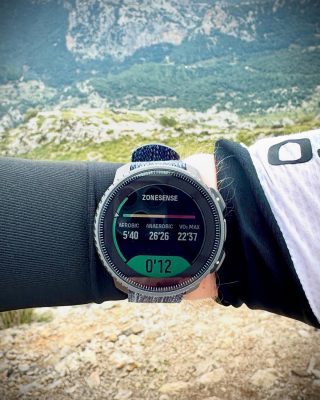
Some watches are built for the gym. The Suunto Vertical Titanium Solar is built for the mountain. It’s a rugged GPS adventure watch with a titanium case, solar-assisted charging, and one of the most accurate GPS systems available on a wrist-worn device in 2026. The combination of exceptional battery life, free offline maps, and a barometric altimeter makes it the serious outdoor athlete’s watch of choice.
Suunto’s Snap to Route GPS is a clever feature that proves particularly useful on race courses and marked trails — it locks GPS tracking to a pre-loaded route for more accurate data rather than drawing jagged lines across switchbacks. The fast-charge system is genuinely fast: ten minutes of charging delivers ten hours of usage, which is the kind of emergency stat that matters when a watch dies at mile 40 of a 60-mile ultra.
Where the Suunto Vertical sits slightly behind the Garmin Fenix 8 Solar is onboard music and deep customization via app stores. It doesn’t have those. What it does have is a cleaner, more elegant design that looks more like a lifestyle watch than a tactical instrument — a distinction that matters to hikers who wear their outdoor watch into coffee shops and meetings. Priced at around £529, it’s a significant investment, but one built for years of sustained use.
Quick specs:
- Case: Titanium | Solar charging: supplemental
- GPS: Multi-constellation + Snap to Route accuracy
- Battery: Multi-day in GPS mode
- Maps: Free offline topo maps
- Fast charge: 10 min = 10 hours
- Price: ~£529 / ~$650
10. HMD OffGrid
 Pin
Pin Photo courtesy of Dostavka Plus
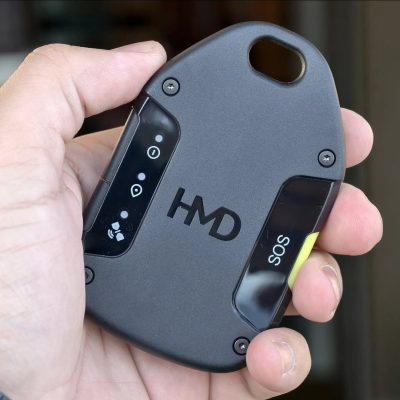
The HMD OffGrid is one of the newer names in satellite communication, and it’s built specifically for people who don’t want to manage a separate subscription device alongside their regular smartphone. It functions as both a satellite communicator and a tracker — connecting to low-earth orbit satellite networks to send messages and share location when cellular service disappears. The design philosophy is simplicity over feature overload.
Where established players like Garmin or SPOT can feel like they require a manual before the first trip, the HMD OffGrid leans toward the plug-and-go experience. Pairing with a smartphone keeps the interaction familiar, and the companion app handles message composition, location sharing, and SOS activation cleanly. Battery life holds up well across multi-day trips, and the device charges via USB-C — the same cable as most modern phones.
For casual backpackers, weekend campers, and travelers heading into genuinely remote regions, the HMD OffGrid represents a sensible middle ground: serious satellite capability at a price and complexity level that doesn’t require the commitment of a dedicated backcountry enthusiast. It’s the satellite communicator for people who rarely need one — which is precisely the group most likely to need it when they do.
Quick specs:
- Network: LEO satellite coverage
- Functions: Satellite messaging + location tracking + SOS
- Interface: Companion smartphone app
- Charging: USB-C
- Best for: Casual to intermediate backcountry travelers
- Price: ~$149 (device) + subscription
11. Bonus Pick: Vastnaut One 4×4
 Pin
Pin Photo courtesy of Wearable Technologies
Note: The Vastnaut One 4×4 is a concept-stage wearable robotics project, not a confirmed consumer product. Specs and availability are unverified. Some gadgets push the boundary of what outdoor gear can be. The Vastnaut One 4×4 represents one of the most ambitious directions in emerging wearable technology — an AI-powered exoskeleton concept designed to assist both hips and knees simultaneously on steep terrain. The design is intended to read gait in real time, predict joint load, and deliver targeted assistance where the body needs it most.
For long-distance hikers carrying heavy packs, for older adventurers managing joint pain, or for people returning to trail activity after injury, the Vastnaut One is a genuinely transformative piece of technology. It attaches to the hips and thighs, fits under or over most hiking pants, and communicates with a smartphone app that displays joint load data, energy expenditure, and fatigue predictions in real time.
It’s the most ambitious item on this list, and if the specs hold up at consumer launch, it would be one with a steep learning curve — the first few miles feeling unfamiliar as the AI calibrates to a user’s specific gait. What it represents is something bigger: the possibility that the line between outdoor gear and medical-grade robotics is finally beginning to dissolve. Worth watching closely as more verified details emerge.
Quick specs:
- Assists: Both hips and knees simultaneously
- AI: Real-time gait analysis and load prediction
- App: Joint load data, fatigue prediction, energy tracking
- Fit: Compatible with most hiking pants/layers
- Best for: Long-distance, heavy pack, joint recovery
- Price: TBC (premium segment)
FAQs
Yes — when chosen for a real need. Satellite communicators and GPS watches earn their weight fast in remote terrain. Translation earbuds and smart water purifiers do the same in international travel.
Most of them are designed precisely for that. Garmin inReach Mini 3 Plus, SPOT X, and HMD OffGrid all run on satellite networks. Gaia GPS works offline once maps are downloaded.
A satellite communicator. The Garmin inReach Mini 3 Plus or SPOT X both provide SOS capability, two-way messaging, and location tracking without needing any phone signal. Worth it every time.
The Timekettle W4 is specifically engineered for noisy environments using bone-conduction voiceprint technology. It performs well in airports, markets, and crowded streets where standard earbuds struggle.
Several. The BioLite Luci Charge 360 runs entirely on solar power. The Suunto Vertical Titanium Solar supplements charging via sunlight. GRAYL’s GeoPress eliminates single-use plastic water bottles on the trail.










 Login with Google