





















 Pin
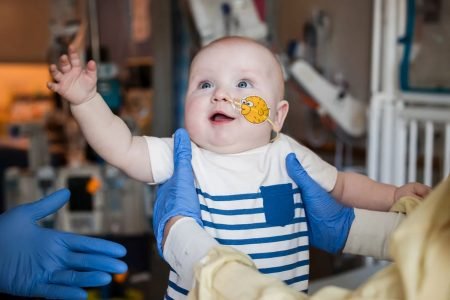
Pin Kyle Muldoon Jr., Photo Courtesy of Children’s Hospital of Philadelphia
Synopsis: In a hospital room in Philadelphia, doctors did something that had never been done before. They built a Personalized CRISPR Therapy from scratch, just for one baby, to fix a genetic error that was slowly poisoning his body. His name was KJ, and he became the first person in history to receive gene editing designed specifically for his own DNA. This is the story of how a team of scientists raced against time and gave the family new hope for their son’s future.
Some medical stories feel too big for a single family to carry. This is one of them. Baby KJ was born with a condition so rare that few doctors ever encounter it — one where his body could not clear a toxic byproduct of ordinary digestion, and the buildup was quietly damaging his system.
Most babies with this disorder do not get a fix. They get a lifetime of restrictions, hospital visits, and hope that a liver transplant might come in time. But KJ’s doctors had another idea. Instead of only managing the symptoms, they would try to go straight to the broken gene itself and correct it.
That idea became reality faster than anyone expected. Within months, a custom-built gene therapy was designed, tested, and given to KJ — not a cure, his doctors are careful to say, but a genuine medical first that is now opening doors for other rare disease patients waiting for their own answer.
Table of Contents
A Diagnosis That Changed Everything
Kyle Muldoon Jr., known to everyone as KJ, was only two days old when the trouble showed itself. His blood carried too much ammonia, a byproduct of ordinary protein digestion that his body could not clear, and every hour it sat there raised the risk of lasting brain damage. Doctors at Children’s Hospital of Philadelphia traced the cause to severe CPS1 deficiency, a genetic disorder so uncommon it affects roughly one in every 1.3 million births. For his parents, Kyle and Nicole, the news landed like a door slamming shut.
There was no easy fix waiting on a shelf. A liver transplant can restore a working urea cycle, and KJ was in fact listed for one at five months old, but infants can suffer dangerous ammonia crises and neurological injury long before they are big enough or stable enough for surgery. Every day without another option meant another day of risk piling on risk. The family needed something no other family had ever been offered before: a Personalized CRISPR Therapy, engineered around KJ’s own DNA.
That single decision — to try something built for one patient and one patient only — set the next several months in motion. It would demand teamwork most hospitals never attempt, and a pace of science usually measured in years, not weeks.
- Condition: severe CPS1 deficiency, a urea cycle disorder
- Incidence: roughly 1 in 1.3 million births
- Standard treatment: liver transplant, difficult in a fragile newborn
The Quiet Danger Inside a Tiny Body
CPS1 deficiency does not announce itself with obvious symptoms at first. It works from the inside, one missing enzyme at a time. CPS1 is an enzyme in the liver’s urea cycle, the chemical pathway that converts toxic ammonia — produced naturally as the body processes protein — into urea the kidneys can safely flush out. Without enough working CPS1, that ammonia has nowhere to go, and it is not gentle on a developing brain.
Babies born with the severe form often need round-the-clock monitoring. Feeding becomes a careful science of its own, with every gram of protein measured and weighed. One bad day, one missed dose of medication, and a child can slip into a crisis that leaves lasting damage. Families learn to live on a knife’s edge, watching lab numbers the way sailors watch the weather.
For KJ, that meant months confined to a hospital bed while his body was kept just stable enough to wait for something better. His doctors were not willing to let “stable” be the ceiling.
The Scientists Who Said Yes
Two names sit at the center of this story: Dr. Rebecca Ahrens-Nicklas, a physician-scientist who runs the metabolic disease gene therapy program at CHOP, and Dr. Kiran Musunuru, a geneticist and cardiologist at the University of Pennsylvania. Between them, they had spent years studying gene editing tools, but never before had one been built for a single, specific child.
Ahrens-Nicklas knew KJ’s case from the inside, watching him day after day in the hospital. Musunuru brought the tool-building expertise, the kind normally reserved for years-long research projects. Together with teams from both institutions, and outside collaborators who donated time and expertise, they decided to try something almost nobody had attempted at this speed.
- Rebecca Ahrens-Nicklas, MD, PhD — CHOP, metabolic disease specialist
- Kiran Musunuru, MD, PhD — Penn Medicine, gene editing expert
- Combined teams from CHOP, Penn Medicine, and outside labs
Their bet was simple to describe and brutally hard to pull off: read KJ’s exact mutation, then build a molecular tool that fit it like a key in a lock.
Building a Key for One Lock
Most gene therapies are developed for diseases that affect groups of patients who share a common target, rather than being built for one person’s unique genetic variant. KJ’s case flipped that model on its head. His mutation was his alone, so the therapy had to be built the same way — from the ground up, around his DNA and nobody else’s.
The team turned to a technique called base editing, a more precise cousin of standard CRISPR that can swap a single faulty letter in the genetic code without cutting the DNA strand entirely. They packaged the gene-editing machinery inside lipid nanoparticles, microscopic lipid-based delivery particles designed to carry it straight to liver cells and drop off their cargo where it was needed most.
Every step, from reading KJ’s genome to manufacturing a safe, sterile dose, had to happen under enormous time pressure. What normally stretches across years of trials was compressed into months, while the team still carried out preclinical testing, toxicology studies, and off-target safety analysis before treatment.
Racing a Clock Nobody Controls
Speed mattered because KJ’s condition would not wait politely for peer review and paperwork. Because his situation was life-threatening and no approved therapy existed for it, the team pursued authorization through a single-patient, expanded-access Investigational New Drug application — a pathway meant for patients with no other treatment options.
The FDA responded with unusual urgency of its own. Reviews of this kind can typically take the better part of a year, but KJ’s application was cleared in about one week, letting his care team move to treatment while continuing their safety and efficacy work under close regulatory oversight.
- Genome sequencing and mutation analysis
- Custom base editor design and lab testing
- Manufacturing under strict safety standards
- Single-patient expanded-access IND filing, cleared in about a week
Behind that single week of paperwork sat months of round-the-clock lab work, built on decades of CRISPR research that came before it.
The First Dose
In late February 2025, when KJ was about seven months old, he received his first infusion of the experimental therapy. Nobody in that room could promise it would work. What they could promise was that they had checked, tested, and rechecked every part of the process they could control.
The early dose was intentionally cautious, small enough to watch closely for any sign of trouble. His medical team stayed close, tracking his blood chemistry hour by hour, looking for the faintest hint that something had gone wrong. Nothing did.
Two more doses followed in the weeks after, in March and again in April, each one a little stronger than the last as his body proved it could handle the treatment. Slowly, a child who had spent his whole life inside hospital walls started looking less fragile.
Watching the Numbers Turn
Medicine rarely offers instant miracles, and KJ’s team was careful not to promise one. But the signs that mattered most began shifting in the right direction. His dependence on ammonia-lowering medication started easing, and his diet slowly allowed more room to breathe.
- No serious adverse events reported during the early follow-up period
- Reduced need for nitrogen-scavenging medication
- Greater tolerance for dietary protein over time
- Better control of ammonia levels, even during common childhood illnesses
When researchers published their findings in the New England Journal of Medicine in May 2025, they described encouraging biochemical and clinical improvements — the kind of steady, unglamorous progress that adds up to a real difference in daily life.
His doctors were careful to note that lifelong monitoring would still be part of his story. This treatment is not a cure, they said plainly, but it can change what living with the condition actually looks like.
Three Hundred and Seven Days
Long before the therapy, and for months after it too, home was a hospital room. KJ spent a total of 307 days at Children’s Hospital of Philadelphia, a stretch of time his parents counted not in weeks but in small victories: a good lab result, a full bottle finished, a nurse’s smile at rounds.
Hospital life for a family in this position is its own kind of endurance test. Parents learn medical vocabulary they never wanted to know, trade sleep for shift changes, and build friendships with nurses who become something close to family. KJ’s parents did all of that, day after day, without knowing for certain how the story would end.
That patience paid off. As his body adjusted to the corrected gene, the visits from doctors grew shorter, the worry in the room grew lighter, and one ordinary Tuesday, everything changed.
Going Home
On June 3, 2025, KJ Muldoon left Children’s Hospital of Philadelphia for the first time as a stable, thriving baby, rather than a patient waiting on results. For his parents, it was the quiet kind of huge — no fanfare needed, just a car seat, a discharge folder, and a door closing behind them on the way out.
Doctors sent him home with a plan, not a promise. Regular check-ups, ongoing blood work, and a slowly expanding diet would track how well his edited gene continued to hold up over time.
- Discharged June 3, 2025, after 307 days in hospital
- Left on a less restrictive diet than before treatment
- Continued monitoring planned for the years ahead
In December 2025, KJ began taking his first steps at home — something his parents once feared they might never see.
The Road Still Ahead
Nobody involved in KJ’s care is calling this a finished story. His doctors continue to track his liver function, his ammonia levels, and his growth, aware that a single round of gene editing is still a new frontier with unknowns yet to surface.
Bigger questions loom over the field as a whole: how to make custom therapies affordable, how to build regulatory pathways that do not require a medical emergency to move quickly, and how to train more teams capable of doing what CHOP and Penn pulled off. None of that happens overnight.
- Long-term monitoring planned for KJ’s liver and metabolic health
- Cost and scalability remain open challenges for future patients
- Regulatory pathways may need to adapt for rare, one-off cases
Still, a baby who once needed every gram of protein measured now takes steps across his living room. That alone has changed what feels possible for the families who come next.
FAQs
He had severe CPS1 deficiency, a rare urea cycle disorder that stops the body from safely clearing ammonia produced during protein digestion.
It was built entirely around his own DNA mutation, making it the first personalized gene-editing therapy ever given to a patient.
His custom treatment moved from design to first dose in only about six months, far faster than usual drug timelines.
It is not a cure, but KJ has tolerated it well with no serious side effects, needs less medication, handles more dietary protein, and later began walking.
Researchers hope so. His case is already shaping new FDA pathways meant to make individualized gene therapies possible for more people with ultra-rare diseases.








 Login with Google