





















 Pin
Pin Photo Courtesy of Pavel Danilyuk
Synopsis: Big, expensive ideas — a new drug, a power grid upgrade, a skyscraper’s blueprint — used to take a decade and a small country’s budget to see daylight. That arithmetic is changing fast. Billion-dollar projects AI could complete in weeks instead of years are no longer confined to research papers; they are already reshaping medicine, energy, construction, and the wiring of entire cities. A vaccine engineered before most people had heard of the outbreak, a computer chip designed between breakfast and dinner — the shift is documented, real, and worth a closer look.
There is a reason skyscrapers, vaccines, and power grids used to swallow entire decades. Every stage needed a small army of specialists, mountains of paperwork, and endless rounds of trial and error. Nobody could shortcut biology, physics, or a stack of permits. So the world waited, and then waited a while longer.
Money made the caution worse. The bigger the price tag, the more careful everyone got. Committees formed, reviews stacked up, and a single miscalculation could sink a billion-dollar bet. Slow felt like the responsible choice, even when it cost years nobody could get back.
That caution made sense right up until computers became powerful enough to evaluate millions of simulated possibilities before lunch. The bottleneck stopped being human effort and started being human speed — and that gap is where the rest of this story lives.
- Large infrastructure projects (power plants, transit systems, and similar builds): 5–15 years on average
- New drug development: often 10 years or more
- Major engineering reviews: months per phase, before construction even starts
Table of Contents
1. Medicine Made at a New Kind of Speed
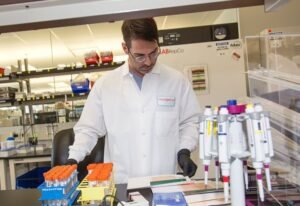
Bringing a single drug to market has long cost upward of two billion dollars and swallowed a decade or more, with roughly nine out of ten candidates failing along the way. Pharmaceutical labs are now leaning on AI to sort through chemical possibilities no human team could ever sift by hand.
Insilico Medicine used AI to identify a promising kinase-inhibitor candidate in 21 days. A separate research team used a similar approach to identify a drug candidate for liver cancer in just 30 days, a disease that claims hundreds of thousands of lives every year. Neither result would raise an eyebrow in a lab a generation from now, but today they count as landmarks.
None of this replaces clinical trials, which still take their own careful time. What has changed is the front end — the guessing, testing, and discarding that used to eat years now gets compressed into weeks, freeing researchers to spend their time on the patients rather than the paperwork.
2. A Vaccine Built Before the Outbreak Had a Name
Moderna’s COVID-19 vaccine is the example everyone half-remembers and nobody quite believes. The genetic design of mRNA-1273 came together in two days, using nothing but the viral genome Chinese researchers had posted online, before human-to-human spread was even confirmed.
That speed is not a fluke of one company having a lucky week. A tool called LinearDesign, built by engineers in China, can scan an almost incomprehensible number of possible genetic sequences and land on the most stable option in about 11 minutes.
Just 42 days after the viral sequence was identified, Moderna had shipped its first clinical batch of mRNA-1273 to the NIH — the first participant was dosed 63 days after sequence selection, a stage that traditional vaccine science measured in years, not weeks. The technology has since moved well past COVID-19, and drugmakers are applying the same approach to other diseases.
3. Protein Shapes Guessed in Seconds, Not Years
Every protein in the body twists itself into a specific 3D shape, and that shape decides what the protein can do. Scientists spent fifty years and Nobel Prizes trying to predict those shapes from a simple string of amino acids, with painfully slow lab methods as the only reliable tool.
DeepMind’s AlphaFold cracked the problem by treating structure prediction as something a neural network could learn, rather than something a lab technician had to measure atom by atom. What once required months of painstaking crystallography can now be predicted in seconds on a computer, with accuracy that holds up well against experimental results, though the two methods aren’t strictly interchangeable.
The tool has since predicted the structures of nearly every catalogued protein known to science — more than 200 million of them — and handed that catalog to researchers everywhere for free. Malaria researchers, honeybee biologists, and cancer scientists have all borrowed the same database for entirely different problems.
4. A New World of Materials, Discovered in About a Year
Every battery, solar panel, and computer chip depends on inorganic crystals, and finding a new stable one has traditionally meant months of trial-and-error lab work per candidate, with no guarantee of success. Humanity had identified roughly 20,000 such materials across the whole of scientific history.
Google DeepMind’s GNoME tool changed that ratio almost overnight. Trained on known crystal structures, it proposed and evaluated 2.2 million new candidates, of which about 380,000 were judged stable enough to be useful — a haul researchers compared to nearly 800 years of traditional discovery work.
Labs around the world have already experimentally synthesized more than 700 of the predicted materials, providing real-world validation for a subset of the AI’s predictions. Among the finds: tens of thousands of graphene-like compounds and hundreds of new candidates for better electric-vehicle batteries.
- Known stable crystals before GNoME: about 20,000
- New materials proposed by GNoME: 2.2 million
- Judged stable and promising: roughly 380,000
5. Microchip Floorplans Designed in Hours
Laying out the millions of components on a modern computer chip is a puzzle so complex that engineers traditionally spent months arranging the pieces by hand, chasing tiny gains in speed and power efficiency with every iteration.
Google’s engineers turned the problem into something closer to a strategy game and let a reinforcement-learning system play it. The result: chip floorplans that matched or beat human designs, produced in about six hours instead of months, and used in production for Google’s own processors.
Chip-design software makers have since pushed the idea further, aiming to shrink the broader design-and-verification cycle from roughly 24 months down to 24 weeks. Samsung, Nvidia, and other manufacturers have already adopted similar AI-assisted tools in their own factories.
6. Taming a Miniature Star
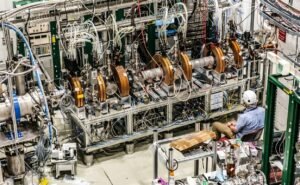
Nuclear fusion promises energy with very low carbon emissions and a different radioactive-waste profile from conventional fission, but only if scientists can hold plasma hotter than the sun’s surface inside a magnetic cage without letting it touch the walls. That requires adjusting powerful magnets thousands of times every second.
Researchers at DeepMind and the Swiss Plasma Center trained an AI system entirely in simulation, then handed it control of a real tokamak reactor. It held the plasma steady and produced shapes physicists had wanted to test but had never dared attempt with older control methods.
The AI found its own unconventional ways to manage the magnetic coils, techniques the human team had not considered. It is one small step on a long road toward practical fusion power, but a rare case of AI doing hands-on physical engineering rather than just crunching numbers.
7. Ten-Day Forecasts in Under a Minute
Weather forecasting has always meant supercomputers grinding through the physical equations of the atmosphere, a process that can take hours to produce a single detailed outlook and costs enormous amounts of electricity to run.
Google DeepMind’s GraphCast took a different route, training on four decades of historical weather data instead of solving equations from scratch. Once trained, it produces an accurate 10-day global forecast in under a minute, running on a single processing chip rather than a room full of hardware.
In independent testing, GraphCast beat the gold-standard forecasting system on the vast majority of the metrics scientists use to judge accuracy, and it caught a hurricane’s landfall days earlier than the older method. The tool is now open to researchers everywhere, free of charge.
8. Buildings Sketched Before the Coffee Gets Cold
Architects have long juggled zoning codes, sunlight angles, budgets, and client wish lists by hand, refining a single building design through weeks of manual iteration before anyone could show a client a workable plan.
Generative design software can take a site boundary and a list of requirements and rapidly produce multiple layout options. Instead of manually refining one concept at a time, architects and developers can evaluate numerous possibilities in the early feasibility stage. The technology doesn’t remove the need for architects, engineers, or building approvals, but it can dramatically shorten the time needed to explore alternatives.
Developers still make the final call, and building codes still apply exactly as they did before. What has changed is how many options a team can see before committing millions of dollars to a single design — and how fast a client can get a real answer.
9. Reading the Earth's Layers in Days, Not Months
Finding oil and gas reserves starts with seismic surveys that generate terabytes of raw data, and geoscientists have traditionally spent six months to a year and a half studying that data before recommending where to drill.
Shell partnered with an AI analytics firm to apply machine learning directly to that seismic data, hunting for patterns a human eye might miss across thousands of square miles of subsurface rock. Shell reported that its AI-assisted seismic workflow could reduce part of an exploration process from about nine months to less than nine days.
The same approach is spreading across the industry, with AI tools now handling pattern recognition that used to require an expert geoscientist to eyeball every cross-section by hand, freeing that expertise for the trickiest judgment calls instead of routine scanning.
10. Getting the Lights On Years Sooner
New power projects can spend years moving through grid-interconnection studies before they can connect, stuck behind a backlog of engineering studies that check whether the existing wires and transformers can handle the extra load. Grid operators are increasingly turning to automation and AI to reduce that bottleneck.
PJM, the largest U.S. grid operator, has partnered with Google and Tapestry to deploy AI-enhanced tools for its generation-interconnection process, aiming to process large volumes of applications faster while maintaining reliability.
PJM’s reformed process now targets roughly one to two years for its interconnection studies, with AI being used to further streamline parts of the process. AI may not build a power plant or transmission line overnight, but it can reduce the analytical bottlenecks that prevent new generation and large electricity users from connecting sooner.
FAQs
AI mainly compresses the design and discovery stages — building, testing, and approvals still take real time and human oversight.
Pharmaceuticals, chip manufacturing, energy, construction, and materials science currently show the clearest, best-documented results.
Yes. DeepMind released its protein structure database publicly, and hundreds of thousands of researchers already use it.
Moderna’s genetic sequence was drafted in two days, though testing, trials, and manufacturing still took many months afterward.
Not yet. AI narrows down options fast, but people still verify results, run trials, and make the final calls.









 Login with Google