














 Pin
Pin Photo courtesy of Simon Crofts
Synopsis: Every May 1st, thousands climb Edinburgh’s Calton Hill under a darkening sky, drawn by fire, drums, and something older than memory. The Beltane Fire Festival is no staged performance — it’s a living revival of a 2,000-year-old Celtic tradition, equal parts ceremony, theatre, and raw human spectacle. People travel from across the world for it, and those who’ve seen it rarely find the right words. They just say: go.
A man once stood at the edge of Calton Hill on a cold May night, watching a torch catch fire in the darkness, and turned to the stranger beside him and said, “I had no idea this was even a thing.”
The stranger smiled and said nothing. She’d been coming for eleven years.
That’s the quiet power of the Beltane Fire Festival — it doesn’t advertise itself the way loud things do. It doesn’t need flashing banners or celebrity endorsements. It has fire, and drums, and two thousand years of human instinct behind it. And every spring, without fail, thousands of people find their way up that hill as though pulled by something they couldn’t quite name if you asked them.
Edinburgh has no shortage of remarkable things. But Beltane sits in a category of its own — not quite a festival in the modern sense, not quite a ritual in the religious sense, and not quite theatre, though it borrows from all three. It’s a ceremony that was nearly swallowed by history, was rescued by a stubborn and passionate few, and has since grown into one of the most extraordinary annual gatherings in the world.
“The hill waits every year. The fire always comes.”
Table of Contents
What Beltane Is and Where It Came From
 Pin
Pin Photo courtesy of Cabellero Edson
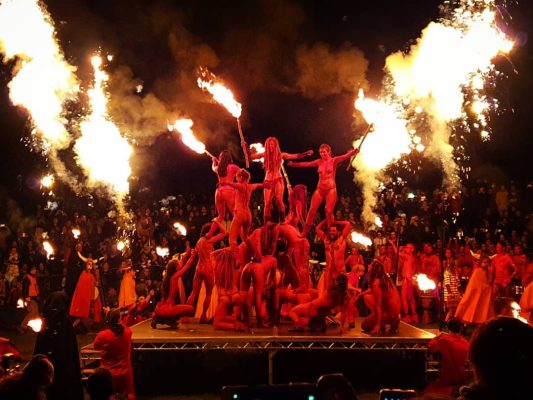
Long before Edinburgh was Edinburgh — before the castle sat on its rocky throne and before the cobblestones wore smooth under centuries of boots — the people of this land had a way of marking the turn of seasons that involved fire, community, and a healthy respect for forces they couldn’t control. Beltane was one of those ways. It fell on the eve of May 1st, and it meant summer was coming.
The ancient Celts divided their year not by solstices alone but by four great festivals, and Beltane stood as the threshold between the cold half of the year and the warm. Cattle were driven between two bonfires — not for spectacle, but for purification — before being led out to summer pasture. Communities gathered on hilltops, lit enormous fires, and performed rituals meant to protect their animals, bless their crops, and remind the world that the dark months were, at last, behind them.
The Beltane Fire Festival draws directly from this tradition, not as a costume interpretation but as a genuine act of cultural memory. The word itself comes from the old Gaelic Bealltainn, and historians trace versions of it across Scotland, Ireland, and the Isle of Man. The Celts believed the boundary between the human world and the spirit world grew thin on these threshold days — and on such nights, the fire wasn’t just warmth. It was protection, invitation, and declaration all at once.
The four great Celtic seasonal festivals:
- Imbolc — February 1st, welcoming early spring
- Beltane — May 1st, welcoming summer
- Lughnasadh — August 1st, beginning of harvest
- Samhain — October 31st, beginning of winter
How Beltane Was Nearly Lost — and Then Saved
 Pin
Pin Photo courtesy of Butser Ancient Farm
By the 18th century, Beltane was fading. The Industrial Revolution had little patience for hilltop fire ceremonies and seasonal rituals. Churches had long discouraged them. Cities were growing, and the old ways — the ones that required a community to stop what it was doing and gather in the dark — were quietly becoming the kind of thing only scholars remembered.
By the 20th century, Beltane as a living tradition had essentially vanished in Scotland. It survived in fragments — in folklore books, in the customs of rural communities, in half-remembered practices that nobody could quite explain anymore. And for a while, it seemed that was that. A beautiful old thing, preserved in ink, no longer practiced in fire.
Then, in 1988, a group of artists, performers, and cultural enthusiasts in Edinburgh decided they weren’t satisfied with that ending. The Beltane Fire Society was formed, and on the night of April 30th that year, a few hundred people gathered on Calton Hill for the first revival ceremony. It was rough, passionate, and entirely homemade. It was also electric. Word spread. The following year, more people came. Then more. The fire, it turned out, hadn’t gone anywhere. It had just been waiting to be lit again.
The Setting — Calton Hill at Night
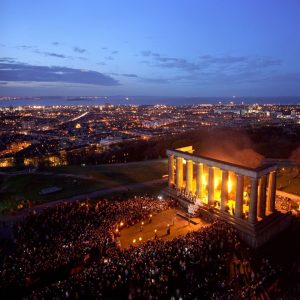
There’s a reason the festival happens on Calton Hill and nowhere else. The hill sits right at the edge of Edinburgh’s city center — close enough that you can hear the city below, far enough that once you’re up there in the dark, surrounded by torchlight and the smell of woodsmoke, the city might as well be another world. It’s a natural amphitheater, an elevated stage where the sky is wide and the horizon stretches in every direction.
On any other night of the year, Calton Hill is a pleasant tourist spot — the kind of place people climb for the view, take a few photographs, and descend before dinner. There’s the old observatory, a half-finished monument that earned Edinburgh its nickname ‘the Athens of the North,’ and a scattering of neoclassical columns that look like they belong somewhere warmer. It’s picturesque, manageable, entirely civil.
On the night of April 30th, it becomes something else entirely. The gates open at dusk and the crowd fills in slowly, finding spots on the grass, watching the performers gather. Then the torches are lit, and everything that was familiar about the hill retreats. What’s left is older than the city, older than the monuments, older than the word ‘festival’ itself. People who’ve attended many times still describe arriving on Calton Hill that night as the moment the year actually begins.
The Characters and What They Mean
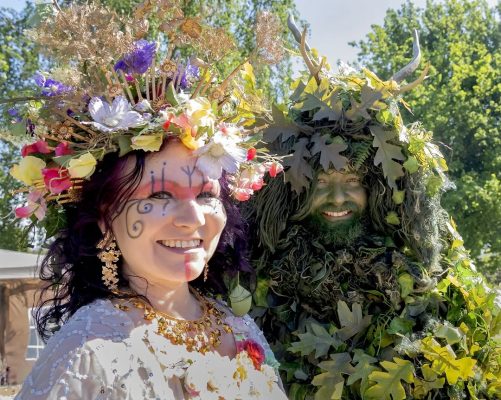
The Beltane ceremony has its central figures, and they’re not random — each one carries symbolic weight that goes back centuries. At the heart of it all is the May Queen, dressed in white, crowned with flowers and ivy. She represents the earth waking up, fertility returning, the warmth of the coming season made flesh. The procession revolves around her. Wherever she walks, the ceremony follows.
Alongside her moves the Green Man — a primal, wild figure smeared in green and earth, representing the raw force of nature that the May Queen’s grace must tame and balance. He’s not a villain, exactly, but he’s not entirely safe either. He represents everything untamed about spring: the sudden storms, the aggressive growth, the life force that doesn’t ask permission. Together, the May Queen and the Green Man enact a kind of cosmic negotiation between order and wildness.
Then there are the Red Men — the fire-keepers, the guardians of the flame, whose role is to light the way and protect the ceremony as it moves across the hill. There are also the White Women, elemental figures who accompany the May Queen, and the Blues, a group of drummers and performers whose rhythms drive the entire procession forward. Every character has a purpose, and watching the ceremony is partly a matter of learning to read what each one represents.
Key characters of the Beltane procession:
- May Queen — the earth’s renewal, the heart of the ceremony
- Green Man — wild nature, untamed seasonal force
- Red Men — fire-keepers and guardians of the flame
- White Women — elemental figures accompanying the Queen
- Blues — drummers who set the rhythm of the whole procession
The Fire — What It Means and Why It Matters
The fire at Beltane isn’t decoration. It isn’t atmosphere. It is, in the most literal sense, the point. The ancient Celts used fire as a threshold — a boundary between states of being. Walking between two fires, or around a bonfire in a specific direction, wasn’t superstition. It was a deliberate act of transformation, a physical declaration that something was ending and something new was beginning. Fire, for them, was the mechanism of change.
At the modern festival, that understanding hasn’t been lost — it’s been embodied. The fire performers who work the hill on Beltane night train for months. They handle poi, staffs, and ropes soaked in fuel and lit. They move through the crowd, not around it, which means the fire is close — uncomfortably close, if you’re used to safety barriers and polite distances. That proximity is intentional. The fire is supposed to wake something up in the people watching.
The great bonfire at the top of the hill is lit at the ceremony’s climax, and when it goes up, the crowd’s reaction is immediate and involuntary. People who describe the moment often say the same thing: that they didn’t expect to feel what they felt. Something loosens. Something responds. Whether that’s the ancestral memory of ten thousand generations who gathered around fires for warmth and protection, or simply the human nervous system reacting to something ancient and enormous — the effect is real, and it’s hard to shake afterward.
“The fire is supposed to wake something up. And it does.”
The Drumming — The Heartbeat of the Night
Before the fire is visible, there’s the sound. Beltane begins, for most attendees, as an experience of hearing — a low, rhythmic drumming that starts somewhere up the hill and works its way into the chest before the brain has fully registered it. It’s not background music. It’s not ambient atmosphere. The drums at Beltane are structural. They hold the entire ceremony together, moving the procession, signaling the transitions, telling the crowd where to look and when.
The drummers who perform at Beltane come from a long tradition of percussive ceremonial music — the kind that’s designed not to be listened to from a distance but to be felt close up, in the body, in the bone. There are moments during the procession when the drumming reaches a pitch that becomes genuinely overwhelming, where conversation becomes impossible and individual thought gets swallowed by the collective rhythm. Participants describe it as the closest thing to a meditative state they’ve ever stumbled into accidentally.
What’s remarkable is how the drumming changes across the night. It starts slow and ceremonial, building as the procession moves. It peaks during the fire-lighting and the most intense performance sequences. Then, gradually, it softens — settling into something that feels less like percussion and more like a pulse, as though the hill itself has a heartbeat and you’ve finally started to hear it. By the end of the night, people often realize they’ve been moving to it without noticing.
The Beltane Fire Society — The People Behind the Flame
The Beltane Fire Society is a non-profit organization, and it runs on something that most modern institutions have quietly given up on: genuine voluntary passion. The majority of the performers, organizers, costume-makers, and fire-handlers who make the festival possible are not paid professionals. They’re painters, teachers, office workers, students, and tradespeople who spend months of evenings and weekends preparing for one night on a hill in April.
The Society was formally established following the 1988 revival, and it has operated continuously since then — through financial difficulties, through the years when the future of the event was genuinely uncertain, and through the particular disruption of 2020, when no gathering was possible and the festival went quiet for the first time in decades. The fact that it returned in 2022 stronger than before says something about the people who run it and the community that supports it.
New members can join the Society, and many people who first attended as audience members have ended up as performers the following year. That’s one of the things that distinguishes Beltane from most large-scale events — the boundary between spectator and participant is genuinely permeable. The Society actively invites people in. What begins as curiosity has a way of becoming commitment, and commitment has a way of lasting years.
What Attendees Actually Experience — Night by Night
The gates to Calton Hill open as dusk falls, and the first thing most attendees notice is the cold. April in Edinburgh is not a warm month, and the hill is exposed. People arrive in layers — coats and scarves over whatever they imagined wearing — and find spots on the grass while the performers assemble in the shadows above. There’s a particular quality to the waiting, a collective held breath that builds for the better part of an hour before anything formally begins.
Then the procession starts. The May Queen emerges, attended by her White Women, and the drums rise. The Red Men move through the crowd with torches, and the hill goes from dark to blazing in what feels like seconds. The procession follows a specific route around the summit, pausing at four fire points that correspond to the four cardinal directions — a structure borrowed directly from ancient Celtic cosmology. At each station, something happens: a performance, a ritual gesture, a moment of ceremony that changes the energy of the crowd.
The final bonfire is lit at the ceremony’s conclusion, and the transition from procession to celebration is immediate. Music shifts, the crowd loosens, and for the last hour of the night Calton Hill becomes something between a party and a vigil — people talking to strangers, sitting around the fire, watching the city below. Many describe that final hour as the most surprisingly emotional part. By then, something has shifted, and they’re not entirely sure when it happened.
What to bring and expect as an attendee:
- Warm layers — April nights on the hill are genuinely cold
- Comfortable shoes — the ground is uneven grass and stone
- Arrive early for the best position on the hill
- No photography of performers’ faces without consent
- Expect the ceremony to last approximately 3 hours
Beltane Beyond Edinburgh — A Global Reach
One of the stranger consequences of Beltane’s revival is how far the idea has traveled. In the decades since the Edinburgh festival was reestablished, Beltane gatherings have emerged in cities across the English-speaking world — in North America, Australia, and across Europe, where Celtic heritage communities have found in the festival a way to reconnect with something older than the countries they now inhabit. None of these gatherings match Edinburgh’s scale, but that isn’t really the point.
The internet, predictably, has played a role. Footage of the Edinburgh festival circulates widely every May, and the images — the fire, the costumed figures, the hilltop silhouettes — have a way of stopping people mid-scroll. There’s a visual language to Beltane that communicates something even without context. People who stumble across it and know nothing about Celtic tradition still recognize that they’re looking at something serious, something human, something that matters in a way they can feel before they can explain.
Academic interest has also grown. Ethnographers, folklorists, and performance studies scholars have written extensively about the Edinburgh festival as a case study in what happens when a society reaches back to reclaim a tradition it nearly lost. The results are complex and interesting: the revival is not identical to the original, because it can’t be. But it is, in some meaningful sense, continuous with it — and that continuity is exactly what makes it worth studying.
The Spiritual Dimension — Belief, Symbolism, and the Sacred
Beltane occupies a peculiar space in the modern world because it’s not formally religious but it’s clearly not secular either. The Beltane Fire Society has always been careful about this — the ceremony draws on Celtic spiritual traditions without claiming to represent any specific faith, and participants bring a wide range of personal beliefs to it. For some, the ritual has genuine spiritual meaning. For others, it’s more about cultural heritage. For many, it’s both, and the line between them blurs somewhere around the time the bonfire gets lit.
The symbols that run through the ceremony — fire, water, earth, seasonal transition, the union of feminine and masculine forces — are old enough that they predate most organized religion in Europe. They’re the kind of symbols that appear independently across cultures precisely because they map onto something universal in human experience: the fear of winter, the relief of spring, the desire to mark change with ceremony. Beltane doesn’t ask people to believe anything specific. It asks them to show up and pay attention.
There are attendees who describe the experience in spiritual terms — who say that something happened on that hill that they’re still processing weeks later, that the fire did something to them that they can’t entirely account for. There are others who describe it as a magnificent piece of living theatre. Both groups are right, and the ceremony is generous enough to accommodate them simultaneously. That’s one of the more remarkable things about it: it meets people where they are.
Why Beltane Keeps Coming Back — And Why That Matters
The practical explanation for Beltane’s endurance is straightforward: the festival is well-organized, financially supported by ticket sales and grants, and backed by a committed volunteer community. But practical explanations only go so far. Plenty of well-organized events with committed communities have faded. Beltane hasn’t — and the reason, if one had to name it, is that the festival addresses something people are genuinely hungry for in ways that more comfortable, more predictable events do not.
There’s a growing conversation about what gets lost when ritual disappears from ordinary life — when there’s no communal way to mark the seasons, no shared gesture that says this moment is different from all the other moments. Beltane offers exactly that. It takes the arrival of May and transforms it into an event — something witnessed, something embodied, something that leaves a mark. The people who attend once and never return are the minority. The people who come back, year after year, are the majority.
And perhaps that’s the deepest answer to why Beltane still captivates thousands every year. It’s not the fire, though the fire is extraordinary. It’s not the drumming, though the drumming gets inside you. It’s the feeling, confirmed once a year on a cold hilltop in Edinburgh, that human beings have always found ways to face the turning of the year together — and that the impulse to do so hasn’t gone anywhere. It’s just been waiting for a hill, and a flame, and a crowd willing to climb.
“The impulse to gather and mark the seasons hasn’t gone anywhere. It was always waiting.”
FAQs
Anyone can attend — tickets are sold to the public each year through the Beltane Fire Society’s official website. They do sell out, often well in advance, so booking early is strongly advisable. The festival is open to adults and older teenagers, though the content and environment aren’t suited to very young children.
Beltane draws on Celtic spiritual traditions, but it isn’t affiliated with any religion and requires no specific belief system from attendees. People of all faiths — and none — attend every year. The ceremony is open to interpretation, and the Society has always been careful to keep it inclusive rather than doctrinaire.
The ceremony runs for approximately three hours, beginning at dusk. First-timers are advised to bring warm, layered clothing — Edinburgh in April is cold, and Calton Hill is exposed. Comfortable footwear is essential as the ground is uneven. Arriving early guarantees a better position on the hill.
Yes — and many of the festival’s most dedicated performers started out as audience members. The Beltane Fire Society welcomes new members each year, offering training in fire performance, drumming, and costuming. It’s a genuine community, not a professional troupe, and new participants are actively encouraged to get involved.
Since the 1988 revival, Calton Hill has been the permanent home of the Edinburgh Beltane Fire Festival. The event was cancelled in 2020 and 2021 due to the global pandemic — the first interruptions since the revival began. It returned in 2022 and has continued since, with the community’s enthusiasm, by most accounts, stronger than ever.






 Login with Google