























 Pin
Pin Photo courtesy of Horizon Dwellers
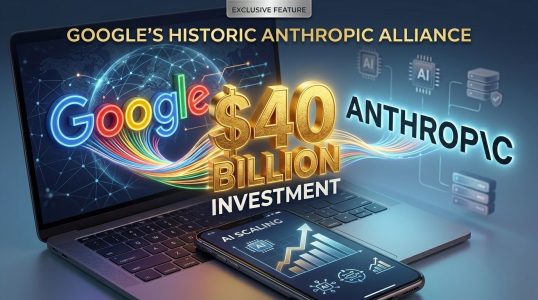
Synopsis: Google’s parent company Alphabet has committed up to $40 billion to Anthropic — the startup behind Claude AI, which happens to be one of Gemini’s biggest rivals. The deal includes $10 billion upfront, another $30 billion tied to performance milestones, and a sweeping compute agreement that hands Anthropic access to 5 gigawatts of Google Cloud capacity over five years. This is not a contradiction. It is a calculated strategy. Google is not just betting on one AI horse. It is buying a stake in the whole track.
There is an old saying in business: if you cannot beat them, fund them. Google appears to have taken that quite literally. While the rest of the technology world was busy arguing over whether Claude or Gemini is the smarter chatbot, Google quietly wrote a check that made the whole argument beside the point.
Forty billion dollars. To its own competitor. And the remarkable part? It may be the most strategically sound move Google has made in years.
Table of Contents
The Deal That Raised Every Eyebrow in Silicon Valley
When the news landed on April 24, 2026, the reaction across the technology industry was somewhere between stunned and deeply impressed. Google — the company that builds Gemini — announced it would invest up to $40 billion in Anthropic, the startup behind Claude. Bloomberg broke the story first. Anthropic and Google both confirmed it shortly after.
The structure of the deal is worth understanding. Google is committing $10 billion immediately, at a valuation of $350 billion for Anthropic — the same figure attached to the company’s February funding round. The remaining $30 billion is contingent on Anthropic hitting specific performance targets. Think of it as a vote of confidence with accountability baked in.
What makes this unusual is not just the dollar amount. It is the relationship. Claude and Gemini go head-to-head every single day for users, enterprise clients, and developer loyalty. Yet here is Google essentially co-signing Anthropic’s future. That is not confusion. That is confidence of a very specific and strategic kind.
- $10 billion committed upfront in cash
- $30 billion more if Anthropic hits performance milestones
- Anthropic valued at $350–380 billion depending on the source
- Deal confirmed by both companies on April 24, 2026
- First reported by Bloomberg
Google Is Playing a Completely Different Game
Most coverage of this deal frames it as a strange paradox: Google funding its own rival. That framing misses the point entirely. Google is not playing the same game as OpenAI, Anthropic, or Meta. Those companies are racing to build the best model. Google is racing to own the infrastructure those models run on.
Sundar Pichai and the Alphabet leadership have made their strategy clear over the past two years: deploy capital where internal opportunities are not yet mature, and take equity positions in companies that will consume enormous amounts of cloud compute for years to come. Anthropic is exactly that kind of company.
The logic is almost elegant in its simplicity. If Gemini becomes the dominant AI model, Google wins on the product side. If Claude wins instead, Google still wins — because Anthropic runs almost entirely on Google’s infrastructure. The company is not betting on a horse. It is the track owner collecting fees from every horse in the race.
“Google is not betting on AI. It’s building the casino, financing the players, and collecting rent from the tables.”
The Compute Angle: Why TPUs Matter More Than Anyone Admits
Strip away the headline number and the real story of this deal is about compute. Specifically, about tensor processing units — Google’s custom-built AI chips that have become one of the most valuable and sought-after resources in the entire technology industry.
Anthropic has relied heavily on Google Cloud’s TPUs for years. According to TechCrunch, the new investment expands that arrangement significantly, with Google Cloud now committing a fresh 5 gigawatts of capacity over the next five years, with room to scale further. For context, a single gigawatt of compute is an enormous amount of power. Five gigawatts, plus the potential for several more, is a declaration of infrastructure dominance.
Earlier this month, Anthropic had already signed a three-way agreement with Google and Broadcom — the chipmaker that designs custom AI silicon for Google — for 3.5 gigawatts of next-generation TPU capacity expected to come online in 2027. The new $40 billion deal layers on top of that, expanding what is already one of the largest compute partnerships in the history of the industry.
- Google Cloud: 5 gigawatts of new capacity over 5 years
- Google-Broadcom-Anthropic deal: 3.5 gigawatts of TPU capacity from 2027
- Anthropic has access to up to one million TPU chips
- TPUs offer strong price-performance vs. NVIDIA GPUs
- Anthropic uses TPUs, Amazon Trainium, and NVIDIA GPUs across a multi-platform strategy
Anthropic’s Revenue Story Is Harder to Ignore Than Its Tech
There is a reason investors are lining up to pour money into Anthropic right now, and it is not purely the quality of Claude’s answers. The company’s commercial trajectory has become one of the most remarkable in enterprise software history.
At the end of 2025, Anthropic’s annualized revenue run rate sat at around $9 billion. By early 2026, it had surged past $19 billion. By April, it had crossed $30 billion. In February 2026 alone, the company added roughly $6 billion to its annualized revenue base. Not for the quarter. Not for the year. For a single month. According to reporting from Let’s Data Science and confirmed by Anthropic’s own CFO Krishna Rao, the company now serves more than 1,000 enterprise customers each spending over $1 million annually.
The primary engine behind this growth has been Claude Code, Anthropic’s AI-powered coding assistant, which has been adopted at a pace that surprised even the company’s own internal projections. Enterprises account for roughly 80% of Anthropic’s business, according to CEO Dario Amodei. That is the kind of commercial durability that makes a $40 billion investment feel less like a gamble and more like arithmetic.
The Mythos Factor: A Model Too Powerful to Simply Release
The timing of this investment is not coincidental. It follows the limited release of Anthropic’s newest and most powerful model, Claude Mythos — a system so capable in cybersecurity that Anthropic has deliberately restricted broader access while it works with select organizations to evaluate risks.
Mythos was described in internal documents, which leaked inadvertently in late March via an unsecured data cache, as “by far the most powerful AI model we’ve ever developed.” The company confirmed the model exists and called it “a step change” in AI performance. Anthropic subsequently launched Project Glasswing, an effort to use Mythos to help secure critical software systems worldwide.
The model’s cybersecurity capabilities are genuinely impressive — and genuinely double-edged. Mythos has already identified thousands of high and critical-severity vulnerabilities across major systems. It has also reportedly already fallen into unauthorized hands, a detail that has drawn scrutiny from regulators and attention from financial institutions including the U.S. Federal Reserve and the Bank of England. Expensive to run at scale, Mythos is part of why Anthropic’s compute demands are so enormous — and why Google’s infrastructure partnership is so strategically vital.
Amazon Is Also In — And That Tells Its Own Story
Google is not the only hyperscaler pouring money into Anthropic. Just days before this announcement, Amazon committed an additional $5 billion to the company, with an option to invest as much as $20 billion more over time. That deal came with its own infrastructure component: Anthropic agreed to spend up to $100 billion on around 5 gigawatts of compute capacity through Amazon Web Services.
Both deals value Anthropic at $350 billion — the same figure from the February funding round. For those keeping score, Anthropic has now secured major investment commitments from both of the two largest cloud providers in the world, in the same week. Google and Amazon are, in most respects, fierce competitors. Here they are both backing the same AI startup.
This is what the AI infrastructure arms race looks like at its most intense. Microsoft did it first with OpenAI, at a scale of roughly $13 billion. Amazon and Google have now replicated that playbook with Anthropic, each doubling down in a matter of days. The message from the hyperscalers is consistent: they do not intend to merely observe the AI era. They intend to be the foundation it is built on.
The IPO Countdown: Anthropic’s Very Public Next Chapter
All of this capital is building toward something. According to reporting from The Information and confirmed by multiple financial analysts, Anthropic is considering an initial public offering as soon as October 2026. Goldman Sachs, JPMorgan, and Morgan Stanley are reportedly in early discussions. Bankers believe the IPO could raise more than $60 billion — which would rank among the largest public offerings in history.
The valuation trajectory has been steep. In November 2024, Anthropic raised at a $40 billion valuation. By February 2026, it closed a $30 billion Series G round at $380 billion. Investors have since reportedly been eager to back the company at $800 billion or more. The question is not whether Anthropic is valuable. The question is whether it can convert that valuation into profitability.
The company generates approximately $2 billion in monthly revenue but projects a $14 billion loss for 2026. Compute costs are enormous, and the infrastructure deals it is signing only deepen that spend in the near term. Any IPO process will need to tell a credible story about the path to breakeven — and the presence of Google and Amazon as both investors and infrastructure partners gives that story some structural weight.
What Google Gets Out of This — Beyond the Headlines
It is worth asking what Google actually receives from this arrangement. The answer has several layers. The most visible is equity upside: if Anthropic IPOs at a valuation significantly higher than $350 billion, Alphabet’s return on a $10 billion investment could be substantial. That is a straightforward financial calculation.
The less visible benefit is compute revenue. A significant portion of the $40 billion committed will flow back to Google Cloud through compute service agreements. This is the circular economic model that has become common in AI partnerships: investment capital returns as cloud revenue, and the investor benefits twice. Google is both a shareholder and a service provider, which means Anthropic’s growth is Google’s growth in two different columns of the balance sheet.
There is also a strategic intelligence dimension. Having a close partnership with one of the most advanced AI research labs in the world gives Google proximity to frontier research, training methodologies, and model architectures. Even if Gemini and Claude remain separate products, the knowledge flows in both directions. Google is not just funding a competitor. It is studying one.
The Broader AI Race: Compute Is the New Oil
The Google-Anthropic deal is best understood not in isolation but as part of a sweeping structural shift in how the AI industry works. The companies that will define the next decade of technology are not necessarily the ones with the cleverest algorithms. They are the ones with access to the chips, the power, the data centers, and the balance sheets.
Anthropic itself has been under intense compute pressure in recent months. The company faced widespread user complaints about Claude usage limits earlier in 2026. It responded with a wave of infrastructure deals: CoreWeave for data center capacity, Amazon for cloud compute, and now Google for TPU access on an unprecedented scale. The message is that even a company with $30 billion in annual revenue and some of the most impressive AI models in existence is still scrambling for compute.
That scramble is what makes hyperscalers so powerful. NVIDIA supplies the GPUs. Google and Amazon supply the data centers, the network, the power contracts, and the long-term capacity commitments. The AI labs may produce the headlines, but the infrastructure owners collect the rent. This is not a new dynamic in technology history — it is a very old one, wearing new clothes.
“AI labs may get the headlines, but hyperscalers own the scarce inputs: chips, data centers, power, cloud contracts, distribution, and balance sheets.”
The Risks Nobody Is Talking About
Any honest account of this deal has to include what could go wrong. The most obvious risk is Anthropic’s profitability problem. A company burning $14 billion a year while preparing for a public offering is navigating a narrow path. The revenue growth is extraordinary, but compute costs are growing alongside it, and the infrastructure deals being signed now commit Anthropic to enormous spending for years to come.
There are also competitive risks. OpenAI has been watching Anthropic’s growth with considerable attention. A leaked memo from OpenAI’s chief revenue officer accused Anthropic of overstating its revenue run rate by billions. CEO Sam Altman publicly accused the company of “fear-based marketing” around the Mythos rollout. These are the kinds of shots that get fired when one company believes another is winning.
Regulatory risks are real as well. The U.S. Defense Department has designated Anthropic a supply-chain risk, restricting certain government sales channels. Anthropic has sued the Trump administration in response — a case still working through the courts. And the cybersecurity capabilities of Mythos have drawn attention from central banks on two continents. A company that powerful, growing that fast, with that much foreign investor interest, is not going to avoid regulatory scrutiny for long.
So Who Is Actually Winning the AI Race?
After all of this, the honest answer is that the AI race does not have a single winner — it has multiple winners at different layers of the stack. Anthropic is winning on product momentum, revenue growth, and enterprise adoption. Google is winning on infrastructure control and strategic positioning. Amazon is hedging its bets with the same logic. And all of them are benefiting from a world in which AI has moved from a research curiosity to a genuine commercial necessity.
The more interesting question is what this moment means for everyone who is not Google, Amazon, or Microsoft. The consolidation of AI infrastructure around a small number of hyperscalers is not a neutral development. The companies that control compute control the cost structure for every AI startup that wants to build at scale. That gives the cloud giants enormous leverage over the pace and direction of AI development — regardless of which model wins any particular benchmark.
Google’s $40 billion investment in Anthropic is, at its core, a statement about that leverage. It is Google saying: no matter who wins the model race, the infrastructure race is already decided. The wires and the chips and the data centers all run through us. And in the long run, that may matter more than any single breakthrough in artificial intelligence.
The AI era is not being decided in research labs alone. It is being decided in balance sheets, data centers, and infrastructure agreements signed quietly on Friday afternoons.
FAQs
Google benefits whether Gemini or Claude wins. Anthropic runs on Google’s cloud infrastructure, so Claude’s growth directly drives Google Cloud revenue regardless of which model users prefer.
No. Google committed $10 billion immediately. The remaining $30 billion depends on Anthropic meeting specific performance milestones, making this a structured and accountable investment rather than a blank check.
TPUs are Google’s custom AI chips. They are among the best alternatives to NVIDIA’s GPUs for training large language models. Anthropic’s access to 5+ gigawatts of TPU capacity is arguably as important as the cash itself.
Anthropic is reportedly targeting an IPO as soon as October 2026, potentially raising over $60 billion. It would rank among the largest public offerings in history, though profitability remains a key hurdle for investors.
Not in terms of ownership or governance. Anthropic has also taken major investments from Amazon and others. The company is deliberately maintaining a multi-partner infrastructure strategy to avoid dependence on any single backer.










 Login with Google