

















 Pin
Pin Photo Courtesy of Annest Kenya Safaris
Synopsis: Every year, without so much as a permit or a packed lunch, millions of creatures set out across deserts, tundra, and grassland on journeys older than most nations. This rundown of the Top 10 Animal Land Migrations on Earth covers the wildebeest herds of the Serengeti, the caribou of the Arctic, the crabs that turn a whole island red, and more. Along the way, it explains what pushes these animals to move, how they find their way, and why some of the grandest migrations in history have already vanished for good.
There is a rule the natural world settled on long before anyone got around to writing rules of any kind: when the grass runs out, get moving. No committee decided this. No treaty was signed. And yet, on schedule, year after year, entire nations of animals rise up together and go.
The distances involved would embarrass most vacation plans. A caribou will out-walk a marathon runner’s yearly total before the season is half over. A red crab, roughly the size of a fist, will cross an entire island on foot rather than wait around for better transportation. None of them complain about it, at least not where anyone can hear.
What follows is a look at ten of the finest overland journeys the planet still has to offer, plus one that vanished before most of us were born. Some of these animals travel by the million. A few travel nearly alone. All of them understand something about timing that no calendar has ever quite managed to capture.
Table of Contents
How and Why They Move
The Top 10 Animal Land Migrations on Earth all run on the same blunt logic: food shifts, water shifts, the seasons turn over, and any animal that insists on staying put usually pays for its loyalty with an empty stomach. Migration is not sentiment. It is arithmetic, worked out over thousands of generations.
The triggers are rarely mysterious once someone bothers to look. Snow depth, day length, and the first green shoots after a drought all serve as starting pistols, nudging animals to move well before conditions turn dire wherever they happen to be standing.
Finding the way is the harder trick, and it varies considerably by species. Some lean on the position of the sun. Others seem to read the Earth’s magnetic field like a compass sewn into their skin. Depending on the animal, landscape features, smell, weather, memory, and social learning from older herd members all play a part, passing the route down the way a family heirloom gets passed down.
1. The Great Wildebeest Migration, Serengeti-Mara
 Pin
Pin The Great Wildebeest Migration / Photo Courtesy of Wealth Worth Collection
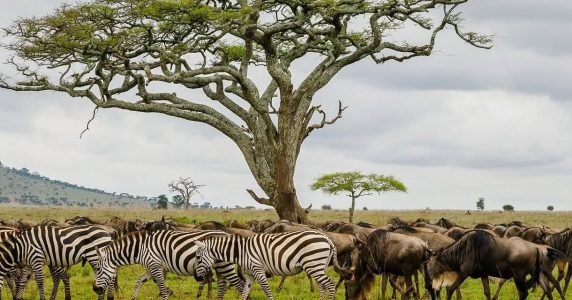
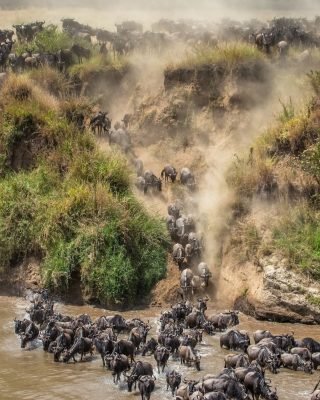
Roughly 1.3 to 1.5 million wildebeest, joined by hundreds of thousands of zebras and gazelles, spend the year walking a rough circle between Tanzania’s Serengeti plains and Kenya’s Maasai Mara. It is widely reckoned the largest land migration left on Earth, and the annual loop is often put at somewhere between 1,000 and 1,800 miles, depending on how the route is measured.
The migration is punctuated by river crossings that have made more documentary careers than any other event in nature filmmaking, above all on the Mara River. Crocodiles wait in the shallows, the currents run high, and the wildebeest cross anyway, because the grass on the far bank is greener and staying behind is not really an option.
Fast facts worth knowing:
- Herd size: roughly 1.2 to 1.5 million wildebeest, plus zebra and gazelle
- Distance: commonly cited as roughly 1,000 to 1,800 miles in a rough annual loop, depending on how it’s measured
- Best known for the Mara River crossings, dense with predators
2. The Caribou of the Arctic
 Pin
Pin Caribou of the Arctic Migration / Photo Courtesy of Braide Driver
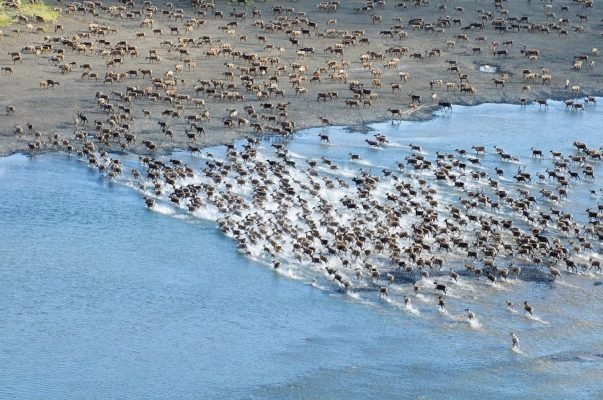
Caribou are widely recognized as having the longest known terrestrial migrations of any mammal alive. Herds such as the Porcupine caribou, roughly 170,000 strong, range across Alaska and northern Canada, chasing thawing tundra north in spring and retreating south before winter locks the ground shut, and individual caribou have been tracked covering more than 4,000 kilometers, or roughly 2,700 miles, over the course of a year.
Wolves trail behind them for much of the route, and researchers tracking both species found the wolves often log even more mileage than the caribou themselves, weaving back and forth along the edges of the herd like sharks working a school of fish.
What makes the caribou migration remarkable is not just its length but its age. Indigenous communities across the Arctic have timed their own seasons around these herds for thousands of years, and the caribou, for their part, have never once needed a map.
3. The Zebras
 Pin
Pin Zebra Migration / Photo Courtesy of Annest Kenya Safaris
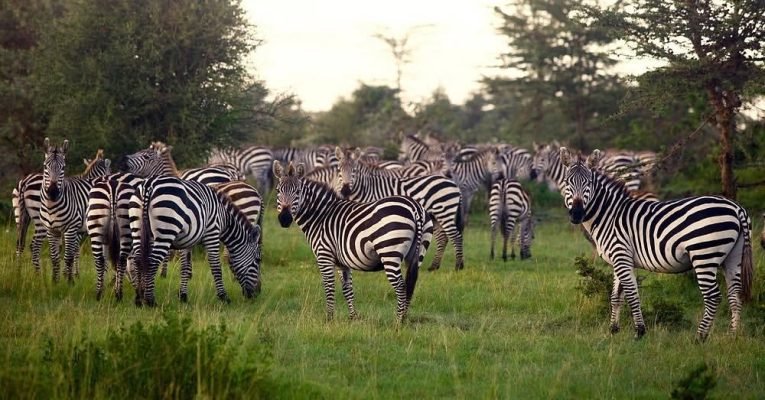
For a long while, the wildebeest got all the attention and the zebras were treated as scenery. Then, in the early 2010s, researchers fitted a handful of Burchell’s zebras with tracking collars and discovered a cross-border migration spanning roughly 500 kilometers, or about 300 miles, between its Namibian and Botswanan endpoints, a route nobody had documented before. Later GPS tracking showed individual zebras covering considerably more ground along the actual route, in some cases 700 kilometers or more round trip.
Further north, close to 20,000 zebras make a separate, smaller loop each year, leaving the Chobe River floodplains for the seasonal rains of Nxai Pan National Park, a salt pan so flat and pale it looks like the moon decided to visit Botswana for a season.
These zebra migrations were, for decades, hiding in plain sight. It took satellite collars, not folklore, to finally put them on the record, which says something about how much of the wild world still goes unnoticed.
4. The Path of the Pronghorn, Wyoming
 Pin
Pin Pronghorn Migration / Photo Courtesy of The WCS
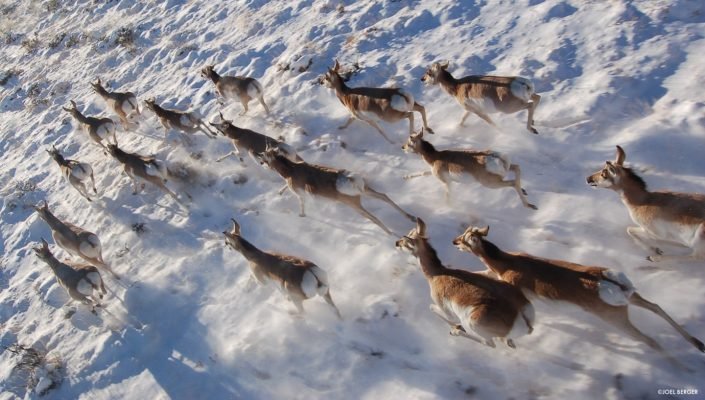
North America’s fastest land mammal, capable of running roughly 55 miles an hour, makes a modest but stubborn journey each year between Grand Teton National Park and the sagebrush flats of Wyoming’s Green River Basin. The famous Path of the Pronghorn covers roughly 150 miles between the two, though some individuals and populations travel considerably farther.
Archaeological evidence suggests pronghorn have walked this same corridor for at least 6,000 years, which puts the route on the books before the pyramids of Giza were so much as sketched on papyrus. Fences, highways, and subdivisions have since carved the path into a gauntlet of narrow bottlenecks.
Wildlife officials have answered with overpasses, underpasses, and wildlife-friendly fencing, proof that an old migration and a modern highway can, with enough patience and steel, learn to share the same ground.
5. The White-Eared Kob of South Sudan
 Pin
Pin White-eared kob / Photo Courtesy of Geosteinmetz
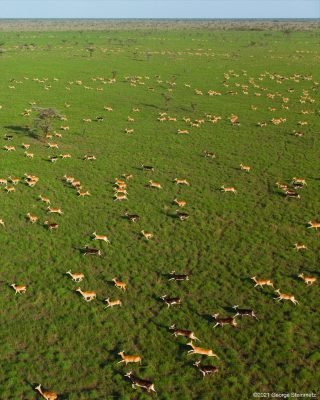
Fewer people have heard of the white-eared kob than the wildebeest, which is a shame, because an estimated 800,000 of these antelope move across the Boma-Gambela ecosystem of South Sudan and Ethiopia, forming one of Africa’s largest, and least-studied, wildlife migrations. GPS tracking has documented individual kob covering several hundred kilometers, with some research suggesting the full migration may approach 900 kilometers or more, though the complete route is still not firmly mapped.
Decades of civil conflict kept the region largely closed to researchers, so for a long stretch the migration was known mostly to local herders and the occasional pilot flying low over the swamps. Aerial surveys eventually confirmed numbers that rivaled the more famous herds further east.
The kob’s route runs through wetlands that flood and dry on their own schedule, forcing the herd to read the land itself rather than any fixed calendar, a skill that has kept the migration alive through years when almost nothing else in the region stayed steady.
6. The Saiga's Return from the Brink
 Pin
Pin Saiga Antelope Migration / Photo Courtesy of Klausnigge
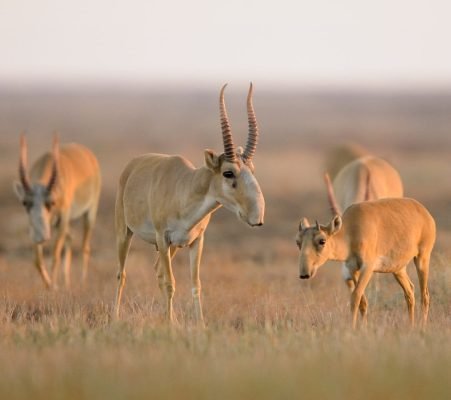
The saiga antelope, an odd-nosed grazer of the Central Asian steppe, once moved across the grasslands from Hungary to northeast China in numbers nobody bothered to count. Poaching and disease later gutted the population, with one herd crashing 95 percent in just fifteen years.
Conservation work has since turned the story around. Kazakhstan’s saiga population has rebounded to roughly four million animals across its three main herds, and migrations stretching over 300 kilometers have returned to the Betpak-Dala and Ural regions, tracked now by GPS collars instead of guesswork.
It remains a fragile recovery. Deep snow can still push herds unexpectedly into farmland and villages, and a single disease outbreak once killed 200,000 animals in under a month, a reminder that a comeback story in the wild is never fully finished.
7. Christmas Island's River of Red Crabs
 Pin
Pin Christmas Island Red Crabs Migration / Photo Courtesy of Swelllodge
Somewhere around 100 million red crabs live on this speck of Australian territory in the Indian Ocean, and once a year, triggered by the first rainfall of the wet season and timed by the lunar cycle, they all leave the forest at once and march for the coast.
Roads close. Cars stop. The ground itself seems to turn red and start moving. Males lead the way, dig burrows near the shore, and wait for the females to arrive and mate, after which the females linger to release up to 100,000 eggs each into the surf before the tide turns.
The whole spectacle runs on lunar timing as much as rainfall, with spawning always set for a receding high tide just before dawn. Sir David Attenborough once called it one of the finest sights he ever filmed, and the island still shuts its roads to prove he was onto something.
8. The Gazelles of the Mongolian Steppe
 Pin
Pin Gazelles of the Mongolian Steppe Migration / Photo Courtesy of Wildlife Initiative
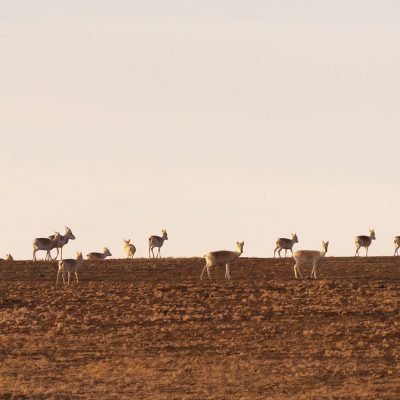
Out on the wide, empty grasslands of Mongolia, gray wolves, khulan, wild camels, and Mongolian gazelles all move across vast unfenced territory in patterns researchers have only recently managed to map in full, using GPS collars strapped onto hundreds of animals over the past two decades.
A curious pattern turned up in the data: Mongolian gazelles look less like classic migrants than true nomads, with GPS-tracked individuals ranging across enormous areas rather than following one fixed route, in one case shifting more than 18,000 kilometers over five years in response to rainfall, vegetation growth, and harsh winters. Research across large mammal migrations more broadly suggests that, under comparable conditions, smaller herbivores can cover more ground than larger ones, though the reasons are still debated.
These movements happen almost entirely in places untouched by roads or fencing, which turns out to be the real secret ingredient. Wherever development creeps in, the great movements shrink, and Mongolia’s steppe remains one of the last places on Earth with enough open ground left for the old patterns to survive.
9. The Vanished Trekbokke of the Karoo
 Pin
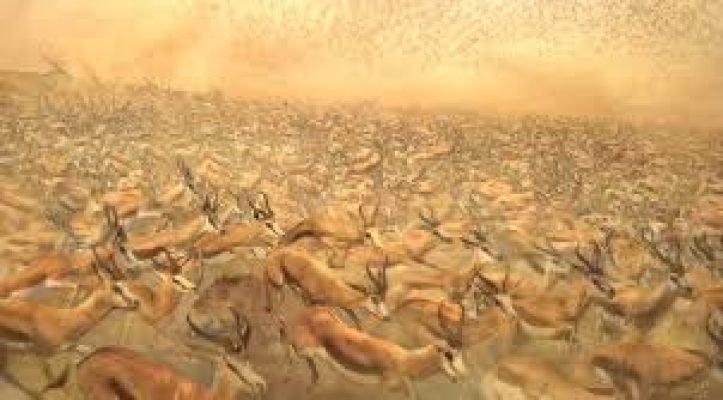
Pin Vanished Trekbokke of the Karoo / Photo Courtesy of Galavanting with Kathryn Costello
In the 1800s, South Africa’s Karoo region saw springbok herds so vast that eyewitnesses described columns of dust visible for miles, with a single herd near Hopetown estimated at half a million animals stretching across a front fifteen miles wide. Farmers built fires and thorn barricades just to survive the passing horde.
Nobody knows exactly how many springbok took part at their peak. Estimates range into the tens of millions, a movement some historians rank above both the American bison and the East African wildebeest for sheer scale. The pattern behind the biggest treks was more tangled than simple drought: several years of good rainfall would swell the herds, and then drought would concentrate those huge numbers into shrinking patches of grazing, sending them pouring south out of the Kalahari in search of anything green.
The last great Karoo trek was recorded in 1896-97, and it disappeared for reasons more tangled than drought alone: intensive hunting of the concentrated herds, expanding livestock farming, spreading fences, and growing settlement all closed in at once. The springbok has never again gathered in numbers anywhere close to those old accounts, and it stands now as a quiet warning about how quickly a migration, once broken, can vanish for good.
10. The Bison of Yellowstone
 Pin
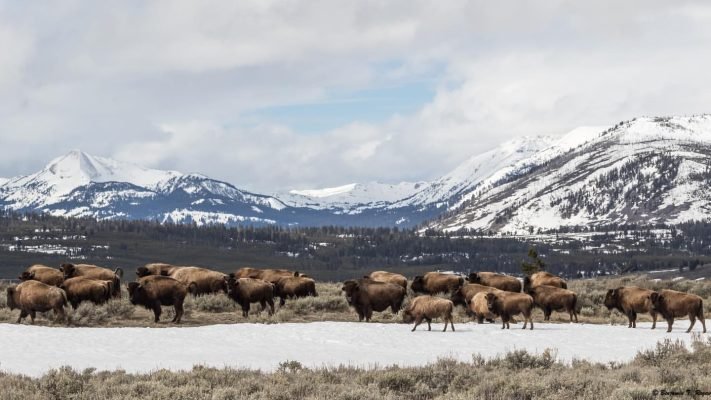
Pin Bison of Yellowstone / Photo Courtesy of My Own Frontier
Not so long ago, the American bison could have filled its own chapter on vanished migrations, right alongside the springbok. Tens of millions once roamed the Great Plains, and by the close of the 1800s, hunting and habitat loss had reduced the population to a few hundred animals holding on in scattered pockets. Yellowstone was one of the last places the old migratory instinct managed to survive.
Today, Yellowstone’s bison, numbering somewhere around 4,000 to 5,000 animals, still make the seasonal trip their ancestors made: down from the high snowbound plateaus of the park’s interior each winter, chasing lower ground and thinner snowpack, then back up into the highlands each spring as the new grass comes in. The full round trip can run anywhere from 50 to over 100 miles depending on the herd and the winter, a modest distance next to the caribou or the wildebeest, but a near-miracle given how close the whole species came to disappearing outright.
The migration still runs into trouble at the park’s edges, where ranchland and property lines pick up where Yellowstone’s boundary leaves off, and disputes over where the bison are welcome to wander have never fully settled. Even so, the herd’s recovery, from a few hundred animals to several thousand, stands as one of conservation’s better comeback stories, and proof that a migration written off as lost can, with enough room and enough patience, start walking again.
Fast facts worth knowing:
- Herd size: roughly 4,000–5,000 bison in Yellowstone
- Distance: roughly 50–100+ miles round trip, elevation-driven rather than fixed
- Notable for one of the great recoveries from near-extinction in the late 1800s
Why These Journeys Still Matter
Every migration on this list does more than move bodies from one patch of ground to another. Wildebeest hooves till soil and scatter seed. Migrating herds like caribou provide recurring pulses of food for wolves, foxes, and ravens along their corridors, and their movement helps redistribute nutrients across the land. Red crabs turn over leaf litter that would otherwise choke Christmas Island’s forest floor.
Break the route, and the whole chain of small favors breaks with it. A single fence line, badly placed, has been enough to end migrations that had run for thousands of years, as the springbok’s fate makes plain enough. Wildlife-friendly overpasses and protected corridors, by contrast, have already saved routes once thought doomed.
None of these animals asked to be studied, protected, or turned into travel-blog material. They simply keep walking, flying feathers of dust behind them, following a set of instructions written into their bones long before anyone was around to read them. The least the rest of us can do is leave the path clear.
FAQs
Caribou herds take that title. They’re widely recognized as having the longest known terrestrial migrations of any mammal, with some individuals tracked traveling more than 4,000 kilometers, or roughly 2,700 miles, in a year across the Arctic tundra.
It depends on the species. Different animals draw on different combinations of cues, including the sun’s position, the Earth’s magnetic field, landscape features, smell, weather, and herd memory, with older animals often leading younger ones along routes passed down for generations.
Several years of good rainfall built up enormous herds, and then drought concentrated them into shrinking pasture. Intensive hunting, expanding livestock farming, and spreading fences then broke the routes apart for good. The last great trek was recorded in 1896-97.
Estimates commonly put the number at around 100 million red crabs, all leaving the forest within days of each other once the wet season rains begin.
Both. Saiga antelope numbers have rebounded to roughly four million, while many other herds keep shrinking as roads and fences carve up open land.









 Login with Google