



















 Pin
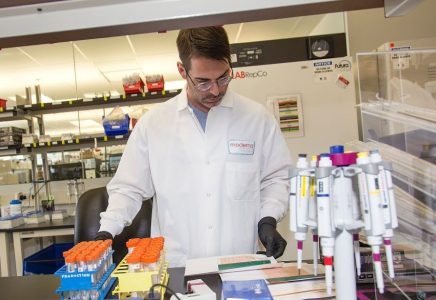
Pin Photo Courtesy of Moderna
Synopsis: Moderna’s Personalized mRNA Vaccine has cleared its toughest test yet. In a late-stage trial run alongside Merck, the custom-built shot — paired with the immunotherapy drug Keytruda — met both its main goals: cutting the odds of melanoma returning and reducing how often it spreads to distant organs, building on earlier data that showed roughly a 49% and 59% risk reduction. It is the first mRNA-based cancer treatment to succeed in a Phase 3 study. This article covers how the vaccine is built, what the trial numbers actually mean, and where the science heads next.
Progress in medicine tends to arrive the way a glacier arrives — slow, unannounced, easy to miss unless a person happens to be standing at the right cliff edge at the right hour. Then, every so often, a single Wednesday changes the shape of an entire field.
That was close to what unfolded this past August, when Moderna and Merck released topline results from a melanoma vaccine trial five years in the making. Investors noticed first — shares jumped sharply, helping the company recover ground lost over a rough multi-year stretch. But the real event sat quietly inside the data itself: a treatment stitched together from a patient’s own tumor, doing precisely what its inventors had spent a decade working toward.
Oncologists, who are not given to theatrics, reached for the word “landmark.” They do not hand that word out casually.
Table of Contents
What Just Happened
The trial itself was built simply enough. Patients who had a high-risk melanoma cut out of their skin were split two ways. One group received Keytruda, the standard drug given after surgery to keep cancer from returning. The other group received Keytruda plus a vaccine manufactured from their own tumor’s genetic code. The comparison decided everything.
The group getting both treatments came out ahead on both the trial’s main goal and its key secondary goal — a result oncology trials rarely deliver this cleanly. It marked the first Phase 3 success recorded for an mRNA-based cancer treatment, a stage where many promising ideas quietly fall apart.
Here’s what’s confirmed so far, current as of August 2026:
- The trial enrolled 1,137 patients, randomized two-to-one to receive the vaccine-plus-Keytruda combination or Keytruda alone
- Earlier five-year follow-up data, presented at ASCO earlier in 2026, showed a 49% reduction in risk of recurrence or death, and a 59% reduction in risk of distant spread or death, versus Keytruda alone
- The exact percentage results specific to this new Phase 3 readout are expected at an upcoming medical meeting, alongside regulatory filing discussions
For a patient staring down a melanoma diagnosis, that is the difference between a nervous wait and reasonably good odds, even with some of the finer print still to come.
How a Vaccine Gets Built From One Patient's Tumor
Calling it a vaccine is a bit misleading, in the way that calling a custom-tailored suit “clothing” undersells the fitting process. This shot is not mass-produced and shipped in identical vials. It is built new, from scratch, for one person only.
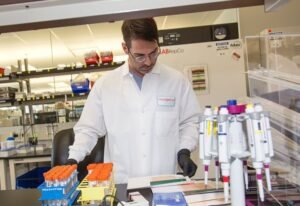
The process starts with a sample of the patient’s own tumor. Scientists sequence its DNA and hunt down the specific mutations that make that particular cancer different from healthy tissue, and different from anyone else’s cancer too. Artificial intelligence tools help narrow down which of those mutations are likely to catch the immune system’s attention.
Once the target list is set, up to 34 of these tumor-specific markers, called neoantigens, are encoded into a single synthetic mRNA strand:
- The mRNA is manufactured individually for that one patient
- It teaches the immune system to recognize those exact markers
- No two patients ever receive the same formulation
The delivery method itself borrows directly from the COVID vaccines developed a few years earlier.
The Science of Neoantigens, Explained Simply
Every cancer cell carries mistakes in its DNA that healthy cells don’t have. Some of those mistakes are cosmetic and change nothing important. Others produce slightly abnormal proteins on the cell’s surface — flags, essentially, that a trained immune system can learn to spot.
Those flags are called neoantigens, and they’ve been a subject of serious research for well over a decade. The trouble was never the idea. The trouble was building something fast enough, precise enough, and affordable enough to manufacture one-of-a-kind for every single patient who needed it.
mRNA technology solved a good part of that manufacturing puzzle:
- It can be programmed with new genetic instructions in a matter of weeks
- Production doesn’t require growing anything in a lab dish, unlike older vaccine methods
- The same manufacturing platform used for COVID shots adapts easily to cancer targets
That speed is what finally made a truly personalized treatment realistic instead of theoretical.
Why Pairing With Keytruda Matters
The vaccine doesn’t work alone in this trial, and that detail matters more than it might first appear. It’s given alongside Keytruda, an immunotherapy drug that’s been a fixture in cancer treatment for years, working by releasing a kind of brake the immune system naturally applies to itself.
Cancer cells are notoriously good at hiding from immune attack, partly by hijacking that very brake. Keytruda releases it. The vaccine, meanwhile, teaches the immune system precisely which cells to go after once the brake is off. Each drug compensates for something the other one can’t do alone.
Per the published study protocol, patients received:
- The personalized vaccine at 1 milligram, given every three weeks, for up to nine doses
- Pembrolizumab (Keytruda), continued for approximately one year following surgery
- Treatment starting only after complete surgical removal of the melanoma
Used by itself, Keytruda already lowers the risk of relapse. Add the vaccine, and earlier-stage data suggests the numbers move further than either drug tends to manage solo.
The Long Road Here
None of this arrived overnight, whatever a stock chart from August might suggest. Researchers have chased the idea of a personalized cancer vaccine since long before mRNA became a household term, going back decades to early attempts at training the immune system against tumor-specific targets.
Moderna and Merck’s own version, known clinically as intismeran autogene, or by its earlier lab name mRNA-4157, has been tracked since a mid-stage trial first posted encouraging results years ago. Five-year follow-up data, released quietly in January 2026, already hinted at what August’s headline would later confirm.
The timeline runs longer than most press coverage lets on:
- Phase 3 trial enrollment began in 2023
- Mid-stage (Phase 2) results were first presented back in 2023
- Five-year Phase 2b follow-up data shared in January 2026
- Phase 3 topline results confirmed in August 2026
Patience, in this business, is not optional. It is the whole job.
Inside the Phase 3 Trial, INTerpath-001
The trial carries the working title INTerpath-001, a name built for a spreadsheet rather than a headline, but the design behind it is what actually earned the applause. It is randomized, meaning neither doctor nor patient chose which treatment arm they landed in — a detail that keeps results honest.
Eligible patients had melanoma that had already spread to a lymph node but had been fully removed by surgery, and needed to be free of any detectable disease when the trial began. That group represents some of the highest-risk patients in melanoma care, the ones most likely to see the cancer return.
Trial specifics worth noting:
- Registered publicly as NCT05933577
- Enrolled 1,137 patients across stage IIB through IV melanoma, all previously untreated with systemic therapy
- Primary measure: how long before the cancer returns
- Secondary measure: how long before it spreads to distant organs
- No new safety signals reported at this interim analysis; earlier-phase data linked the combination mainly to fatigue, chills, and injection-site reactions, typical of mRNA-based shots
Both the primary and key secondary measures hit their mark, a rarer outcome in oncology trials than most headlines let on, and the safety picture so far hasn’t raised new concerns.
Wall Street's Reaction and What It Means for Moderna
Investors are not sentimental people, as a rule, and cancer trial data doesn’t usually move a stock price the way a product launch might. This time it did. Moderna’s share price closed at more than $174 on the day of the announcement, up from roughly $63 the day before, and the company’s market capitalization gained an estimated $40 billion in a single session, according to news reports.
The reaction makes more sense with a bit of context. Moderna’s market value had collapsed more than 90% from its pandemic-era peak, as demand for COVID vaccines faded and investors questioned what the company’s next act might be. This result gave them an answer, at least for now.
What the trial success could mean for the company:
- A possible commercial launch as early as next year, contingent on regulatory review and FDA approval
- A credible path beyond COVID and flu vaccines
- Renewed investor confidence after a rough multi-year stretch
Analysts covering the stock cautioned that other cancer types still need their own trial results before anyone gets ahead of themselves.
A Vaccine Caught in a Political Storm
The timing carries its own irony. This breakthrough landed in the middle of a rockier political moment for mRNA technology in the United States, with federal health officials pulling funding from new vaccine programs and publicly questioning whether the platform’s risks outweigh its benefits.
That skepticism sits awkwardly next to a cancer trial result strong enough to make hardened oncologists use words like “landmark.” Researchers in the field have pushed back gently but firmly on the criticism, pointing to the technology’s track record so far.
mRNA technology has been studied in various forms for decades, with large-scale human use beginning during the COVID-19 pandemic and now under continued evaluation in oncology trials such as this one. One veteran biomedical engineer who helped develop the lipid technology that carries mRNA into human cells put the disagreement simply: the evidence, in the end, tends to settle these debates. For now, the data is doing most of the talking.
What Scientists and Analysts Are Saying
Reactions from the research community landed somewhere between cautious and genuinely excited, which for oncology is close to a standing ovation. Independent scientists not involved in the trial described the results as proof that the neoantigen approach, debated for years, actually works in practice.
Financial analysts were a touch more measured, as their job requires. One Wall Street analyst covering Moderna noted the company appears on track for FDA approval and a commercial launch next year, while adding that it would be premature to assume similar success in other cancer types before those trials finish.
Common threads across the reactions:
- Widespread agreement this proves the underlying science works
- Real caution about applying results to cancers beyond melanoma
- General consensus that more trial data, and full regulatory review, are still needed before wider claims
Excitement and caution, in this case, are coming from the same room.
Beyond Melanoma — Lung, Bladder, Kidney and the Competition
Melanoma was always meant to be the proof of concept, not the final destination. Moderna and Merck currently have roughly eight separate trials running across other tumor types, testing whether the same personalized approach holds up outside of skin cancer.
Non-small cell lung cancer, bladder cancer, and kidney cancer are all in the pipeline, at various trial stages. Moderna isn’t working this ground alone, either — competitors including Roche and BioNTech are running a similar personalized mRNA cancer vaccine, testing it in colon and pancreatic cancer patients.
What to watch for next in the broader field:
- Colon cancer trial results expected in 2027
- Pancreatic cancer trial results expected to follow, around 2031
- Multiple companies racing toward similar personalized approaches
If melanoma was the opening chapter, several more are already being drafted at once.
What Comes Next — Approval, Access, and the Road Ahead
Commercial availability, if it comes, will depend entirely on regulatory review and formal approval. The companies have signaled a possible filing and launch as early as next year, which would make this the first personalized mRNA cancer vaccine ever sold, though that timeline isn’t guaranteed.
Manufacturing a treatment individually for every patient is not a simple supply chain problem either. Each dose starts with a fresh tumor sample and a narrow window after surgery in which it needs to be administered — real-world logistics that clinical trials don’t always have to reckon with at scale.
Questions still open heading into 2027:
- How quickly a personalized dose can realistically be manufactured and delivered
- What the treatment will cost, and who ends up covering it
- Whether results in melanoma repeat themselves in other cancer types
None of that undoes what the trial proved. It just means the harder, less glamorous work is only getting started.
FAQs
Not yet. It remains investigational, though the results support a possible FDA approval and commercial launch as early as next year, pending regulatory review.
No. It’s given after surgery, alongside Keytruda, specifically to lower the odds of high-risk melanoma coming back, not as a replacement for either treatment.
Possibly. Trials are already underway testing it in lung, bladder, and kidney cancer, though those results are still pending confirmation.
It is not a cure, but KJ has tolerated it well with no serious side effects, needs less medication, handles more dietary protein, and later began walking.
Because each dose is built from that specific patient’s own tumor DNA — no two people ever receive the same vaccine formulation.
mRNA has been studied for decades, with large-scale human use since COVID-19 and ongoing safety monitoring in oncology trials; no new safety signals were reported in this trial’s interim analysis.







 Login with Google