






















 Pin
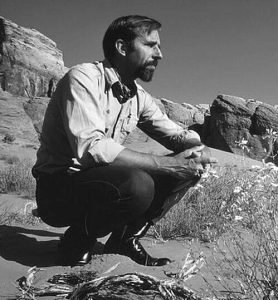
Pin Edward Abbey / Photo Courtesy of Wikimedia Commons
Synopsis: Edward Abbey never had much use for progress, at least not the kind that paved over canyons and called it civilization. Armed with nothing but a typewriter and a short temper, he spent his life picking fights with bulldozers, dams, and shopping malls. His most famous line — that growth for the sake of growth is the ideology of the cancer cell — has outlasted every highway project he ever cursed. Here is the story of the man who said it, and why the words still cut.
He did not write to be liked. He wrote to be right, and being right in the desert usually meant being alone. Long before every company with a recycling bin started talking about sustainability, this cranky ranger-turned-novelist was already telling anyone who’d listen that endless expansion had a bill coming due.
He lived rough, drank hard, and left behind a shelf of books that read less like literature and more like a dare. Readers who pick him up for the first time tend to finish a page, blink twice, and reach for the next one.
This is the story of the man who compared unchecked growth to a tumor, and never once took it back.
Table of Contents
A Farm Boy with a Grudge
Edward Abbey arrived on January 29, 1927, in Indiana, Pennsylvania, though he later cultivated the story that he’d actually been born in the smaller town of Home nearby, simply because the name suited him better. His father farmed the land and lectured on anarchism at the supper table; his mother taught school and kept music in the house. Between the two of them, the boy got an education no college catalog could list.
At seventeen, he left home to explore the American West, riding freight cars and sleeping wherever the ground was flat. The trip rearranged something in his skull. Cities had always struck him as crowded and dishonest; the open desert, by contrast, felt like the one place that never lied to him.
A few facts worth keeping in your back pocket:
- Grew up during the Depression in a house long on argument, short on cash
- Left home at seventeen to see the West firsthand
- Later studied philosophy at the University of New Mexico, where his master’s thesis carried the cheerful title “Anarchism and the Morality of Violence
- Served as a military police officer in Italy for two years before returning to his studies
Two Years in Uniform, Then Back to the Books
The draft caught up with him same as it caught up with most young men of his generation, and he spent 1945 to 1947 in the Army, stationed overseas as a military police officer in Italy. That stretch in uniform strengthened a distrust of authority and large institutions that would run through everything he wrote afterward.
The G.I. Bill paid his way to the University of New Mexico, and there he studied philosophy the way other men study a rival — closely, and with an eye for weakness. He earned two degrees and a Fulbright fellowship along the way, proof that a rebellious streak and a sharp mind can occupy the same skull without canceling each other out.
It was also in New Mexico that the Southwest sealed its hold on him for good. He’d tell people later it was love at first sight, the kind that doesn’t fade with age or familiarity, only deepens.
Sixteen Years Watching for Smoke
For sixteen years, on and off, Abbey worked as a seasonal park ranger and fire lookout for the National Park Service and the Forest Service. It was a strange sort of job — long stretches of silence broken by short bursts of purpose — and it suited him better than any classroom ever had.
Sitting alone in a fire tower gives a man plenty of time to think, and Abbey used that time to sharpen the arguments that would later fill his books. He watched, up close, the machinery of tourism and industry creeping into land that had gotten along fine without either.
Those seasons produced three early novels that drew little attention outside a small circle of readers. Patience, in his case, was about to pay off in a way nobody — least of all his publisher — quite expected.
The Book That Made His Name
In 1968, Abbey published Desert Solitaire, a memoir built from his seasons as a ranger in southeastern Utah. It read like nothing else on the shelf at the time — part journal, part sermon, part grumbling complaint against anyone who thought a paved road improved on a canyon.
The book turned him, almost overnight, into a figurehead for a movement he never asked to lead. Readers latched onto his descriptions of silence and struggle and raw, undecorated beauty, and they kept coming back for the grumbling too.
Robert Redford was among its admirers, later became a friend of Abbey’s, and helped carry his ideas about the American West to a wider audience. That’s a fair legacy for a man who mostly just wanted to be left alone with his canyons.
A Dam Worth Hating
Nothing sat worse with Abbey than the Glen Canyon Dam, a slab of concrete that drowned a stretch of red-rock canyon under Lake Powell. He treated it less like an engineering project and more like a personal insult, and he wasn’t shy about saying so in print.
The dam became his standing example of growth chasing growth with no thought for what got buried along the way. He’d seen the canyon before the water came, and he never forgave the trade.
That grudge didn’t stay confined to essays for long. It was about to walk straight into fiction, wearing a stick of dynamite.
The Novel That Started a Movement
In 1975, Abbey published The Monkey Wrench Gang, a novel following four unlikely saboteurs whose dream was to take down that very dam. He called the book a satire. Plenty of readers took it as an instruction manual, which says something about how convincingly he wrote it.
The novel helped popularize a new term — monkey-wrenching — for sabotage aimed at protecting wild land. In the story itself, the gang’s targets are machinery and property rather than people. Abbey drew that line carefully in his fiction, even if the term went on to a life of its own.
Key details from the novel’s legacy:
- Inspired the founding of the radical environmental organization Earth First!
- Helped popularize the term “monkey-wrenching” for sabotage in defense of wilderness
- Its gang targets machinery and property rather than people, within the novel’s own story
- Followed by a sequel, Hayduke Lives!, published posthumously in 1990
A Reluctant Figurehead
Abbey never much cared for the title of counterculture hero, and he made that plain every chance he got. He’d rather have been left to write and hike in peace, but the books had a way of dragging him into the spotlight anyway.
He responded to the attention the way he responded to most things — with a sharp aphorism aimed at whoever was listening. “Society is like a stew,” he liked to say. “If you don’t stir it up every once in a while, then a layer of scum floats to the top.”
He spent his career being called both a public nuisance and a moral compass, often by the same people in the same breath. He likely enjoyed the contradiction more than either label on its own.
More Than Twenty Books, One Consistent Grudge
Between his early novels and his later essays, Abbey produced more than twenty books over his career, a body of work that rarely strayed far from a single argument: that consumer culture was eating the American wilderness one highway and one subdivision at a time.
Fire on the Mountain, published in 1962, won him a Western Heritage Award and showed early flashes of the voice that would define Desert Solitaire six years later. Later works like Abbey’s Road and The Fool’s Progress kept the same fire burning, if a little more weathered.
He earned a Guggenheim Fellowship in 1975, the same year The Monkey Wrench Gang hit shelves — proof that the literary establishment respected him even while he spent his career needling it.
The Line About the Cancer Cell
Of all the lines Abbey ever wrote, one keeps getting quoted long after the rest have faded from memory: that growth for the sake of growth is the ideology of the cancer cell. It comes from his essay “The Second Rape of the West,” first published in Playboy in December 1975 and later collected in his 1977 book The Journey Home, on page 183.
Abbey’s own target was specific: real estate brokers and road builders turning the Arizona desert into another version of Los Angeles. His metaphor compares that kind of unchecked growth to a cancerous process — expansion that becomes an end in itself and eventually damages the very system it depends on.
The line has since traveled far past the desert where he first aimed it, showing up in debates about economics, city planning, and corporate strategy — mostly among people quoting a rebel who never expected to be so widely read outside his own turf.
A Grave with No Marker
Abbey died at his home in Tucson, Arizona, on March 14, 1989, at the age of sixty-two. His instructions to his friends were plain and entirely in character: no embalming, no coffin, no fuss, and a burial spot nobody would ever bother marking with a headstone.
His closest friends carried out those wishes to the letter. They wrapped him in his own sleeping bag, packed the truck with dry ice and a few cases of beer, and drove into the desert until they found ground that felt right, then dug the grave themselves.
It was, by every account, exactly the send-off he would have written for himself — quiet, unofficial, and a little bit illegal.
Why the Argument Still Holds Up
Decades on, the debates Abbey picked haven’t gone anywhere. Cities still spread outward without much of a plan, companies still chase quarterly growth like it’s an end in itself, and somebody, somewhere, is still arguing that another dam or another highway counts as progress.
His readers keep finding him because he asked the one question most growth projects would rather skip: growth toward what, exactly, and at whose expense? A cancer cell never answers that question either, which was precisely his point.
He’s buried without a marker, but the line he left behind marks plenty of arguments all on its own, decades after the man who wrote it stopped needing to defend it in person.
FAQs
He’s best known for Desert Solitaire (1968) and The Monkey Wrench Gang (1975), two books that shaped modern environmental writing and activism.
It’s from his 1975 essay “The Second Rape of the West,” collected in his 1977 book The Journey Home, page 183.
His novel helped popularize the term “monkey-wrenching” and inspired Earth First!, though within the story itself, the gang targets machinery, not people.
In an unmarked grave in the Arizona desert, exactly as he requested — no headstone, and the exact spot was never publicly disclosed.
Just a writer, though a former park ranger and philosophy graduate — his authority came from watching the land up close, not a lab.










 Login with Google