




















 Pin
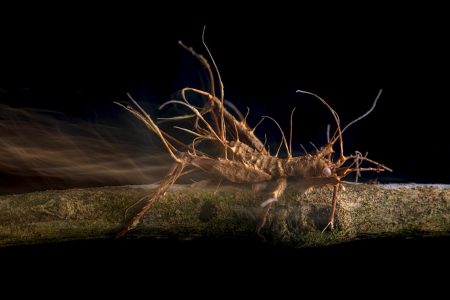
Pin Entomopathogenic Fungi / Courtesy of Roberto Gracia
Synopsis: The natural world harbors creatures that behave like the undead from our darkest nightmares. These organisms hijack nervous systems, rise from apparent death, and consume their victims from the inside out. While Hollywood invented fictional monsters, evolution created real parasites and predators with abilities far stranger than any screenplay. Scientists continue discovering how these extraordinary animals manipulate biology in ways that blur the line between life and death. Their survival strategies reveal nature’s capacity for creating truly horrifying yet fascinating phenomena.
You’ve probably watched zombie movies and thought they were pure fiction. But nature has been perfecting the art of the undead long before humans ever picked up a camera. Real creatures exist right now that control minds, reanimate corpses, and turn living beings into mindless slaves.
These aren’t mutants from a laboratory accident. They’re the result of millions of years of evolution pushing survival instincts to their absolute limits. What makes them even more unsettling is that they’re not rare exceptions—they’re thriving in ecosystems around the globe, right now as you read this.
The biology behind these zombie animals in real-life reveals something profound about nature itself. Life doesn’t play fair, and sometimes the most successful organisms are the ones that learned to hijack, manipulate, and control others. Let’s meet ten of the most chilling examples that actually exist on our planet today.
Table of Contents
1. Zombie Ant
 Pin
Pin Courtesy of Ooi Bak Kheang
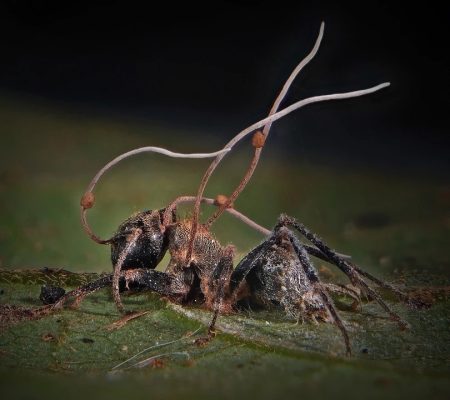
Deep in tropical rainforests, ants go about their daily business until a microscopic horror takes control. The Ophiocordyceps unilateralis fungus infects carpenter ants through spores that latch onto their exoskeletons. Once inside, the fungus doesn’t just kill—it commandeers the ant’s entire nervous system like a sinister puppeteer pulling invisible strings.
The infected ant begins acting strangely within days. It abandons its colony and climbs upward, drawn by an urge it cannot resist. Scientists believe the fungus manipulates the ant’s perception of light and height, forcing it to scale vegetation until it reaches the perfect spot. This location isn’t random—it’s exactly where humidity and temperature conditions allow the fungus to thrive.
Then comes the final act. The ant clamps its jaws onto a leaf or twig in what’s called the “death grip,” locking itself in place with such force that it cannot let go even after dying. Within days, a fruiting body erupts from the ant’s head like something out of a horror film, releasing spores onto unsuspecting ants below. The cycle begins again, turning entire ant populations into fungal farms.
2. Zombie Cockroach
 Pin
Pin Entomopathogenic fungus infected Cockroach / Courtesy of Prathamesh Ghadekar
The emerald jewel wasp is beautiful to look at, but its hunting technique is the stuff of nightmares. This tiny predator has evolved one of nature’s most precise forms of mind control. When it encounters a cockroach, the wasp delivers not one but two calculated stings with surgical accuracy that would make a neurosurgeon jealous.
The first sting temporarily paralyzes the roach’s front legs, preventing escape. The second sting is where things get truly disturbing. The wasp injects venom directly into the cockroach’s brain, specifically targeting the regions that control the escape reflex. The roach remains alive and fully capable of moving, but it has completely lost the will to run away or defend itself.
What happens next looks like a scene scripted for maximum horror. The wasp grabs one of the cockroach’s antennae and leads it like a dog on a leash to a nearby burrow. Once inside, the wasp lays a single egg on the roach’s abdomen, then leaves and seals the entrance. The cockroach just stands there while the wasp larva hatches and begins eating it alive, carefully avoiding vital organs to keep its food fresh for as long as possible.
3. Zombie Mouse/Rat
Toxoplasma gondii might be one of the most successful parasites on Earth, infecting roughly one-third of all humans. But its most dramatic effects show up in rodents, where it performs a truly diabolical trick. This single-celled organism needs to get inside a cat to complete its reproductive cycle, so it does something unthinkable—it makes mice and rats attracted to cat urine.
Healthy rodents have a hardwired fear of cat odors because cats are their primary predators. This fear is so deeply ingrained that it’s almost impossible to overcome through normal means. But Toxoplasma doesn’t play by normal rules. Once it infects a rodent’s brain, it forms microscopic cysts in regions that control fear and arousal, essentially rewiring the animal’s survival instincts.
Infected rodents not only lose their fear of cats but actually become sexually attracted to the smell of cat urine. They wander into dangerous areas, linger near cats, and basically offer themselves up as meals. When a cat eats the infected rodent, the parasite finally reaches its destination and reproduces inside the cat’s intestines. The offspring then exit through the cat’s feces, ready to infect new hosts and start the zombie cycle all over again.
4. Zombie Fly
 Pin
Pin Courtesy of Nature the Journal
The Entomophthora muscae fungus has perfected the art of turning flies into unwitting accomplices in their own species’ destruction. When a fly becomes infected, the fungus grows quietly inside its body for several days, feeding on the fly’s internal organs while the insect goes about its normal activities, completely unaware of the doom growing within.
As the infection progresses, the fungus begins producing chemicals that alter the fly’s behavior in very specific ways. The infected fly becomes increasingly attracted to high surfaces and bright light. In its final hours, the fly climbs upward—onto a leaf, a blade of grass, or a window—driven by an urge it cannot understand or resist.
Then death arrives with theatrical flair. The fly extends its proboscis fully and dies in this position, stuck to the surface with its wings spread. The fungus erupts through the fly’s body, particularly through the gaps between its body segments, releasing a shower of spores into the air. Any fly that passes nearby becomes coated in these spores, ensuring the next generation of zombies. The dead fly remains glued in place for days, a gruesome billboard advertising the fungus’s success.
5. Zombie Fish
Parasitic worms like Diplostomum have developed a clever but cruel strategy for completing their life cycle. These tiny parasites need to get inside a bird to reproduce, but they start their lives inside fish. The solution? Turn the fish into an easy meal by destroying its ability to hide and escape.
When these worms infect a fish, they migrate to its eyes and brain, causing visible black spots under the skin. But the real damage happens in the fish’s nervous system. The infection disrupts normal swimming behavior, making the fish dart erratically near the water’s surface, spin in circles, or swim in strange patterns that make it stand out like a neon sign to predatory birds.
Healthy fish instinctively stay in deeper water or near cover where birds can’t easily snatch them. Infected fish lose this survival instinct entirely. They become reckless, swimming in exposed areas during broad daylight, making themselves impossibly easy targets. When a bird finally eats the infected fish, the parasite reaches its goal and reproduces inside the bird’s digestive system. The eggs exit through the bird’s droppings, contaminate the water, and the horrifying cycle continues.
6. Zombie Cricket
 Pin
Pin Courtesy of Iris Copen
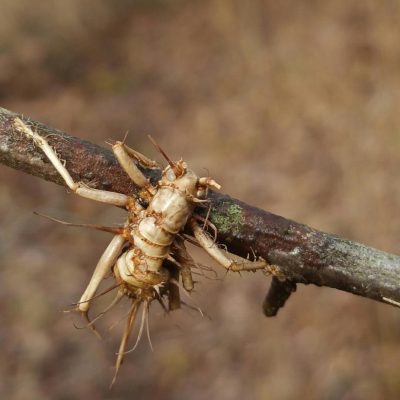
Hairworms are among nature’s most patient zombifiers. These thin, thread-like parasites can live inside crickets and grasshoppers for weeks or even months, growing larger while their host goes about its business. But when the worm finally matures and needs to reproduce, it must return to water—and it forces the cricket to deliver it there personally.
The mechanism behind this mind control remained mysterious for years, but scientists now believe the worm produces proteins that interfere with the cricket’s central nervous system. Crickets normally avoid water because they can’t swim and will drown. Yet infected crickets suddenly develop an overwhelming compulsion to seek out water, abandoning all their natural caution and self-preservation instincts.
When the doomed cricket reaches a pond, stream, or even a puddle, it jumps in without hesitation. Once submerged, the hairworm exits the cricket’s body in a grotesque emergence that can take several minutes. The worm, which can be several times longer than its host, writhes away into the water to find a mate and reproduce. The cricket, its purpose fulfilled, drowns or becomes easy prey for fish. The worm cares nothing for its host’s fate—it got exactly what it needed.
7. Zombie Snail/Bird
The parasitic flatworm Leucochloridium paradoxum executes one of nature’s most visually disturbing manipulations. Its life cycle requires moving through both snails and birds, so it’s developed a strategy that’s equal parts brilliant and nauseating. After a snail ingests the parasite’s eggs, the worm grows inside the snail’s body and eventually migrates to an unusual location—the snail’s eyestalks.
Once there, the parasite doesn’t just hide. It transforms the eyestalks into throbbing, colorful tubes that pulse rhythmically and look remarkably like caterpillars. The worm even manipulates the snail’s behavior, forcing it to climb out of its normal dark, moist hiding places and venture into bright, open areas where birds are hunting.
Birds love caterpillars, and the pulsating eyestalks are too tempting to resist. When a bird swoops down and tears off the infected eyestalk, the snail survives but the parasite achieves its goal—it’s now inside the bird where it can reproduce. The eggs pass through the bird’s digestive system and exit in droppings, which snails then consume while feeding. The cycle repeats, creating more zombie snails with hypnotic, fake caterpillar eyes.
8. Rabid Mammals
Long before anyone coined the term zombie, people witnessed rabies turning mammals into aggressive, unpredictable versions of themselves. This ancient virus attacks the brain and nervous system, causing behavior changes that seem designed to spread the infection as efficiently as possible. Rabid animals become either furiously aggressive or paralyzed and docile, but both forms are equally deadly.
The aggressive form creates what many consider the original zombie. Infected foxes, dogs, bats, and other mammals lose their fear of humans and other animals. They become irritable, confused, and prone to biting anything that moves. The virus concentrates in their saliva, ensuring that every bite has a high chance of spreading the infection. Foaming at the mouth occurs because the throat muscles become paralyzed, preventing swallowing.
What makes rabies particularly terrifying is how it changes personality and behavior so dramatically. A friendly dog becomes vicious and unrecognizable. Wild animals that normally flee humans instead wander into neighborhoods and attack without provocation. The virus literally hijacks the host’s brain, turning it into a delivery system for spreading more infections. Without treatment, rabies is almost 100% fatal once symptoms appear, making it one of the deadliest zombie-creating pathogens in existence.
9. Parasitized Termites
Certain fungi have evolved to target termites, social insects that live in massive underground colonies. When these fungi infect individual termites, they don’t work alone—they take over entire sections of the colony, creating what scientists call zombie clusters. The infected termites stop performing their normal duties and instead gather together in specific areas.
These zombie termites become living incubators for the fungus, which grows throughout their bodies while keeping them technically alive. The infected insects stop eating, stop communicating normally with nestmates, and essentially become stationary fungal gardens. Their only purpose now is to allow the fungus to grow and eventually produce spores.
The fungus benefits from keeping multiple hosts alive in close proximity because it increases the chances of spreading to other termites. When the fungus finally fruits and releases spores, it can infect dozens or even hundreds of termites at once. The colony tries to isolate these infected members, but the fungus often spreads faster than the termites can contain it, slowly converting more of the colony into zombie workers serving the fungus’s needs rather than their own.
10. Zombie Cicada
The Massospora fungus saves its most disturbing trick for cicadas, turning them into what scientists call “flying saltshakers of death.” When a cicada becomes infected, usually after emerging from years underground, the fungus begins consuming the insect’s abdomen. Within days, the entire rear section of the cicada’s body is replaced by a plug of white or yellow fungal spores.
Here’s where it gets truly bizarre—the cicada doesn’t die. It continues flying, singing, and attempting to mate despite having lost a third of its body to fungus. The infection even appears to increase the cicada’s energy and mating drive, making infected males more active than healthy ones. Some infected males even mimic female mating signals to attract other males, a behavior never seen in healthy cicadas.
As the zombie cicada flies around, the fungal plug crumbles and releases spores with every movement. Each flight spreads millions of spores that coat other cicadas, vegetation, and the ground below. The fungus also produces chemicals that may act like amphetamines, keeping the cicada hyperactive and ensuring it spreads spores far and wide before finally dying. It’s one of nature’s most efficient and disturbing methods of creating an undead carrier that spreads death while appearing almost normal.
FAQs
Most are species-specific, but Toxoplasma gondii does infect humans. It rarely causes obvious symptoms in healthy people, though pregnant women and those with weak immune systems should avoid cat litter boxes where the parasite spreads.
Dead hosts stop moving and spreading the parasite. Zombie hosts walk, fly, or swim to exactly where the parasite needs to go next, making them far more useful alive than dead for completing complex life cycles.
No credible evidence suggests this is possible. These parasites evolved over millions of years to target specific species. Jumping to humans and controlling our complex brains would require evolutionary changes so massive they’re essentially impossible.
Rabid mammals are the most dangerous zombie animals in populated areas. If you see any wild animal acting strangely friendly or aggressive, especially during daytime, stay far away and contact animal control immediately.
Scientists are studying how parasites control behavior to develop better treatments for brain disorders and mental health conditions. Understanding natural mind control might help us treat Parkinson’s, depression, and other neurological problems.









 Login with Google