





















 Pin
Photo Courtesy of parisbypierre
Synopsis: Under Paris lies a hollow second city of old limestone quarries, and in one small corner of it rest the bones of around six million people. The tunnels were dug for building stone, propped up after a street swallowed several houses in 1774, and filled with the dead of overflowing graveyards from 1786. Later came wartime hideouts, secret parties and a very well-furnished illegal cinema.
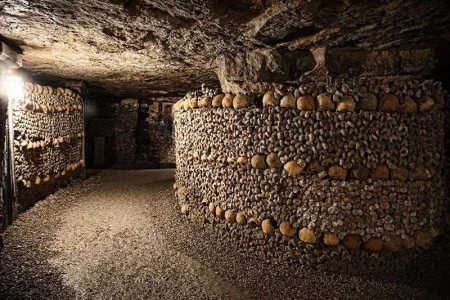
Most cities keep their dead in the ground and hope for the best. Paris went a different way and kept them in the basement, neatly shelved. A few storeys below the busy streets of the 14th arrondissement, the skulls and thigh bones of around six million people sit in tidy walls, the kind of tidy that suggests somebody had strong opinions about femurs.
The Paris Catacombs are an ossuary, which is a polite word for a room built to hold bones. It is one of the biggest in the world, yet it fills only a small slice of a far larger maze of old quarry tunnels. Parisians often use the word “catacombs” for the whole maze, which is a bit like calling a whole house “the bathroom”.
A few quick facts before going deeper:
- Location: south of central Paris, near Place Denfert-Rochereau
- Depth: about 20 metres (65 feet) underground
- Public route: roughly 1.5 km of walkway
- Whole tunnel network: hundreds of kilometres, with estimates ranging from about 200 to 300 km
- Original purpose: limestone quarries, not tombs
Table of Contents
Why Is Paris Hollow? Limestone Quarries and the 1774 Sinkhole
 Pin
Photo Source Instagram
Forty-five million years ago, a warm tropical sea covered the ground where Paris now stands. When it drained away, it left limestone, a fine pale stone that is easy to cut and handsome once cut. The Romans carved it, and later builders used it for Notre-Dame, the Louvre and a long list of other famous buildings.
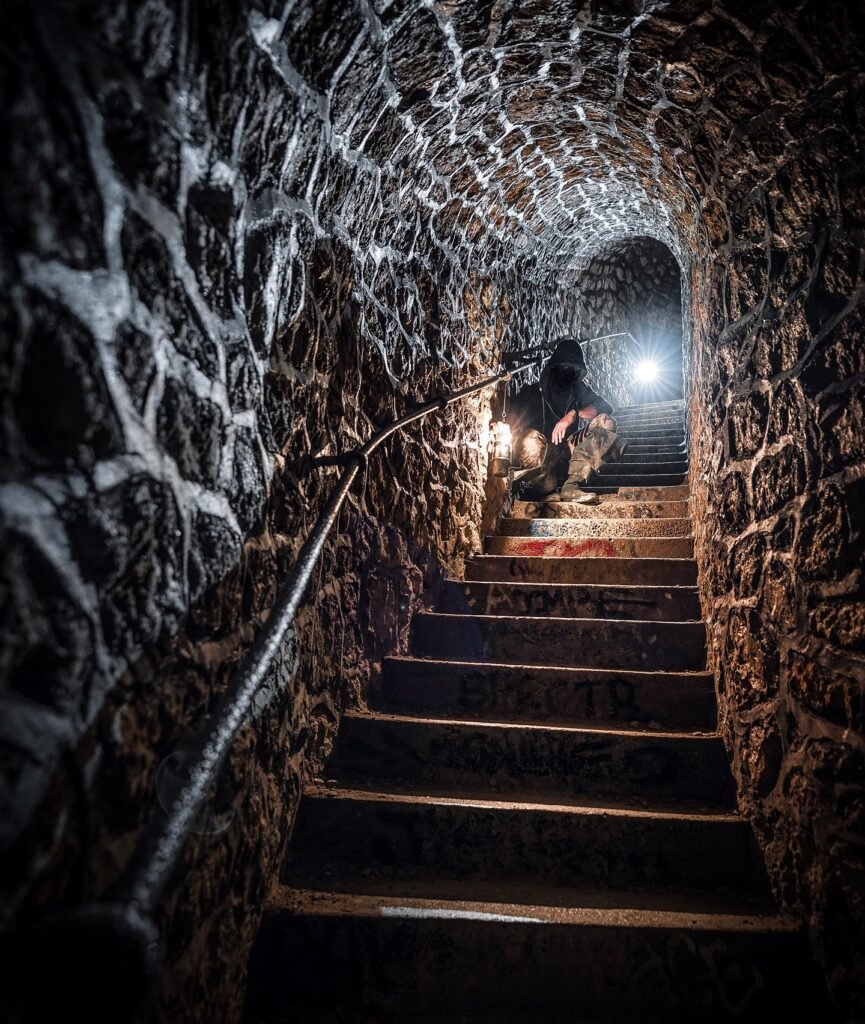
Digging stone leaves holes, and nobody had been keeping a tally. The city carried on building above the gaps with the calm confidence of a man standing on a trapdoor. In December 1774, a stretch of the Rue d’Enfer, whose name means Hell Street, gave way and swallowed houses and the people inside them. The street’s name did not help matters.
King Louis XVI answered by creating the Inspection Générale des Carrières, a service to map and prop up the underground. Its head, Charles-Axel Guillaumot, spent years documenting the empty spaces and building support pillars. Paris had finally noticed its own basement, and the inspectors would soon find a use for it.
Why Did Paris Move Its Dead? The Overflowing Cemetery of the Innocents
 Pin
Photo Source Instagram
In the middle of Paris sat the Cemetery of the Holy Innocents, used since the Middle Ages. The dead of eighteen parishes, two hospitals and the city morgue all ended up there. One estimate puts the total at about two million burials over some six hundred years, which is a lot of people for a patch of ground that never got any bigger.
By the late 1700s the place had become a health problem, and the neighbours knew it. The cemetery was closed in 1780, and Louis XVI later banned burials inside the city altogether. The living wanted their dead somewhere else, preferably somewhere large, quiet and out of smell range.
The repaired quarries ticked every box. Here is how the timeline looked:
- 1774: the Rue d’Enfer collapses
- 1780: the Innocents cemetery closes
- 9 November 1785: the quarries are officially chosen as the new home for the bones
- 7 April 1786: the site is blessed
How Millions of Bones Were Moved Underground: The Night Carts of 1786
 Pin
Photo Source Instagram
On 7 April 1786, the old Tombe-Issoire quarries were blessed and became the Paris Municipal Ossuary. The name “catacombs” arrived soon after, borrowed from the Roman burial tunnels that had the public thoroughly fascinated at the time. It sounded grander than “former rock hole”.
The moving itself happened after dark. Carts draped in black rolled through the streets and carried bones out toward the southern edge of the city, where workers tipped them down a shaft and stacked them in the galleries below. Emptying the Innocents alone took about two years, and bones from other cemeteries kept arriving for decades, with the last deposits made around 1860 during Haussmann’s rebuilding of Paris.
The early result was less a memorial and more a very large, very serious pile. Nobody had planned for the people who would later want to look at it.
Who Turned the Bone Pile Into a Museum? Héricart de Thury’s Makeover
 Pin
Louis-Étienne Héricart de Thury / Photo Courtesy of Horizon Dwellers
The man who dealt with the pile was Louis-Étienne Héricart de Thury, who took over the quarry inspection service in 1810. He decided the ossuary should be a place fit for visitors and quiet thought, not a heap of leftovers. The public had been allowed in by appointment since 1809, and he set about giving them something worth the trip.
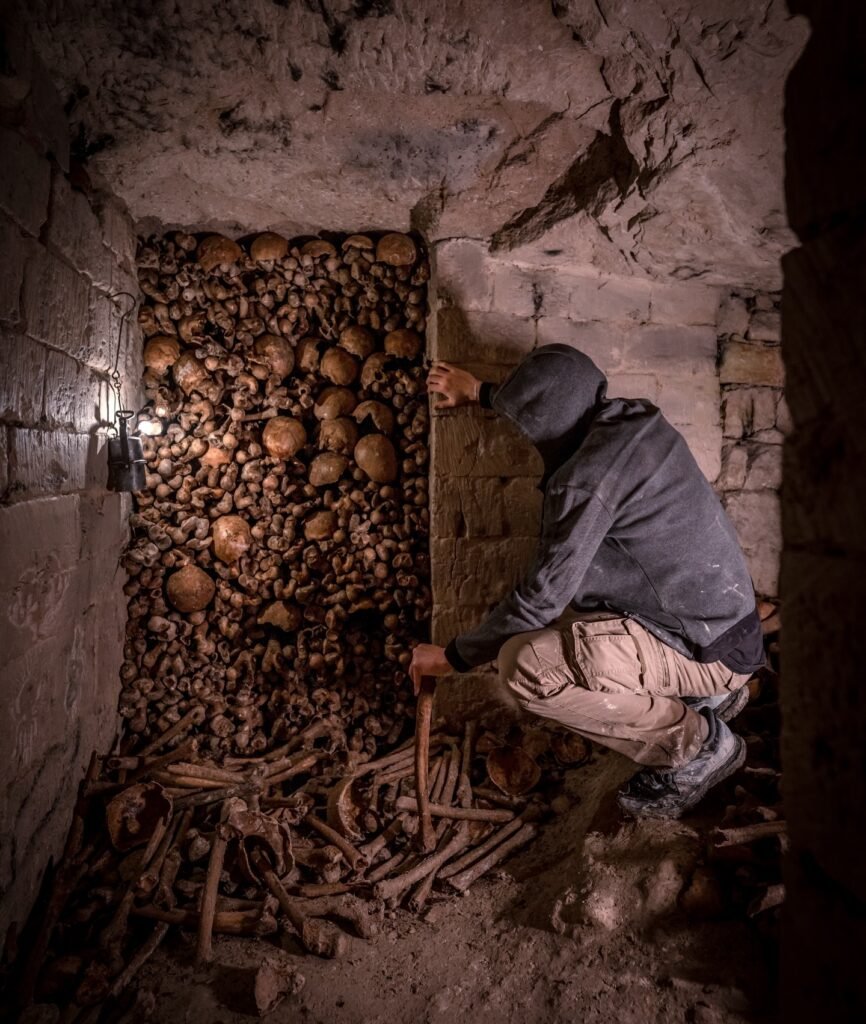
Under his direction, thigh bones and shin bones were lined into walls, with skulls set in patterns, and signs recorded which cemetery each lot came from. Doric columns and classical touches gave the place the air of an ancient temple. Over the entrance went a warning that remains famous: “Arrête! C’est ici l’empire de la Mort”, meaning “Stop! This is the empire of Death”. It is not a welcome mat.
Visits stayed rare for a long time. Records show four a year around 1850 and monthly by 1867. Today the same man’s voice, recreated for the new 2026 audio guide, leads visitors through his own work.
What’s Inside the Ossuary? The Barrel, the Crypts and the Port-Mahon Carvings
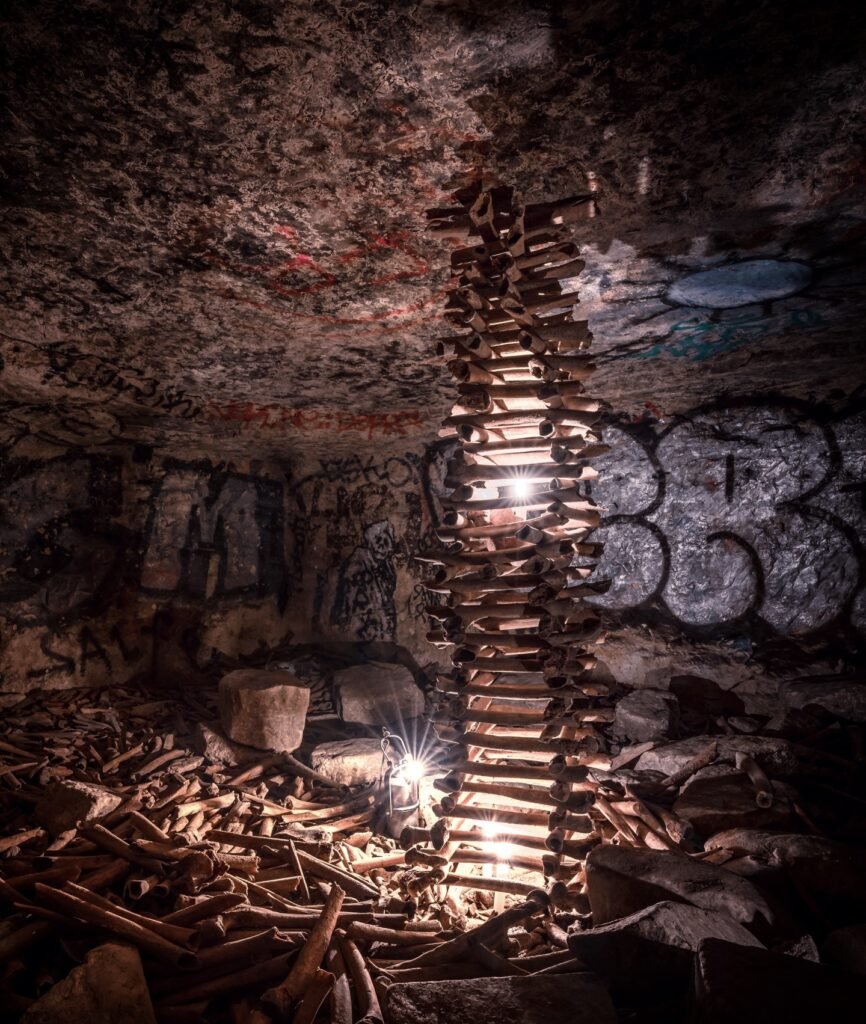
The public route holds a handful of rooms that visitors tend to remember. The best known is the Crypt of the Passion, also called the Tibia Rotunda, where a supporting pillar is hidden under skulls and shin bones arranged in the shape of a barrel. It is part decoration and part engineering, which is the most Parisian sentence ever written about bones.
Near the start, small stone models of a fortress are carved into the limestone. They were made by Décure, a quarry worker and former soldier of Louis XV’s army, who shaped the Port-Mahon fortress from memory while working by torchlight. He died in a tunnel collapse before he could finish.
Other things to look for:
- The Sepulchral Lamp crypt and the Samaritaine fountain
- Gilbert’s Tomb, which carries a verse and also hides a structural reinforcement
- A room that displays Paris minerals and another showing skeletal deformities
- A night concert held in the Crypt of the Passion on 2 April 1897
Who Is Buried in the Catacombs? Famous Names and Nameless Millions
Almost everyone down there is anonymous. The bones came from parish cemeteries, hospitals and the morgue, and during the move they were mixed together by the cartload. The Innocents supplied by far the largest share, while the cemetery of Saint-Étienne-des-Grès is counted among the oldest to contribute. Nobody can sort one skull from another, and nobody has tried for a long time.
A few famous names are listed among the moved remains. They include the chemist Antoine-Laurent de Lavoisier and several others who died during the French Revolution in 1794, among them Marie-Jean Hérault de Séchelles and Lucile Duplessis, widow of Camille Desmoulins. Where exactly they lie is another matter.
The ossuary does hold one tombstone, which belongs to a woman named Françoise Gellain. She is, in a sense, the only resident with a front door, in a building of six million.
Hidden Tunnels Under Paris: Cataphiles, “Cataflics” and the Secret Cinema of 2004
The public route is a tiny fraction of the underground. The rest is off-limits, which has never stopped a determined crowd of urban explorers known as cataphiles. Over the decades they have found their own ways in and left behind carved benches, sculptures, painted walls and graffiti, some of it older than anyone’s great-grandparents. Entering the restricted tunnels is risky as well as forbidden, with flooding and unstable ground among the hazards.
The police have a unit for this. Known as ERIC, and nicknamed “cataflics” by the locals, its officers patrol with maps, lights and dry clothes, because in some galleries the water reaches chest height.
In August 2004, officers on a training exercise stumbled on a cavern beneath the Palais de Chaillot with a screen, seats, a projector, a bar, a restaurant corner, electricity and three phone lines. When police returned days later, it had been dismantled, and a message was left behind asking not to be looked for.
Dark Secrets, Myths and Wartime Stories of the Tunnels
Legends grow fast in the dark. One says there are vast secret cemeteries under Paris, but the evidence does not back it up. The bones are in the known ossuary, and the hidden parts of the network are mostly empty quarry, flooded corridors and the odd decorated room. Stories of Revolution-era meetings and shadowy gatherings are told often and proven rarely.
The war stories are better documented. During the liberation of Paris in 1944, members of the French Resistance used the tunnel system, and Colonel Henri Rol-Tanguy ran the uprising from a command post in the Denfert-Rochereau area. His preserved bunker can still be seen at the Museum of the Liberation of Paris, and the avenue outside the ossuary entrance carries his name. German forces built their own bunker under a school in the 6th arrondissement.
Getting lost is the oldest danger. Early visitors followed a black line painted on the ceiling, the one guide that did not go out when a candle did.
Facts About the Catacombs That Surprise Most Visitors
A few details tend to catch even well-read visitors off guard. The temperature stays at a steady 14°C (57°F) all year, so the tunnels feel cold on a hot August afternoon and merely cool in January. Underground, the weather has given up.
The numbers are big, but the humans behind them were practical. The ossuary itself covers about 11,000 square metres, and it was set up by officials trying to solve a public health problem, not to create a tourist attraction. The attraction came along later, as these things do.
More small surprises:
- The Rue d’Enfer, scene of the 1774 collapse, later became Place Denfert-Rochereau, and the name still sounds a bit like “Hell”
- Farmers have grown mushrooms in disused quarries around the city, which like cool, dark, steady air
- The Paris quarries gave the stone for Notre-Dame and the Louvre
- Visitors’ bags are checked on the way out, so nobody leaves with a souvenir that used to be a person
How to Visit the Catacombs: Tickets, Opening Hours and Tips
The site closed in November 2025 for renovation work meant to protect the structure, improve air quality and cut humidity. It reopened on 8 April 2026 with a new route and a new audio guide. The basics below were reported at the time of writing, so confirm everything on the official site, catacombes.paris.fr, before booking.
- Entrance: 1 avenue du Colonel Henri Rol-Tanguy, 14th arrondissement; exit at 21 bis avenue René-Coty
- Hours: Tuesday to Sunday, 9:45 am to 8:30 pm, last entry 7:30 pm; closed Mondays and some holidays
- Tickets: about €31 for adults, €25 for ages 18 to 26, €12 for ages 5 to 17, sold online only, up to seven days ahead
- The walk: 131 steps down, 112 steps up, around 1.5 km, about 45 to 60 minutes
- Access: no lift, not wheelchair accessible, no strollers
Visitors should pack a jumper, wear sturdy shoes and book the moment the window opens, since slots sell out in busy months. Third-party tickets and guided tours cost more but can still be available when the official site has sold out. And the sensible way to see the hidden tunnels is the one with the audio guide.
FAQs
Around six million, mostly moved from overflowing city cemeteries between 1786 and about 1860. Most are nameless, and their bones were mixed together long ago.
No proof exists. The setting does most of the haunting by itself: a steady 14°C, low light and long walls of skulls. Visitors mostly report cold feet and a very quiet group.
No. Only about 1.5 km is open to the public. The rest is restricted, can flood or collapse, and is patrolled by a special police unit. The official route is the safe way in.
Plan 45 to 60 minutes along 1.5 km. Visitors go down 131 steps and climb 112 on the way out. There is no lift, and the site is not wheelchair accessible.
City cemeteries like the Innocents had become overcrowded and unhealthy, and burials inside Paris were banned. The quarries were empty, outside the old city gates and already strengthened after the 1774 collapse.









 Login with Google