




















 Pin
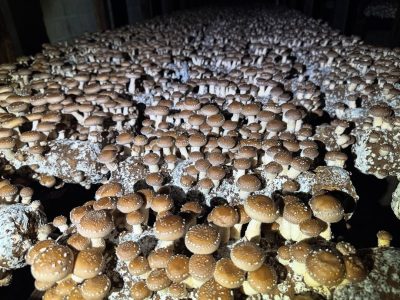
Pin Shiitake Mushrooms / Photo courtesy of Mountain Meadow Mushroomfarms
Synopsis: China feeds roughly one-fifth of the world’s population on less than ten percent of Earth’s arable land. The crops making that possible aren’t mysterious superfoods hyped on social media — they’re real, deeply rooted in Chinese soil, culture, and centuries of farming instinct. From crunchy lotus roots pulled from muddy ponds to garlic fields that supply most of the planet, this list cuts through the noise and shows what China actually grows — and why it matters far more than any viral rumor ever could.
The internet has a fondness for China’s agriculture that borders on mythology. Giant vegetables bred in secret. Synthetic rice pressed from plastic. Fruits engineered by shadowy laboratories. The stories spread fast, get shared widely, and carry that satisfying whiff of scandal that makes people forward things without thinking twice.
The actual fields, however, are less dramatic and considerably more interesting. China sits on a stretch of land that holds every climate a farmer could ask for — tropical coastlines in the south, brutal desert in the northwest, fertile river plains in the middle, and freezing steppes up north. A country that size doesn’t need conspiracy to grow an extraordinary variety of food. It just needs soil and sense.
What follows is a plain account of fifteen crops China grows at a scale that genuinely deserves attention — not because they’re strange, but because they’re real, they’re remarkable, and the story behind each one has been sitting in plain sight all along, waiting for someone to look past the rumors.
Table of Contents
1. Asian Pear
 Pin
Pin Photo courtesy of Food Lovers Farm
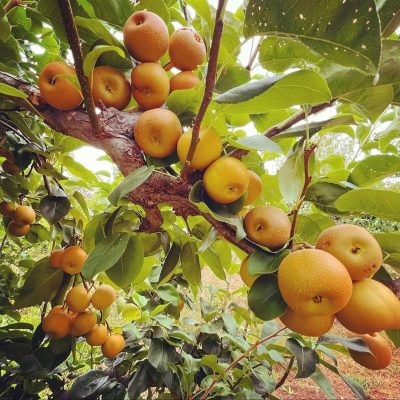
A person who has only ever eaten a Western pear might be forgiven for expecting all pears to behave the same way — soft, yielding, prone to bruising if you look at them wrong. The Asian pear (Pyrus pyrifolia) has no patience for that kind of fragility. It stays firm when ripe. It holds its shape through handling, shipping, and storage without complaint.
A pear that travels badly is a pear that doesn’t sell. The Nashi pear — as it’s also known — was developed over generations to be reliable: consistent sweetness, crisp bite, and a shelf life that lets it move from orchard to distant market without turning to mush along the way.
China grows more Asian pears than any other country on the planet, and the fruit earns its place in the kitchen as much as the fruit bowl. It goes into soups, juices, and slow-simmered broths. In traditional Chinese households, a pear broth sweetened with rock sugar has long been the first thing offered to someone suffering a dry winter cough — a remedy older than most modern medicine cabinets.
Key facts:
- Stays firm and crisp even when fully ripe
- Selectively bred over generations for transport and shelf life
- Used in cooking, juicing, and traditional medicinal broths
2. Bok Choy
 Pin
Pin Photo courtesy of Hitchcock Farms
There is a kind of vegetable that feeds a nation not through glamour but through sheer dependability, and bok choy (Brassica rapa subsp. chinensis) is exactly that kind of vegetable. It grows fast, asks for little, survives in more climates than most crops dare to attempt, and ends up on the table in some form nearly every day across hundreds of millions of Chinese households.
Under favorable conditions, bok choy moves from seedling to harvest in as few as 45 days. That speed matters enormously in agriculture — a quick crop means more rotations per season, more income per plot of land, and more food moving into markets without long waits. Farmers in both humid southern provinces and cooler northern regions grow it reliably, which makes it one of the most geographically flexible vegetables in the entire country.
Nutritionally, it carries more than its price suggests. Vitamins C and K show up in solid quantities, alongside calcium and a range of antioxidants. Stir-fried with garlic and a splash of oyster sauce, braised until tender, or dropped into a clear broth at the last moment — bok choy accommodates every method without making a fuss, which is exactly why Chinese cooks have trusted it for centuries.
Key facts:
- Harvest-ready in as little as 45 days from seedling
- Grows across multiple climate zones throughout China
- High in vitamins C and K, calcium, and antioxidants
3. Ponkan Mandarin
 Pin
Pin Photo courtesy of Ward’s Berry Farm
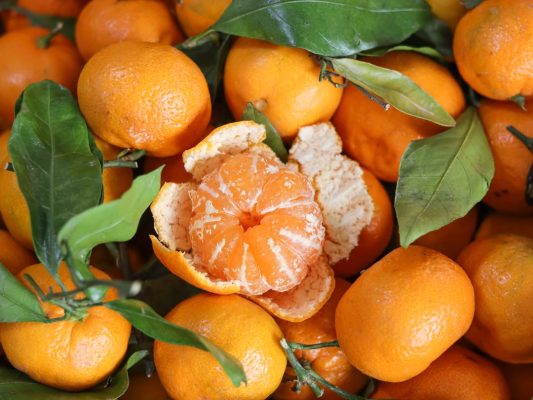
Some fruits require patience — knives, peelers, stained fingers, the particular frustration of pith that clings like it has personal reasons. The Ponkan mandarin (Citrus reticulata) asks for none of that. Its skin sits loose over the flesh, separating cleanly with minimal effort, as though the fruit was designed with the eater’s convenience specifically in mind.
Ponkan ripens across southern China — Fujian, Guangdong, and Sichuan among the leading provinces — and it chooses its moment well. The fruit comes into season in late autumn and early winter, arriving just as temperatures drop and people find themselves wanting something bright, sweet, and easy to eat without ceremony. Markets fill with it at exactly the right time of year.
Chinese growers have developed hybrid cultivars that push the sugar content higher while keeping the loose peel that makes the variety worth buying in the first place. Those improvements have made Ponkan a genuine export contender — Southeast Asian markets know it well, and Western grocery stores have started carrying it in places where Clementines once had the easy-peel segment entirely to themselves.
Key facts:
- Loose skin separates cleanly — no knife or peeler required
- Ripens in late autumn, naturally timed for cold-weather snacking
- Hybrid cultivars developed for higher sweetness and export quality
4. Chinese Long Chili
 Pin
Pin Photo courtesy of Khir Johari
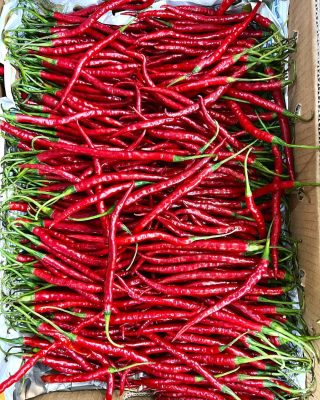
Not every chili is trying to make a point. The Chinese long chili (Capsicum annuum var. longum) brings heat that registers, lingers pleasantly, and then lets the rest of the dish speak — the kind of warmth that adds dimension rather than dominance. It is the working chili of Chinese cooking, present daily in Sichuan stir-fries, Hunanese dry-fried meats, and pickled vegetable preparations across half the country.
High-yield hybrid varieties have made it an agricultural workhorse. A single plant produces generously across a long growing season, which is why farmers in Hunan, Sichuan, and Guizhou — provinces where chili isn’t optional, it’s structural — grow it in serious volume. The economics are favorable, the demand is consistent, and the plant doesn’t require coddling.
Drying extends its usefulness well beyond the fresh harvest window. Dried Chinese long chili ends up crushed into chili oil, blended into spice pastes, and preserved in fermented sauces that sit on Chinese tables year-round. The chili oil revolution that captured Western kitchens in recent years drew heavily from this tradition — the long chili, dried and infused into oil, is the quiet engine behind condiments that now ship around the world.
Key facts:
- Mild-to-medium heat suited for everyday cooking
- High-yield hybrids support mass cultivation across multiple provinces
- Dried form used in chili oils, pastes, and fermented condiments
5. Chinese Eggplant
 Pin
Pin Photo courtesy of John Vena Inc.
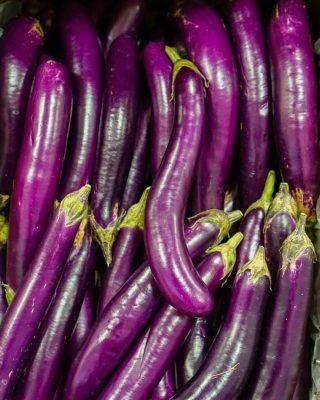
The globe eggplant familiar to Western cooks is a sturdy, thick-skinned thing that often requires salting, waiting, and a certain amount of patience before it cooperates in the kitchen. The Chinese eggplant (Solanum melongena) was bred with fewer of those requirements. It is long, slender, pale purple, and thin-skinned — and it goes straight into the wok without any of the preparatory persuasion its Western cousin demands.
The bitterness difference is significant. Globe eggplant contains higher concentrations of bitter alkaloids that standard preparation techniques aim to draw out. Chinese eggplant carries less of that compound naturally, which means the cook saves time and the dish tastes cleaner. Under high heat, the flesh collapses into something silky — absorbing garlic, ginger, doubanjiang, and soy sauce the way a good sponge absorbs water, evenly and completely.
Generations of selection have produced a vegetable optimized not for appearance in a grocery bin but for performance in a hot wok. Chinese home cooks keep it in the refrigerator as a reliable weeknight option — something that can become a proper dish in under ten minutes, with ingredients most kitchens already have on hand.
Key facts:
- Thin skin and low bitterness — no pre-salting required
- Silky texture under high heat; absorbs flavor deeply
- Bred for wok performance across generations of selective cultivation
6. Chinese Sweet Potato
 Pin
Pin Photo courtesy of マサコ アーント from Pixabay
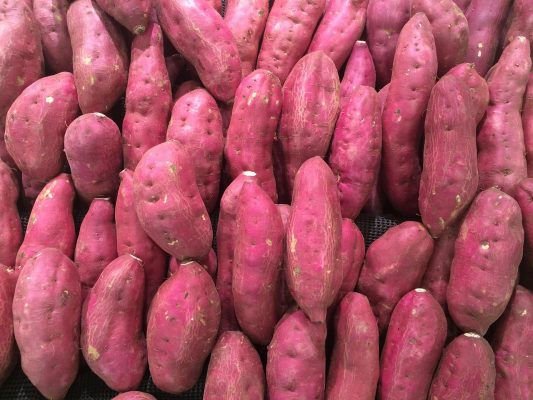
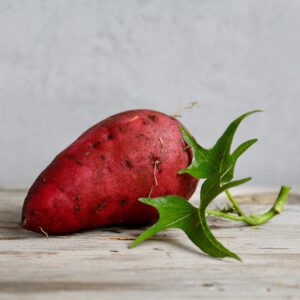
A person searching for the single crop that carries the most weight in China’s food system might pass right over the sweet potato (Ipomoea batatas) without realizing it. It doesn’t have the glamour of exotic fruit or the mystique of ancient grains. It just grows, feeds people, and gets processed into half a dozen other things — quietly, reliably, and at a scale that makes every other country’s sweet potato production look like a kitchen garden experiment.
China produces more sweet potatoes than every other country on Earth combined. Estimates place the annual harvest somewhere above 50 million metric tonnes. A large share of that volume never arrives at a table as a recognizable vegetable — it’s processed into starch, flour, glass noodles, and fermentation feedstock. The glass noodles sitting in a bowl of Sichuan hot pot almost certainly started their life as a Chinese sweet potato.
Street food tells the more personal side of the story. In Chinese cities every winter, vendors park coal drum ovens on sidewalks and roast sweet potatoes until the skin blisters and the flesh caramelizes inside. People queue for them the way other cultures queue for street snacks — because the smell alone is worth stopping for, and the taste delivers exactly what the cold air demands.
Key facts:
- China produces more sweet potatoes than the rest of the world combined
- Processed into starch, flour, glass noodles, and industrial feedstock
- Roasted sweet potato is a beloved winter street food across Chinese cities
7. Shine Muscat Grapes
 Pin
Pin Photo courtesy of Hunterlim
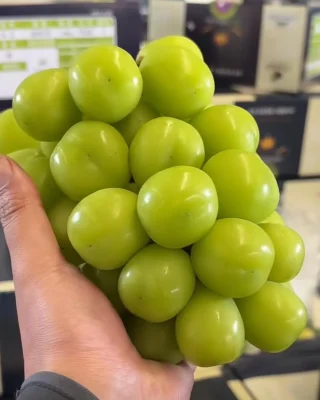
Shine Muscat grapes (Vitis vinifera) did not originate in China — they came from Japanese agricultural research — but China adopted them with the kind of enthusiasm that tends to turn a niche crop into a national moment. Production scaled rapidly. Premium markets took notice. And the grape that once carried a Japanese price tag began appearing across East Asia at volumes Japanese growers alone could never have managed.
The appeal is not complicated to explain. Shine Muscat grapes are seedless, with thin skin that needs no peeling, and they carry a floral, musky sweetness that plain green grapes simply don’t match. The sugar content reads high and the texture holds — firm enough to feel substantial, not so firm as to feel under-ripe. One cluster on the table tends to disappear faster than any other fruit.
Chinese growers, particularly in Yunnan and Xinjiang, have developed cultivation methods that maximize both size and sweetness. Individual clusters are often bagged on the vine — a labor-intensive practice that protects the skin from insects, prevents scarring, and produces a grape that looks almost too perfect to eat. The price reflects that effort, and for the buyers who seek them out, the price appears to be no great obstacle.
Key facts:
- Seedless, thin-skinned, with high floral sweetness
- Clusters bagged on the vine for protection and cosmetic quality
- Premium pricing sustained by strong demand across East Asian markets
8. Hami Melon
 Pin
Pin Photo courtesy of Zaytoon Las Vegas
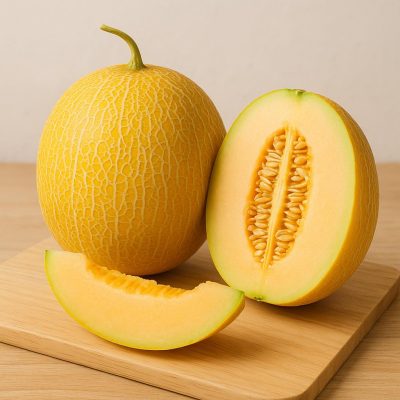
Xinjiang is not a place one typically associates with abundance. It is dry, vast, and extreme in its temperatures — scorching during the day, sharply cold at night, and receiving little of the rainfall that most fruit crops consider non-negotiable. The Hami melon (Cucumis melo) grows here anyway, and the desert, rather than limiting it, is precisely what makes it extraordinary.
Plants under water stress concentrate their sugars as a survival response. The Hami melon, irrigated carefully through ancient karez underground canal systems and stressed by Xinjiang’s harsh conditions, develops a sweetness that melons grown in gentler environments rarely achieve. The dramatic swing between daytime heat and nighttime cold slows the ripening process, giving the fruit extended time to build flavor that more temperate growing regions simply cannot replicate.
The melon has been cultivated in this corner of China for over a thousand years and once traveled as imperial tribute to courts in Beijing. Today it moves by refrigerated truck across the country, sold fresh in summer markets and dried into chewy amber strips that carry the sweetness of the original fruit in concentrated form. A cold Hami melon on a hot day is not a complicated pleasure — it is just very good.
Key facts:
- Desert water stress concentrates natural sugars significantly
- Hot days and cold nights slow ripening and deepen flavor
- Cultivated for over 1,000 years; historically sent as imperial tribute
9. Lotus Root
 Pin
Pin Photo courtesy of Dans Market
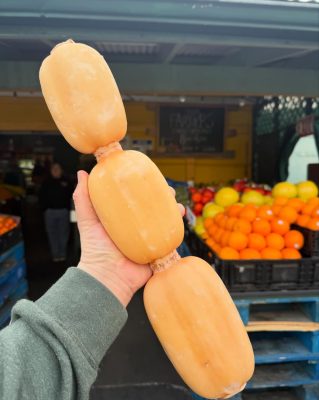
Lotus root (Nelumbo nucifera) begins its life in the mud at the bottom of ponds and canals — not the most auspicious origin for something that ends up in some of China’s most elegant dishes. Workers wade in, feel along the murky bottom with their feet, and pull the roots free by hand or with simple tools. Cleaned up, the root is cream-white, firm, and perforated with a ring of hollow tunnels that run its entire length.
Those tunnels are not decorative. They carry oxygen down to the plant’s submerged root system, allowing the lotus to breathe in conditions that would suffocate most other plants. Sliced crosswise, they produce rounds that look almost architectural — circular, patterned, and striking enough that Chinese cooks regularly use lotus root in dishes where presentation matters as much as flavor.
It holds its crunch through almost any cooking method, which is a quality that not many vegetables share. Stir-fried with vinegar and dried chili, simmered in pork rib soup, stuffed with sticky rice and steamed whole — the texture stays present regardless of technique. Nutritionally, it contributes fiber, vitamin C, potassium, and iron, and in traditional Chinese medicine, different parts of the lotus have served different purposes for generations.
Key facts:
- Hollow tunnels carry oxygen to the submerged root system
- Retains crunch through boiling, stir-frying, and steaming
- High in fiber, vitamin C, potassium, and iron
10. Shiitake Mushroom
 Pin
Pin Photo courtesy of Mountain Meadow Mushroomfarms
China grows the majority of the world’s shiitake mushrooms (Lentinula edodes), and the industry behind that fact is considerably more sophisticated than the image of a damp log in a forest might suggest. Modern Chinese shiitake operations run in controlled indoor environments — humidity dialed in, temperature cycled to mimic seasonal shifts, light kept low, and substrate packed into compressed sawdust blocks that replicate the oak wood conditions the fungus prefers.
Traditional cultivation used actual logs, drilled and inoculated with spawn, then left in shaded outdoor areas to fruit on their own schedule. That method still exists, and the shiitake it produces — slower to grow, less predictable — carries a depth of flavor that growers and chefs argue no industrial version fully matches. Both approaches coexist in China, serving different markets with different expectations.
The flavor is why shiitake traveled so far from its East Asian origins. Compared to the button mushrooms that dominate Western supermarkets, shiitake carries a richer umami — earthy, meaty, and capable of transforming a broth from thin to substantial without adding a single gram of meat. Dried shiitake concentrates that quality further, and the liquid left from rehydrating them is itself a stock worth saving.
Key facts:
- China produces the majority of the world’s shiitake supply
- Grown in controlled humidity and temperature environments year-round
- Dried form has concentrated umami; rehydrating liquid used as natural stock
11. Chinese Yam
 Pin
Pin Photo courtesy of Kitchen Butterfly
Chinese yam (Dioscorea polystachya) doesn’t announce itself the way flashier crops do. It grows underground, climbs quietly on thin vines, and gets pulled from the earth looking like a long, rough-skinned stick. Peel it back, though, and the flesh is white, smooth, and faintly fragrant — a vegetable that has been feeding and medicating Chinese households for well over two thousand years.
The texture surprises people who encounter it raw for the first time. Grated, it becomes slightly sticky — almost gelatinous — a quality that Chinese cooks lean into rather than avoid. Grated Chinese yam spooned over hot rice is a dish in itself, simple and nourishing. Sliced and stir-fried, it firms up and takes on a clean, mild flavor that pairs readily with stronger seasonings without disappearing into them.
Traditional Chinese medicine has long classified the yam as a food that supports the spleen, lungs, and kidneys — organs that classical Chinese medical theory associates with overall vitality and immunity. Whether one subscribes to that framework or not, the nutritional profile holds up: good dietary fiber, a range of B vitamins, potassium, and compounds studied for their potential role in blood sugar regulation. It is a crop that earns its place at both the dinner table and the herbalist’s shelf.
Key facts:
- Grated raw texture is slightly sticky — used over rice as a simple dish
- Stir-fried slices hold shape and absorb seasoning well
- Used in traditional medicine for digestive and immune support
- Contains dietary fiber, B vitamins, potassium, and blood sugar-regulating compounds
12. Chinese Garlic
 Pin
Pin Photo courtesy of Brazil’s Fruits
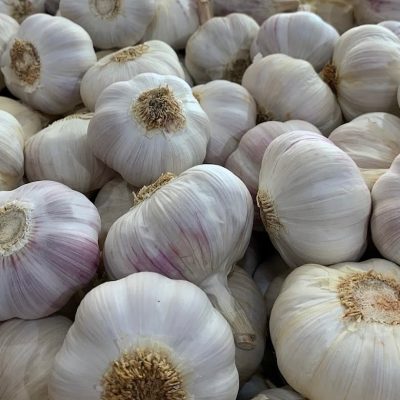
There is a reasonable chance that the garlic sitting in any kitchen on any continent right now came from China. China produces somewhere between 70 and 80 percent of the world’s garlic supply — a market share so dominant that it makes most agricultural monopolies look modest by comparison. The global garlic trade, in practical terms, runs through Chinese farms whether the packaging mentions it or not.
Garlic (Allium sativum) is not a crop China stumbled into growing at scale — it is a flavor so structurally embedded in Chinese cooking that treating it as optional would be like treating salt as optional. It goes into the wok first, in oil, before almost anything else. The smell of garlic hitting hot oil is the opening note of thousands of Chinese dishes, from the plainest home cooking to the most elaborate restaurant preparation.
Chinese garlic is known for strong flavor, consistent size, and a papery skin that protects well during long storage and shipping. Growers in Shandong and Yunnan provinces lead production, harvesting in late spring and storing in temperature-controlled facilities that supply markets year-round. It arrives in markets across Europe, Southeast Asia, and the Americas, usually at prices that local garlic producers find very difficult to compete with — a commercial reality that has made Chinese garlic both indispensable and occasionally controversial in international trade conversations.
Key facts:
- China produces 70–80% of global garlic supply
- Garlic is a structural flavor base in Chinese cooking — not optional
- Major producing provinces: Shandong and Yunnan
- Long shelf life and strong flavor make it ideal for global export
13. Welsh Onion
 Pin
Pin Photo courtesy of Rekha Mistry
The Welsh onion (Allium fistulosum) has one of the more misleading common names in agriculture — it has no meaningful connection to Wales. Its origins are in Asia, its cultivation history in China stretches back millennia, and its presence in Chinese cooking is so consistent that finding a savory Chinese recipe that doesn’t call for it in some form requires genuine effort.
It functions differently depending on when it enters the dish. Added early to hot oil, it builds a fragrant base that carries through the entire cooking process. Scattered raw over a finished plate, it lifts the whole thing — a bright, sharp note that cuts through richness and signals freshness. Some dishes use it both ways simultaneously, cooked into the base and raw on top, because the two preparations taste meaningfully different despite coming from the same plant.
Agronomically, the Welsh onion is a farmer’s straightforward friend. It grows rapidly in a wide range of climates, tolerates both heat and cold better than many alliums, and produces multiple harvests from the same planting. Across China’s northern plains and southern provinces alike, it stays in the ground and keeps producing — a reliable, low-maintenance crop that earns its place in the rotation season after season.
Key facts:
- Used in Chinese cooking as both a flavor base and a fresh garnish
- Tolerates a wide range of climates — grown across all major Chinese regions
- Multiple harvests possible from a single planting
- Origins in Asia, despite the misleading European name
14. Flat Peach
 Pin
Pin Photo courtesy of Sunshine Market
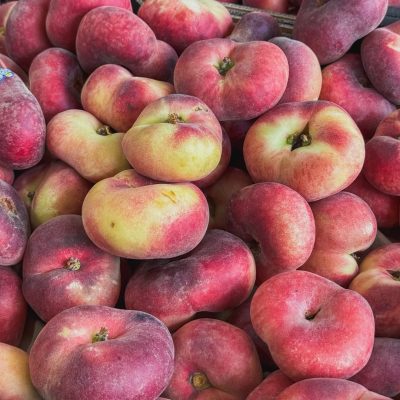
A flat peach (Prunus persica var. platycarpa) placed next to a standard peach looks like the result of some gentle disagreement with physics. It is squat, disc-shaped, and noticeably flattened — as though someone pressed down on it firmly while it was still deciding what to become. The shape is not a defect. It is the variety, and Chinese growers have cultivated it deliberately for centuries.
The flavor justifies the attention. Flat peaches carry more sugar per bite than standard round peaches, and the flesh is denser and more aromatic — a sweetness that comes with a floral, almost perfumed quality that makes them immediately distinguishable from ordinary peaches. The pit is small relative to the fruit’s volume, which means a higher ratio of edible flesh per piece, a practical advantage that growers and buyers both appreciate.
In Chinese cultural tradition, the peach carries considerable symbolic weight. It appears in classical literature and mythology as a symbol of longevity and immortality — the peaches of the Queen Mother of the West in Chinese legend are among the most famous fruits in any mythological tradition. The flat peach, with its distinctive shape and exceptional sweetness, occupies a premium tier in Chinese fruit markets and commands prices that reflect both its flavor and its cultural standing.
Key facts:
- Disc-shaped variety cultivated deliberately — not a defect
- Higher sugar content and more aromatic flesh than standard peaches
- Small pit means higher edible flesh ratio per fruit
- Symbolically associated with longevity in Chinese mythology and literature
15. Buddha's Hand
 Pin
Pin Photo courtesy of Jonkmanshof
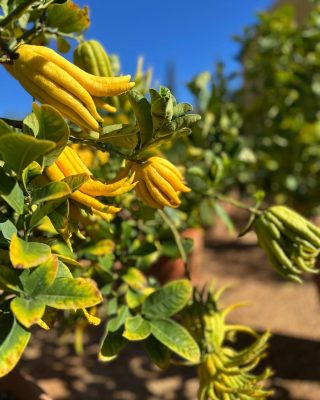
Buddha’s Hand (Citrus medica var. sarcodactylis) produces no juice worth mentioning and almost no flesh to speak of. What it produces instead is a cluster of elongated yellow protrusions — finger-like segments that splay outward from the base like an open hand mid-gesture. It looks extraordinary sitting on a table, and it smells even better than it looks — intensely citrusy, clean, and floral in a way that fills a room without effort.
Chinese cooks use the zest in savory and sweet preparations alike, and the thick peel is frequently candied or dried for use in confections and herbal medicine. The pith, which is bitter in most citrus, is notably mild in Buddha’s Hand — making the entire rind usable in ways that lemon or orange peel rarely allows. Bartenders and pastry chefs outside China have discovered this quality recently, but Chinese kitchens have been aware of it for considerably longer.
Beyond the kitchen, Buddha’s Hand has occupied a ceremonial role in Chinese culture for centuries. Temples display it as an offering. Homes keep it for its fragrance during festivals. It is associated with happiness, longevity, and good fortune — the three qualities that appear most often in Chinese symbolic tradition. A crop that serves as food, medicine, perfume, and religious offering simultaneously is, by any measure, earning its growing space.
Key facts:
- Almost no juice or flesh — the zest and peel are the usable parts
- Pith is unusually mild, making the entire rind suitable for cooking
- Used in candied preparations, herbal medicine, and culinary zest
- Displayed in temples and homes as a symbol of happiness and longevity
FAQs
Yes. China’s garlic output dwarfs every other producer combined. Most garlic in global markets traces back to Chinese farms, regardless of local packaging.
Primarily yes. Xinjiang’s desert climate and ancient karez irrigation create the specific stress conditions responsible for the melon’s exceptional sweetness.
Easily. It cooks faster, skips pre-salting, and absorbs flavor more readily — most cooks find it a clean upgrade for stir-fries and braises.
The zest and peel. There’s almost no flesh or juice — but the fragrance is intense, and the candied peel is a long-standing traditional delicacy.
Labor-intensive vine-bagging, high sugar content, and strong demand across premium East Asian markets keep prices high — supply hasn’t caught up with appetite yet.








 Login with Google