





















 Pin
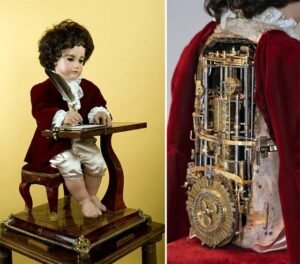
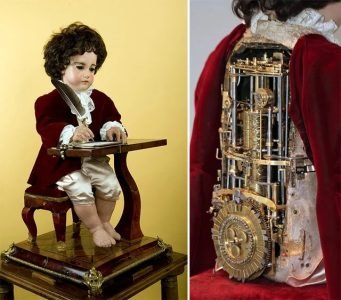
Pin The Writer, Automated Doll by Pierre Jaquet-Droz / Photo Courtesy of Wikimedia Commons
Synopsis: The Writer is a 250-year-old machine built by Swiss watchmaker Pierre Jaquet-Droz, his son Henri-Louis, and Jean-Frédéric Leschot between 1768 and 1774. Shaped like a small boy at a desk, he was made to dip a real quill in ink and write a message of up to 40 characters while his eyes follow the pen. Springs, gears, and cams run everything, with no electricity. This article covers who built him, how he works, and where he sits today.
A small boy sits at a wooden desk, head slightly bowed, waiting. When he is wound and set going, his eyes wake up, his hand lifts, and he dips a goose-feather quill into a pot of ink. He taps off the extra drops, the way a careful clerk would, and lowers the pen to the paper.
Nobody is touching him. No cord, no battery, no hidden fellow in the next room. The whole business runs on a wound spring and a great many brass parts, and it was designed that way in the 1770s, which is roughly when the American colonies were busy picking a fight with King George.
This is The Writer, a machine that learned hand-writing before most of the world had a telephone. His makers built him as a showpiece for their workshop’s skill, and it made their name. He ended up doing something larger: he showed what a machine could be told to do.
Table of Contents
The Watchmaker With a Taste for Trouble
 Pin
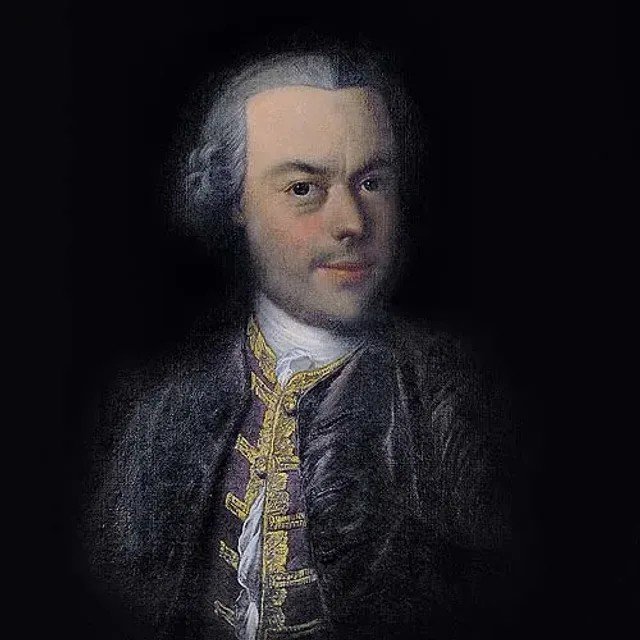
Pin Pierre Jaquet-Droz / Photo Courtesy of WatchTime
Pierre Jaquet-Droz was born in 1721 in the Swiss Jura, watchmaking country, where a man who could not fix a clock was thought to be missing an arm. He grew into a clockmaker of unusual ambition. By the 1740s his clocks were chiming on their own, and some even played music.
Life was not all tidy gears. He married Marianne Sandoz in 1750, and the couple had two children, Julie and Henri-Louis. In 1755 he lost both his wife and a daughter. He never remarried, and he threw himself into his work, which is how a good many great things get made, and not always cheerfully.
His skill caught the eye of a Scottish nobleman named George Keith, who governed Neuchâtel. Keith had friends in high places and was willing to use them.
Quick facts about the maker:
- Born: 1721, Swiss Jura
- Trade: clockmaker
- Helpers: his son Henri-Louis and Jean-Frédéric Leschot
- Big break: a friend at court
A Very Long Ride to Spain
In April 1758, in the middle of a blizzard, Jaquet-Droz packed six dismantled clocks into a specially built carriage and set out for Madrid. His assistant and his father-in-law came along. The trip took 49 days by way of Lyon and Barcelona, and the father-in-law kept a diary, so we know the travelers were not shy about their opinions.
They liked the buildings and the food. They tasted tomatoes and cucumbers for the first time and apparently survived. They liked the Spanish Inquisition rather less, being Calvinists from the mountains, and they spent a good while looking over their shoulders.
The clocks arrived a little worse for wear, and it took weeks to put them right. Then came months of waiting for the king to find time for them. Patience, it turns out, was also part of the trade.
The King, the Gold, and the Great Idea
 Pin
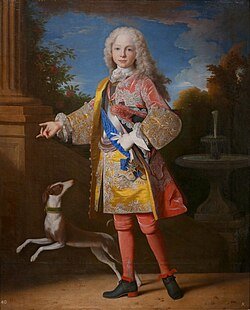
Pin King Ferdinand VI / Photo Courtesy of Wikimedia Commons
King Ferdinand VI loved mechanical gadgets and was said to wind his own clocks with a key. When Jaquet-Droz finally showed him a clock that could strike on request without a finger touching it, the court was thunderstruck. The king bought the lot for his royal palaces.
The payment came to 2,000 gold pistoles, which was the sort of sum that lets a man stop worrying about the rent. Jaquet-Droz went home in 1759 with a full purse and a new plan. He would give his time to watches, clocks, and the mechanical figures that were to make his name.
Marvels of this kind had a practical side. A workshop that could build a machine that wrote, drew, or played music would have the wealthy talking about it, and talk, in any century, is a cheap way to build a reputation.
A Family Workshop and a Borrowed Son
 Pin
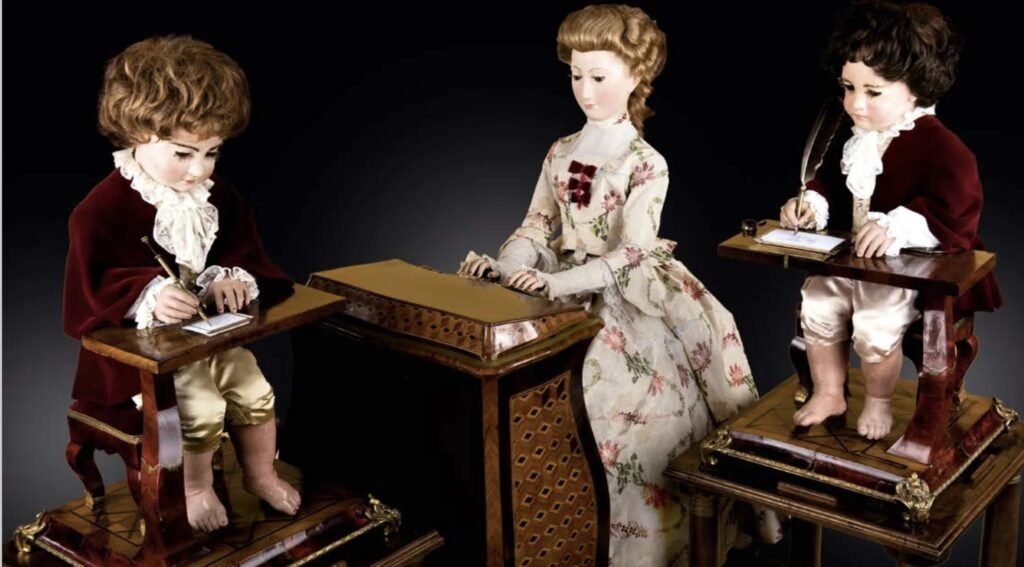
Pin The Trio – The Writer, The Musician, The Draughtsman / Photo Courtesy of Johnson & Co
The work took years, and it took a team. Pierre’s son Henri-Louis worked beside him. So did Jean-Frédéric Leschot, a neighbor’s boy whom Pierre took in after the boy’s mother died and treated as his own. Leschot grew into a fine craftsman and later handled a good part of the business.
Together they built three famous figures between 1768 and 1774, and showed them to the public in La Chaux-de-Fonds in 1774. All three have survived. Museum records also mention a fourth piece, called La Grotte, which has not.
The trio:
- The Writer: a boy who writes up to 40 characters
- The Draughtsman: a boy who sketches a handful of drawings
- The Musician: a young woman who plays five tunes on a real organ
The Writer was the most complicated of the three, and it was no close race.
How a Wooden Boy Learned to Spell
Start with the outside. The boy stands roughly 70 to 76 centimeters tall, depending on which source is measuring, dressed in fine clothes, with nothing to give him away. The clever part is inside. Unlike most automata of his day, whose gears hid in a table or a cabinet, his whole mechanism fits inside his own body. One scholarly count puts the parts at more than 6,000, packed tighter than a Sunday crowd in a small church.
A stack of cams does the guiding, if guiding is the word. A cam is a shaped disc that pushes a lever as it turns, so the lever moves in whatever pattern the disc’s edge dictates. Each cam steers the hand along a certain path, and together they trace out the letters.
There is no brain in any of this. There is only a very well-planned path, cut in metal, followed without complaint.
The Programming Wheel, or How to Change What He Says
The neat trick is that the boy does not have to write the same line every time. A mechanical programming wheel lets the operator pick the characters in order, up to 40 in all, and the boy then writes that custom message. Change the selection and you change the sentence. Nobody had to rebuild the machine to teach it a new phrase.
That is why people call the boy a distant cousin of the computer. He takes instructions, and he follows them exactly. But it pays to keep the family tree honest. This is not digital memory. He cannot decide anything, cannot check anything, and cannot do a sum. Give him no instructions and he sits there, as well-behaved as a stone.
What he does, in order:
- Dips the quill in the inkwell
- Shakes off the extra ink
- Writes the selected message
- Moves his eyes and head along with the pen
A Show That Built a Reputation
The three figures were made to impress, and they did their job. After the 1774 debut, the family took them on the road. They went to Geneva, then to Paris in 1775, where they were shown to Louis XVI and Marie-Antoinette. Later came London, Holland, Flanders, Lyon, and even a showing at the Russian court in Kazan.
Audiences watched a boy do what boys sometimes cannot be talked into doing: sit still and write neatly. One popular account says Jaquet-Droz worried he might be hauled in for sorcery, a fear that would have made sense in a century when a machine that behaved like a person could make a nervous man reach for a prayer book.
The spectacle served the business well. The figures built the reputation of the workshop, and the firm’s clocks and watches found buyers as far away as India, Japan, and China through a London trading company.
The Long Wander Home
Good times never last, and the Jaquet-Droz business was no exception. Wars, revolution in France, and some troubled deals in the East wore the firm down. Pierre died in 1790, and the business he had built came apart in the years after.
The figures kept traveling without him. They turned up in Spain in 1787, in Paris in 1812, and on tours across Europe for much of the 1800s, changing hands and getting lost along the way, like a trunk with a mind of its own.
Finally they came to rest in Neuchâtel. A local historical society bought them around 1906, and they were gifted to the city on 1 May 1909. It was a fitting end for a traveler. The figures came home to the very region where a clockmaker had once packed his first clocks into a carriage and driven into the snow.
Where Can You See The Writer Today?
The Writer is kept at the Musée d’art et d’histoire in Neuchâtel, Switzerland, in the automata room he shares with the Draughtsman and the Musician. Here the story takes a sad turn for the visitor. As of September 2026, the museum says the Writer is out of working order because of a defective part and a technical problem. He is still on display, but he is not writing, and the museum says it is doing everything possible to get him going again.
His two siblings are still performing. Public demonstrations of the automata are held on the first Sunday of every month, at 2, 3, and 4 p.m., and other times can be arranged by reservation.
Before you go:
- The Writer is on display but currently not working
- Check the museum’s website for the latest status and demonstration times
- Arrive early for the monthly demonstrations, as the room is small
Why a Wooden Boy Still Matters
The boy had a small career in the movies too. He and a similar figure made by Henri Maillardet helped inspire Martin Scorsese’s 2011 film Hugo. Not bad for a fellow who has never been paid a wage.
His real importance is quieter. He shows that people were already dreaming of machines that follow stored instructions long before anyone built an electronic one. Cams, wheels, and springs did what code does now: they told a device what to do, one step at a time.
He is also a good reminder for a world that gets excited about clever machines every few years. The boy does not think, does not understand words, and never will. What he has is a set of very good instructions and the patience of a saint. There are people who cannot say as much.
FAQs
Swiss watchmaker Pierre Jaquet-Droz built it with his son Henri-Louis and Jean-Frédéric Leschot at La Chaux-de-Fonds between 1768 and 1774. Two sibling figures, The Draughtsman and The Musician, came from the same workshop.
A wound spring supplies the power. Stacked cams guide the hand along the path of each letter, and a mechanical programming wheel selects which characters get written. Gears link everything, including the eyes and head.
He can write a message of up to 40 characters, and the operator changes the text by selecting different characters on the wheel. He uses a real goose-feather quill and real ink, dipping and shaking off the extra drops.
Not quite. He can be set to write different messages, which makes him a distant ancestor of programmable machines. But he cannot make decisions or calculate, so he is best described as a clever mechanical forerunner rather than a true computer.
Not at the moment. He is on display at the Musée d’art et d’histoire in Neuchâtel, but as of September 2026 the museum says he is out of working order. The Musician and Draughtsman still perform, so check the museum’s website before visiting.









 Login with Google