




















 Pin
Pin Photo courtesy Vision Motive
Synopsis: The bug crawling across your kitchen counter right now might possess abilities that would make a science laboratory envious. Beetles walk around with chemical explosives that reach boiling temperatures. Ants have been practicing agriculture since before humans figured out which end of a stick to use. Bees navigate using what appears to be quantum mechanics—a field that still baffles our best physicists. Some insects can hoist fifty times their body weight without breaking a sweat, while others stroll across water surfaces like it’s solid ground. A certain resilient bug can live for weeks without its head, which raises uncomfortable questions about what we consider essential for survival. These aren’t exaggerations or folk tales. These are documented, scientific facts about creatures so small you could accidentally inhale one while yawning.
You’ve probably swatted a fly without giving it much thought, or crushed an ant on your countertop with barely a flicker of guilt. After all, they’re just bugs—simple little machines running on instinct, right? Well, that comfortable assumption is about to get seriously rattled.
The insect world operates on a level that makes our finest technology look like stone-age tools. These creatures have spent hundreds of millions of years perfecting abilities that our smartest engineers are still trying to figure out. They’ve mastered chemistry, physics, architecture, agriculture, and navigation using nothing but evolution’s ruthless trial-and-error process. No blueprints, no instruction manuals, no universities—just survival pressure and an unfathomable amount of time.
What you’re about to read isn’t exaggerated for effect. These are real abilities, documented by scientists who’ve spent careers studying these remarkable creatures. A beetle that carries a chemical weapon reaching boiling temperatures. An ant that’s been farming for fifty million years. A bee that might be using quantum mechanics to navigate. These aren’t myths or tall tales from unreliable sources—these are facts that’ll make you look twice before you reach for that flyswatter.
The truly humbling part is that these insects accomplish their feats with brains smaller than pinheads, running on energy that wouldn’t power a nightlight. They don’t understand what they’re doing in any conscious sense, yet they outperform human technology in efficiency, precision, and elegance. Evolution has handed them abilities that seem almost supernatural, yet every one of them follows the laws of physics and chemistry—just in ways we’re only beginning to understand.
So the next time you see a bug crawling across your floor, you might want to pause before squashing it. That little creature might be carrying technology that took nature hundreds of millions of years to perfect, and that humanity would pay billions to replicate. The insect abilities you’re about to discover will fundamentally change how you see the tiny world that exists right alongside ours, mostly unnoticed and vastly underestimated.
Table of Contents
1. The Bombardier Beetle's Chemical Warfare
 Pin
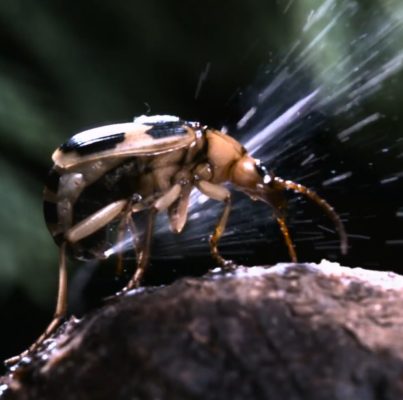
Pin Bombardier Beetle / Photo courtesy BBC
The bombardier beetle carries what amounts to a portable chemistry lab inside its rear end, and it’s not shy about using it. This peculiar creature stores two completely separate chemicals in special chambers within its abdomen. When a bird, frog, or unfortunate human gets too close, the beetle mixes these chemicals in a combustion chamber that would make any engineer jealous.
The reaction happens faster than you can blink. The mixture heats up to nearly 100 degrees Celsius—that’s just below the boiling point of water—and shoots out with an audible pop. The spray doesn’t just burn; it arrives with enough force to actually knock smaller predators backward. What’s truly remarkable is that the beetle never burns itself, despite hosting what’s essentially a controlled explosion just inches from its vital organs.
The secret lies in a series of valves and chambers that release the chemicals in precise pulses rather than one continuous stream. Each pulse lasts just milliseconds, giving the combustion chamber time to cool between blasts. Scientists have studied this mechanism for years, hoping to apply the same principles to fuel injection systems and fire extinguishers. The beetle figured it out millions of years ago.
2. Ant Strength That Defies Physics
 Pin
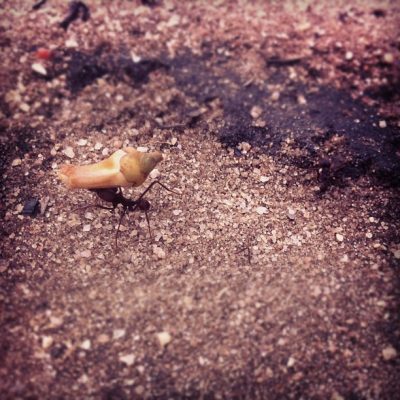
Pin Ant carrying Fruit / Photo courtesy Isabelle Mecattaf
An ant hauling a breadcrumb ten times its size across your picnic blanket isn’t showing off—it’s just another Tuesday for these miniature powerhouses. The average ant can lift between twenty and fifty times its own body weight, depending on the species. Some particularly gifted varieties can manage even more, carrying loads that would be equivalent to you hoisting a fully loaded cement truck over your head.
This strength doesn’t come from bulging muscles or special training regimens. Ants benefit from what scientists call the square-cube law, which means as creatures get smaller, their strength-to-weight ratio increases dramatically. Their muscles might be tiny, but they’re densely packed and attached to a hard exoskeleton that distributes force incredibly efficiently. Think of it as having a body made entirely of levers and pulleys, all working in perfect coordination.
But here’s where it gets interesting—ants don’t just lift things. They coordinate with their colony members to move objects hundreds of times heavier than any single ant could manage. They’ll form living bridges with their bodies, create rafts during floods, and even wage organized warfare. All this from a creature with a brain smaller than a pinhead. Makes you wonder what they could accomplish with just a bit more gray matter.
3. The Praying Mantis and Its Predatory Vision
 Pin
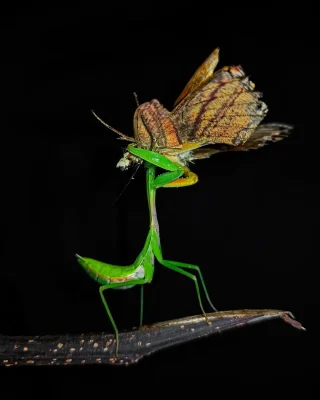
Pin Praying Mantis and Moth / Photo courtesy Insectstory
The praying mantis sits perfectly still on a branch, looking for all the world like a twig with an attitude problem. Then something moves fifty feet away, and that triangular head swivels with unsettling precision. What happens next happens so fast you’d miss it if you blinked—the mantis snatches a fly right out of the air with those serrated front legs.
This hunting success comes from having genuinely unusual eyes for an insect. Most bugs see the world as a fragmented mosaic, like looking through a kaleidoscope made of thousands of tiny lenses. The mantis has that too, but it also has true stereoscopic vision, meaning it can judge distance and depth the way you do. Those bulging eyes aren’t just for show; they’re sophisticated targeting systems that calculate trajectory, speed, and distance in real time.
The mantis also sees polarized light, which helps it detect movement against complex backgrounds. A camouflaged grasshopper might fool other predators, but the mantis spots the tiny differences in how light reflects off its prey versus the surrounding leaves. Scientists have discovered that mantises even have a primitive form of 3D vision that works differently from ours but achieves similar results. The mantis essentially has fighter pilot vision installed in a body the size of your thumb.
4. Dragonfly Precision and Aerial Dominance
 Pin
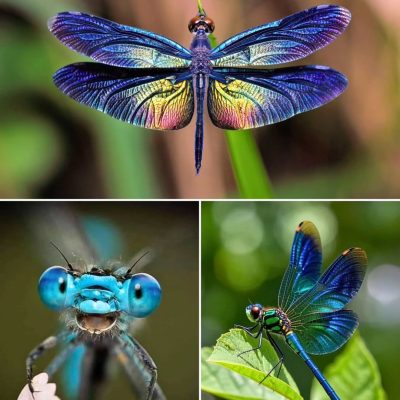
Pin Dragonfly / Photo courtesy Wild Animals Hindi
The dragonfly hovering over that pond isn’t just passing time—it’s one of nature’s most efficient killing machines. These aerial hunters boast a success rate approaching ninety-five percent, which puts them ahead of lions, sharks, and pretty much every other predator you can name. They don’t chase their prey so much as intercept it, calculating where a mosquito will be and meeting it there.
Each dragonfly eye contains up to thirty thousand individual lenses, creating a visual field that covers nearly every direction simultaneously. They can see you coming from behind, above, and both sides without turning their head. But the real magic happens in their tiny brain, which processes all this visual information and performs calculations that would require serious computing power if we tried to replicate it artificially.
What makes dragonflies truly special is their ability to predict movement. They don’t just see where their prey is right now; they calculate where it’s going to be in the next fraction of a second. Military researchers have studied dragonfly vision to improve missile targeting systems and drone navigation. The dragonfly pulls off these computational feats with a brain the size of a grain of rice, running on the energy equivalent of a weak nightlight. Efficiency experts could learn a thing or two from these ancient insects.
5. The Cicada's Underground Time Capsule
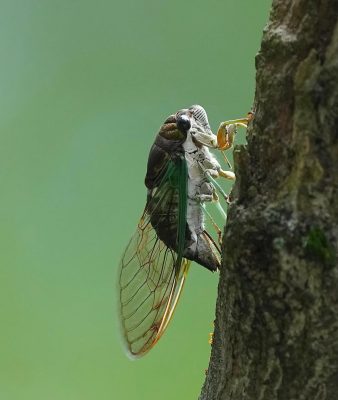 Pin
Pin Cicada / Photo courtesy Beverly W. Cochran
Somewhere beneath your feet right now, there might be a cicada that’s been waiting in the dark since you were in diapers. Some cicada species spend thirteen or seventeen years underground—prime numbers, oddly enough—feeding on tree root juice and doing absolutely nothing else worth mentioning. Then, on some mysterious signal that scientists still can’t fully explain, millions of them emerge all at once.
This synchronized emergence serves a brutally simple purpose. When millions of cicadas appear simultaneously, predators can’t possibly eat them all. Birds, squirrels, and other hungry creatures stuff themselves until they’re sick, and still, plenty of cicadas survive to reproduce. It’s a strategy called predator satiation, and it works because of the sheer overwhelming numbers involved.
The mystery deepens when you consider how they all know when to emerge. There’s no alarm clock down there, no calendar, no cicada elder counting the years. Yet somehow, these insects track time with remarkable accuracy while living in complete darkness, through weather changes, temperature fluctuations, and all manner of disturbances. They emerge within days of each other, sometimes covering entire regions in a deafening chorus. Then they mate, lay eggs, and die, leaving their offspring to begin the count all over again.
6. Firefly Light Without Heat
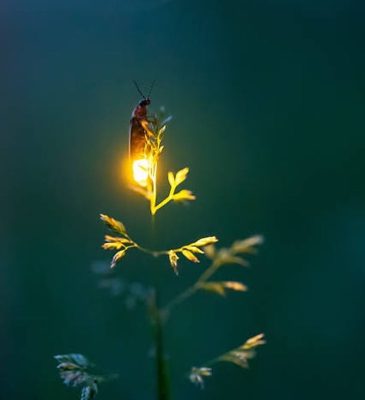 Pin
Pin Firefly / Photo courtesy Cloe Hershey
A firefly blinking in your backyard on a summer evening is demonstrating something that human engineers have been trying to perfect for over a century—light production without wasted energy. When you flip on a light switch, your bulb converts most of its energy into heat rather than light. A firefly converts nearly one hundred percent of its energy into light, producing almost no heat whatsoever.
The trick involves a chemical called luciferin, which reacts with oxygen in the presence of an enzyme called luciferase. This reaction releases energy in the form of photons—light particles—rather than heat. The firefly can control this reaction with remarkable precision, creating different flash patterns to attract mates, warn predators, or communicate with other fireflies. Different species have different flash patterns, like morse code written in bioluminescent ink.
Scientists have borrowed this technology for medical imaging, where luciferase helps track cancer cells and monitor infection. Researchers are also exploring ways to use firefly chemistry for emergency lighting that works without electricity or batteries. Meanwhile, the firefly keeps blinking away in your garden, completely unaware that it’s carrying around a Nobel Prize-worthy innovation in its glowing rear end.
7. Water Striders Walking on Liquid
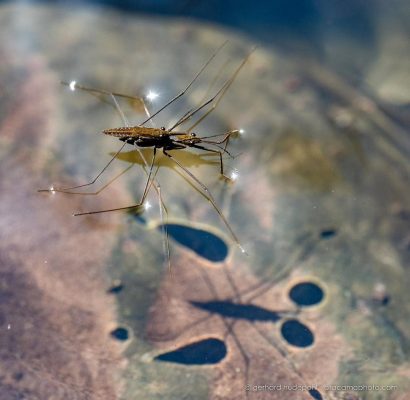 Pin
Pin Water Striders / Photo courtesy Atacama
The water strider sitting on your pond’s surface is performing a physics trick that seems to violate everything you learned in school about density and buoyancy. This insect doesn’t float the way a boat floats; it literally stands on top of the water, supported by nothing more than surface tension and some remarkably clever evolutionary engineering.
Each of the strider’s legs is covered in thousands of microscopic hairs that trap tiny air bubbles, making the legs extremely water-repellent. When the insect steps onto water, these hairs create dimples in the surface without breaking through. The strider distributes its weight so precisely that the water’s surface tension—the same force that makes water droplets round—supports its entire body.
But the strider doesn’t just sit there looking smug. It can run, jump, and hunt on this liquid surface, detecting vibrations from drowning insects and skating over to claim its meal. The strider’s feet never actually touch the water itself; there’s always a thin cushion of trapped air between the insect and the liquid. Engineers have studied water striders to develop water-repellent materials and tiny robots that could someday explore environments too dangerous for humans. The strider manages all this without a degree in physics or any understanding of molecular bonding—it just does it.
8. Leafcutter Ants and Ancient Agriculture
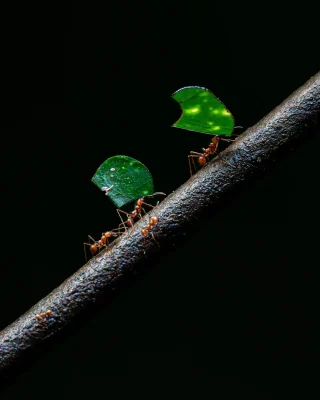 Pin
Pin Leafcutter Ants / Photo courtesy Maud Witte
The leafcutter ant carrying a piece of leaf three times its size isn’t planning to eat it. These ants discovered agriculture roughly fifty million years before humans stopped being nomadic hunters, and they’ve perfected farming techniques that would impress any agronomist. Those leaf pieces are heading underground to feed a fungus garden that the entire colony depends on for survival.
Inside the colony, specialized worker ants chew the leaves into pulp and use it as fertilizer for a specific species of fungus. This fungus exists nowhere else in nature—it’s been domesticated for so long that it can’t survive without the ants, and the ants can’t survive without it. The workers maintain precise temperature and humidity levels, remove competing molds and bacteria, and even apply what appears to be a natural antibiotic to protect their crop.
Different ants have different jobs in this farming operation. Some cut leaves, others carry them home, smaller ants ride on the leaf pieces to defend against parasitic flies, and the tiniest ants tend the fungus gardens directly. The whole system runs with an efficiency that makes modern agriculture look wasteful. These ants have been farming successfully for millions of years without depleting their resources or poisoning their environment—something humans are still trying to figure out.
9. Stick Insect Camouflage Mastery
 Pin
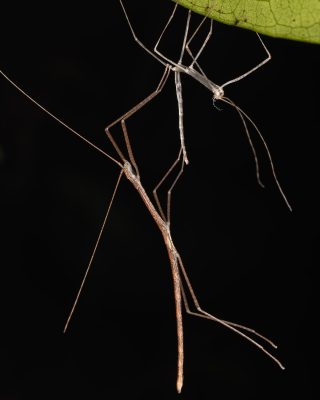
Pin Stick Insects /Photo courtesy Hollie & Travis Rose
The stick insect sitting on the branch in front of you looks exactly like a twig because it is, for all practical purposes, a living twig. This isn’t just about being brown and skinny. Some species have evolved bark-like texture on their bodies, complete with fake moss patterns and artificial growth rings. They’ve even developed the habit of swaying slightly, mimicking how a real twig moves in the breeze.
This camouflage works so well that researchers sometimes discover new species only when a museum specimen that’s been sitting in a collection for decades suddenly moves. Predators walk right past them, sometimes using them as perches without realizing they’re standing on their dinner. The stick insect doesn’t need to run, fight, or produce toxins—it just has to hold still and trust that evolution has done its job.
Some species take this deception even further. Certain stick insects have wings that look like dead, dried leaves, complete with fake holes and decay patterns. Others can change color slightly to match different types of vegetation. A few species drop convincing eggs that look like seeds, tricking ants into carrying them to safe locations. The stick insect has turned invisibility into an art form, proving that sometimes the best defense is to not be noticed at all.
10. Flea Jumping Power
 Pin
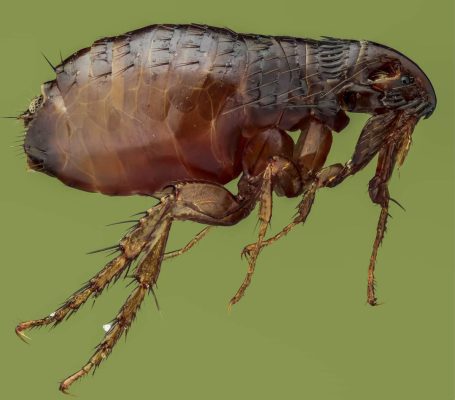
Pin Flea / Photo courtesy NGOC
A flea sitting on your dog’s back can jump over two hundred times its own body length, which would be equivalent to you leaping over a seventy-story building from a standing start. This isn’t muscle power in the traditional sense—no muscle can contract fast enough to produce that kind of acceleration. The flea uses something far more clever.
Inside the flea’s legs is a protein called resilin, which acts like a microscopic spring made of biological rubber. The flea slowly compresses this spring using its muscles, then releases it all at once using a trigger mechanism. The stored energy explodes outward, launching the flea into the air at speeds that subject it to forces over one hundred times Earth’s gravity. If you experienced that kind of acceleration, you’d black out instantly.
The flea uses this ability to escape danger and jump between hosts, which is crucial for a parasite that can’t fly. Scientists have studied resilin to develop better synthetic rubbers and springs for everything from medical devices to aircraft components. Meanwhile, the flea keeps jumping, completely unbothered by the fact that it regularly experiences forces that would liquify human organs.
11. Honeybee Quantum Navigation
 Pin
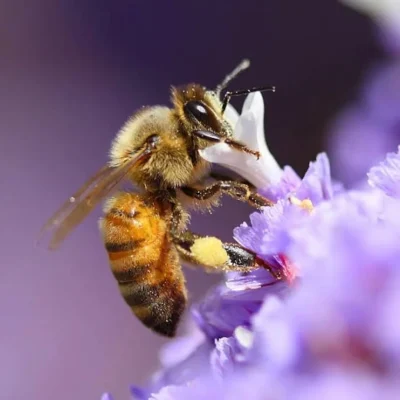
Pin Honeybee / Photo courtesy Morage
The honeybee flying past your window might be using quantum mechanics to find its way home, which sounds like science fiction but appears to be genuine science fact. Bees navigate using the sun, landmarks, and apparently something called quantum entanglement—a phenomenon so strange that Einstein himself called it “spooky action at a distance.”
Inside a bee’s eyes are specialized proteins that become quantum-entangled when exposed to Earth’s magnetic field. This creates a kind of quantum compass that allows the bee to sense magnetic direction even when visual cues disappear. When scientists disrupt the local magnetic field, bees become confused and lose their sense of direction, supporting this quantum theory.
This navigation system works in conditions where normal methods should fail—low light, cloudy skies, unfamiliar territory. The bee is essentially using subatomic physics to find flowers, performing quantum calculations that human scientists still struggle to understand or replicate in laboratory conditions. They do this with a brain smaller than a sesame seed, running on nectar, while simultaneously remembering the locations of hundreds of flowers and performing complicated waggle dances to communicate with their hive mates.
12. Termite Architecture and Climate Control
 Pin
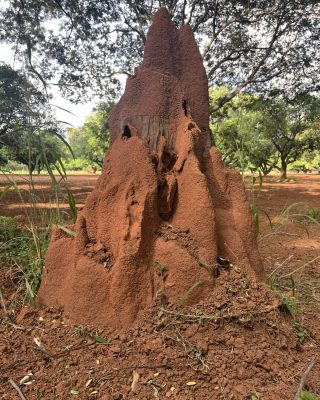
Pin Mound-building termites / Photo courtesy Suresh Shanthi
The termite mound rising from the African savanna looks like a pile of dirt, but it’s actually a sophisticated ventilation system that maintains stable temperature and humidity without any moving parts or electrical systems. Inside that mound, millions of termites live in comfort while outside temperatures swing from scorching hot to surprisingly cold.
The mound works like a massive lung, with carefully designed tunnels that create airflow through temperature differences and wind patterns. Hot air rises through central chimneys while cool air enters through lower tunnels. The termites constantly adjust the structure, opening and closing certain passages to regulate airflow based on external conditions. The result is an interior climate that stays within a few degrees of optimal, day and night, summer and winter.
Architects have studied termite mounds to design energy-efficient buildings in hot climates. The Eastgate Centre in Zimbabwe uses termite-inspired ventilation, cutting its energy costs dramatically compared to conventional air-conditioned buildings. The termites accomplished this engineering feat through trial and error over millions of years, building and rebuilding until they perfected a design that humans are only now beginning to appreciate.
13. Parasitic Wasp Mind Control
 Pin
Pin Parasitic Wasp / Photo courtesy Shuvam Photography
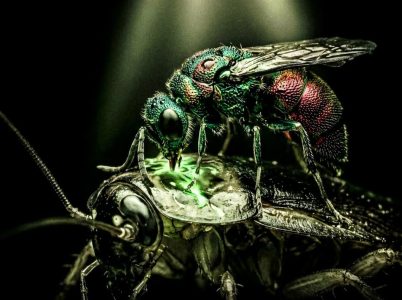
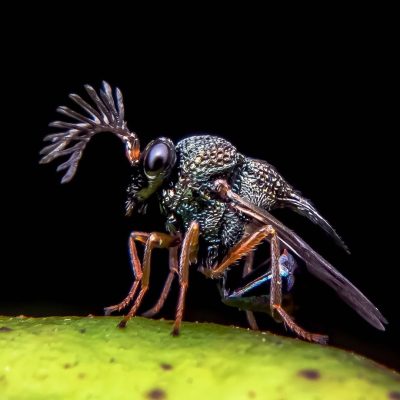
The wasp hovering near that caterpillar isn’t just hunting—it’s about to commit one of nature’s most disturbing acts of manipulation. Certain parasitic wasps inject their eggs directly into other insects, along with a cocktail of chemicals and viruses that hijack the host’s nervous system. What happens next belongs in a horror movie.
The infected caterpillar continues living, eating, and growing, but it’s no longer fully in control of its own behavior. When the wasp larvae inside it are ready to pupate, the caterpillar stops eating and stands guard over them, defending the parasites that are literally eating it from the inside. The host will attack anything that threatens the wasp cocoons, even though those cocoons represent its own death sentence.
This mind control works through chemistry, not intelligence. The wasp doesn’t understand neuroscience; evolution simply favored wasps whose venom happened to produce these effects. The chemicals alter the host’s brain function in specific ways, turning a normally self-preserving creature into a zombie bodyguard. Scientists study these mechanisms to understand how brains work and how behavior can be modified through chemical intervention. The wasp just does what works.
14. Cockroach Survival Skills
 Pin
Pin Cockroach / Photo courtesy Paul Resiga
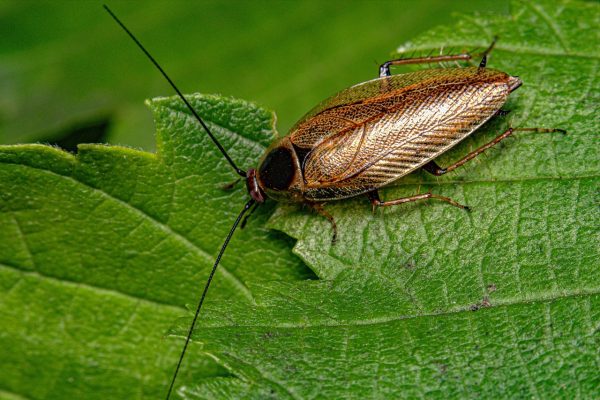
The cockroach you just spotted in your basement can survive for weeks without its head, which raises uncomfortable questions about what exactly counts as essential anatomy. Unlike mammals, cockroaches don’t breathe through their mouths. They have tiny holes along their body segments called spiracles that deliver oxygen directly to their tissues. No lungs, no blood pressure issues, no immediate death.
A headless cockroach eventually dies from dehydration or infection, not from the actual beheading. During those weeks, it can still stand, react to touch, and even walk around a bit. The head isn’t where all the important decisions get made—cockroaches have nerve clusters throughout their body that handle basic functions independently. It’s less like having a brain and more like having multiple control centers that can operate without constant supervision.
Cockroaches have survived for over three hundred million years with minimal changes to their basic design. They can withstand radiation levels that would kill a human, survive on almost anything organic, and reproduce at alarming rates. They’ve outlived the dinosaurs, survived multiple mass extinctions, and will probably still be around long after humans are gone. That’s not toughness—that’s engineering excellence.
15. Ant Colony Collective Intelligence
 Pin
Pin Ant Colony / Photo courtesy Dr. Moittreyee Saha
An individual ant wandering across your kitchen floor is, frankly, not very bright. It has maybe two hundred fifty thousand brain cells, compared to your eighty-six billion. Yet put enough ants together, and they create something that looks suspiciously like intelligence—decision-making, problem-solving, and adaptive behavior that emerges from thousands of simple interactions.
No ant in the colony understands the big picture. There’s no leader issuing orders, no blueprint, no master plan. Instead, each ant follows simple rules based on chemical signals called pheromones. One ant finds food and leaves a scent trail. Other ants follow stronger trails more often. Trails to better food sources get reinforced while weaker trails fade. The result is a colony that makes smart collective decisions despite being composed of individually stupid insects.
This swarm intelligence has inspired computer algorithms, robotics, and artificial intelligence research. Engineers use ant-colony optimization to solve complex routing problems, design communication networks, and coordinate robot teams. The ants pull this off using nothing more sophisticated than smell and simple response patterns. They’ve created a hive mind that functions like a single organism, solving problems that would stump individual ants while never understanding what they’re accomplishing together.
FAQs
Yes, their spray reaches nearly 100°C and causes painful burns. However, they usually spray in short bursts, so serious injuries are rare unless you’re deliberately harassing one.
The 13 and 17-year cycles may help them avoid syncing with predator population cycles, though scientists still debate the exact evolutionary advantage of these specific prime numbers.
They control the flash timing through nerve signals to light-producing cells, similar to how you control blinking, though they use it specifically for mating communication.
This behavior appears to be instinctive rather than learned, encoded in their genetics through millions of years of evolution favoring insects that moved convincingly.
Some species can lift even more—up to 100 times their body weight. Their small size and efficient muscle-to-weight ratio makes this possible through basic physics.









 Login with Google