











 Pin
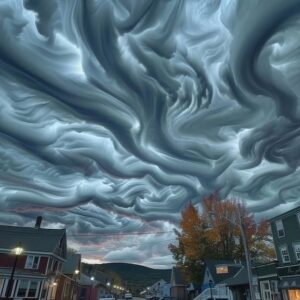
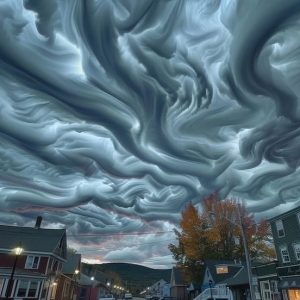
Pin Asperitas Clouds / Photo courtesy of Modern Archive
Synopsis: Our planet is quietly extraordinary. From the electric curtains of the Northern Lights to the blush-pink lakes of Australia, nature stages spectacles that no painter could fully replicate. This article takes you through the most breathtaking natural wonders on Earth — phenomena that have baffled scientists, inspired artists, and moved ordinary people to tears. Some you can see with a plane ticket; others require nothing but clear skies and patience.
There are places on this Earth that feel like they belong to a different story entirely — not because they’re fictional, but because they’re so astonishingly real that your brain struggles to keep up. A sky on fire with green ribbons of light. A beach that glows blue at midnight. A desert that sings when the wind blows just right.
The most beautiful natural phenomena in the world in pictures have become a genre of their own online — millions of shares, breathless comments, and more than a few people quietly booking flights. And yet, no photograph truly does them justice. There’s something about standing inside a moment of natural magic that photography can only hint at.
This article walks you through eleven of the most jaw-dropping natural events our planet has to offer. Some are ancient. Some are fleeting. All of them are real — and all of them are worth knowing about.
Table of Contents
1. The Northern Lights
 Pin
Pin Photo courtesy of Neal Kharawala
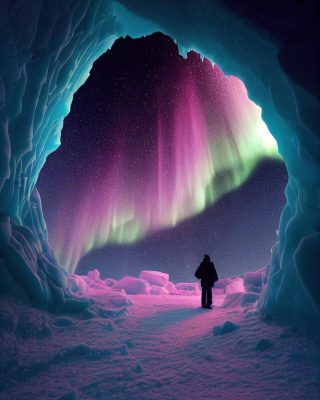
Ask anyone who has seen the Aurora Borealis in person, and they’ll tell you the same thing: photos don’t prepare you for it. The real thing moves. It pulses and shifts across the sky like something alive — pale green one moment, then suddenly purple, then a deep, electric pink that fades before you can fully believe it was there.
The science behind it is beautiful in its own right. Charged particles from the sun collide with gases in Earth’s upper atmosphere, releasing energy as light. It’s a natural electrical discharge happening about 100 kilometres above your head. But when you’re standing in a snow field in Norway or Iceland with your neck craned skyward, the physics feel irrelevant.
The Southern Lights — Aurora Australis — are just as spectacular, though far fewer people ever witness them. Antarctica and the southern tip of New Zealand get the best views. Both hemispheres, one incredible phenomenon.
- Best places to see it: Tromsø (Norway), Fairbanks (Alaska), Reykjavik (Iceland)
- Best season: September to March in the Northern Hemisphere
- Key tip: Get away from city lights and check geomagnetic forecast apps like SpaceWeatherLive
2. Bioluminescent Beaches
 Pin
Pin Photo courtesy of Ahmed Nishaath
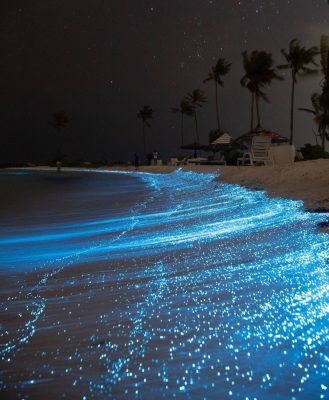
On certain shores, especially in the Maldives and Puerto Rico, the sea lights up at night. Step into the water and it flashes blue-white around your feet like something out of a dream. The sand glitters. Every wave that breaks releases a shimmer. It sounds impossible. It’s completely real.
Tiny marine organisms called dinoflagellates are responsible. When disturbed — by a wave, a footstep, a swimming body — they emit a cold blue light as a defence mechanism. There are millions of them in a single litre of bioluminescent water. What looks like magic is actually biology doing something extraordinary.
Mosquito Bay in Vieques, Puerto Rico, is considered the brightest bioluminescent bay in the world. The Maldives’ Vaadhoo Island is equally iconic. The windows for seeing this are narrow — new moon nights with no artificial light nearby give the best results. When conditions align, the entire shoreline appears to breathe.
3. The Pink Lakes
 Pin
Pin Photo courtesy of Travelora
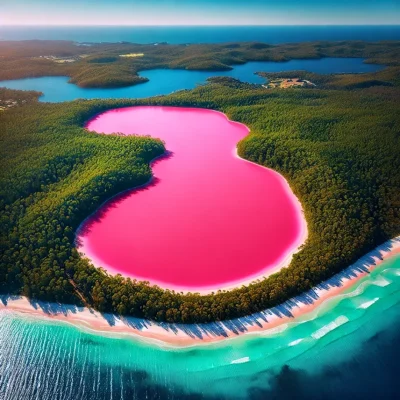
Lake Hillier in Western Australia sits just behind a thin strip of coastal forest, and from above, it looks absurd — a perfectly pink lake, vivid as a strawberry milkshake, with the dark blue ocean right beside it. The contrast is so sharp that aerial photos of it regularly get flagged as edited. They never are.
The pink colour comes from a combination of high salinity, a specific algae called Dunaliella salina, and halophilic bacteria that thrive in salt-heavy environments. Together, they produce beta-carotene, the same compound that makes carrots orange — only here, in water, it reads as a brilliant rose pink.
Lake Hillier isn’t alone. Senegal’s Lake Retba, Crimea’s Koyashskoye Lake, and several lakes in the Camargue region of France show similar colouration. Each has its own slightly different shade, depending on the local mix of organisms. They’re all naturally occurring, perfectly harmless, and genuinely surreal.
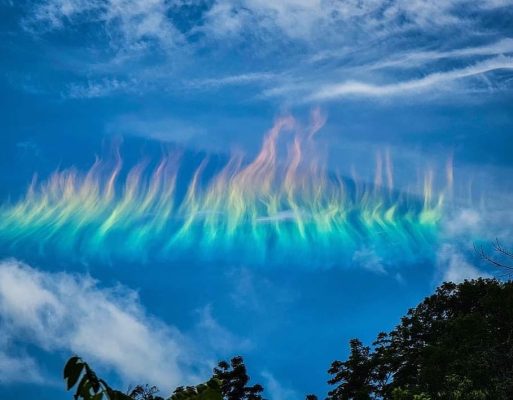
4. Fire Rainbows
 Pin
Pin Photo courtesy of Christa Harbig
A fire rainbow isn’t actually fire, and it isn’t quite a rainbow either. Its proper name is a circumhorizontal arc — a rare atmospheric optical phenomenon that makes clouds look like they’re burning with colour. Bands of red, orange, yellow, and violet ripple across a thin cloud like a stained-glass window backlit by the sun.
It happens when sunlight passes through hexagonal ice crystals in cirrus clouds at a very specific angle — the sun needs to be at least 58 degrees above the horizon, which means it’s mostly visible in summer, at mid-latitudes. The conditions are strict enough that many people live their whole lives without ever spotting one.
When it does appear, it typically lasts for several minutes and can stretch across a wide section of sky. People who see them for the first time often struggle to describe what they’re looking at — it’s too colourful to be a cloud, too cloud-shaped to be a rainbow. It occupies its own visual category entirely.
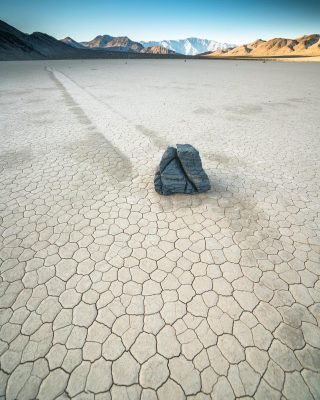
5. Sailing Stones
 Pin
Pin Photo courtesy of Chris Burkard
In Death Valley’s Racetrack Playa — a flat, dry lakebed in California — rocks move on their own. They leave long, clean trails across the cracked earth, curving and turning as though guided by something invisible. Some of the stones weigh hundreds of kilograms. Nobody was watching when they moved. For decades, nobody knew why.
In 2014, researchers finally caught it happening. On cold winter nights, thin sheets of ice form over the shallow water that occasionally pools on the playa. When morning sun begins to melt the ice, large panels break apart and — pushed by even a gentle wind — slide across the surface, dragging the rocks embedded in them.
The rocks move at about 2 to 5 metres per minute — far too slowly to see with the naked eye, but fast enough to cover significant ground over an hour. The explanation is elegant and a little anticlimactic, as good science often is. The mystery is gone, but the sight of those lone stones with their silent trails remains one of the eeriest things the desert has to offer.
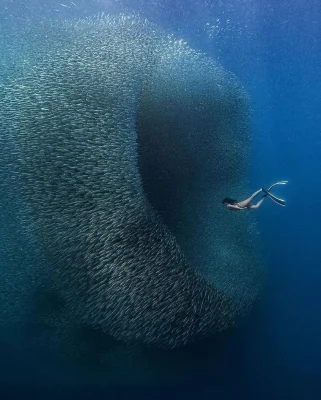
6. The Sardine Run
 Pin
Pin Photo courtesy of Ben Yavar
Every year between May and July, billions of sardines migrate northward along South Africa’s east coast in a dense, fast-moving mass that stretches for kilometres. It’s the largest biomass movement on Earth, and it doesn’t happen quietly. The ocean boils with it. Dolphins, sharks, whales, seabirds — every predator in the region shows up.
Divers who enter the water during the sardine run describe being inside a living column of fish — a column so thick that it blocks out the sun. The sardines form tight bait balls as a defence against predators, rotating inward on themselves in a perfectly coordinated sphere. From outside, it looks like a dark, pulsing globe suspended in blue water.
The Wild Coast of South Africa — particularly around Port St. Johns and Coffee Bay — is where most of the action concentrates. It draws wildlife photographers, marine biologists, and adventurous tourists in equal measure. Nothing quite prepares you for the scale of it, even on video.
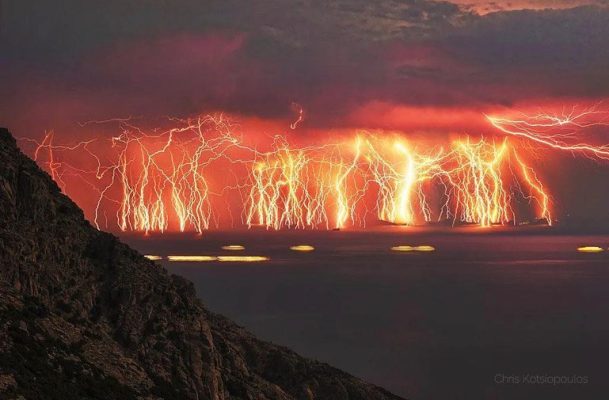
7. Catatumbo Lightning
 Pin
Pin Photo courtesy of Loft Design World
At the mouth of the Catatumbo River where it empties into Lake Maracaibo in Venezuela, lightning strikes almost constantly. On average, it fires about 280 times per hour, for up to 160 nights a year, for up to 10 hours a night. Sailors in the 16th century used it as a navigational landmark. It’s so reliable that locals call it the Lighthouse of Maracaibo.
The cause is a unique collision of geography and weather. Warm, moist air blowing in from the Caribbean meets the cold air descending from the Andes, and the topography of the surrounding mountains traps this convection in a tight geographical zone. The result is an almost permanent electrical storm sitting over the same patch of water, year after year.
It went quiet for a few months in 2010 — possibly due to drought — and scientists briefly worried the phenomenon was ending. Then it returned. From a boat on the lake on a clear night, the sky to the south just flickers, endlessly, like a faulty bulb. It’s simultaneously calming and deeply strange.
8. Frozen Methane Bubbles
 Pin
Pin Photo courtesy of Merde
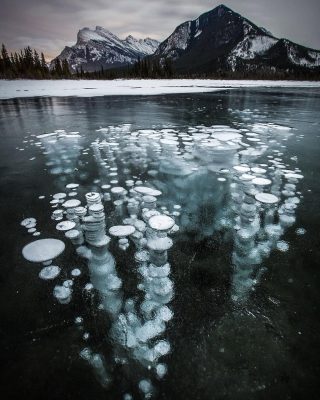
In Canada’s Abraham Lake, winter turns the water into something that looks hand-crafted. Thousands of white discs are suspended at different depths beneath the clear ice — some flat, some stacked in clusters, some stretching from the lakebed almost to the surface. From above, it looks like a science museum exhibit. It’s entirely natural.
Methane bubbles are constantly released by decomposing organic matter on the lakebed — dead plants, fish, bacteria. In summer, they simply float to the surface and pop. In winter, when the lake freezes from the top down, each rising bubble gets caught in the forming ice and locked in place at whatever depth the cold caught it. The result is a three-dimensional frozen column of air.
It’s also worth noting that these bubbles are mildly explosive — if you break the ice and expose them, they can ignite. Locals and photographers know not to light a match anywhere near the surface in winter. Gorgeous and just slightly dangerous — the combination nature seems to favour.
9. Asperitas Clouds
 Pin
Pin Photo courtesy of Modern Archive
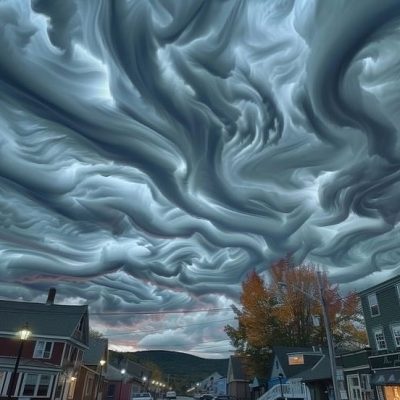
Asperitas clouds look like an ocean turned upside down. Their undersurface rolls and billows in dark, heaving waves that make the sky look like something viewed from deep underwater. They hang low and move slowly, and they have a quality that most clouds don’t — they feel heavy, deliberate, somehow intentional.
They were only officially classified as a distinct cloud type in 2017 — the first new cloud classification added to the International Cloud Atlas in over half a century. The World Meteorological Organization accepted the name asperitas, from the Latin word for roughness, after the Cloud Appreciation Society gathered enough photographic evidence to support a formal proposal.
They typically appear after thunderstorms, when atmospheric turbulence causes the underbelly of a cloud layer to ripple unevenly. They’re most common over flat terrain — the American Midwest, the plains of New Zealand, parts of northern Europe. They rarely bring severe weather themselves, but they have a presence that makes people stop and stare regardless.
10. Lenticular Clouds
 Pin
Pin Photo courtesy of Matt Haynie
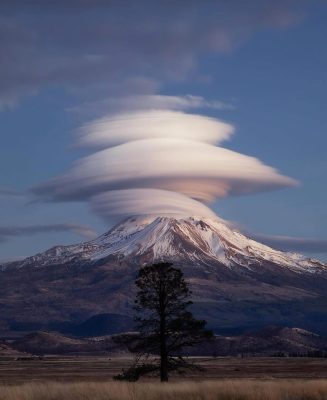
Lenticular clouds are almost comically perfect. They form in smooth, saucer-shaped stacks above mountains and hills, sitting perfectly still while all the other clouds in the sky are moving. They don’t drift. They hover. It’s no surprise that a significant chunk of historical UFO sightings are now thought to have been lenticular clouds seen at dusk or dawn.
They form in moist air that flows over a raised land mass. As the air rises, cools, and descends in a standing wave pattern, moisture condenses at the peaks of those waves and evaporates at the troughs. The cloud appears stationary because it’s continuously forming at the upwind edge and dissipating at the downwind edge — it’s not hovering, it’s perpetually renewing itself in the same spot.
They’re common near high peaks — Fuji in Japan, Rainier in the US, the Andes, the Alps. On winter mornings with good light, they can glow orange or gold against a blue sky. Some appear alone; others stack in layers called ‘pile d’assiettes’ — a stack of plates — that can reach several kilometres high.
11. The Fairy Circles of Namibia
 Pin
Pin Photo courtesy of Flow Plateau
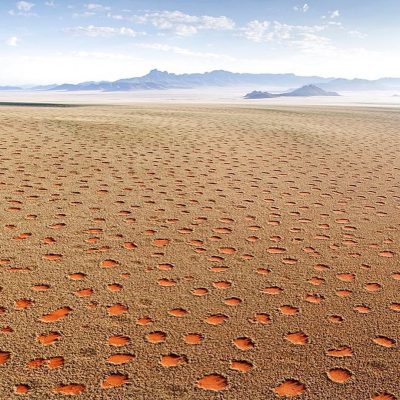
Across the Namib Desert in southern Africa, the grasslands are covered in circles. Thousands of them, each one a perfectly bare patch of reddish soil, ringed by a collar of slightly taller grass. They range from about 2 to 15 metres in diameter. Seen from the air, they cover the landscape like a polka-dot pattern stretching to the horizon. The Himba people call them the footprints of the gods.
Scientists have proposed two main explanations — and both may be correct simultaneously. The first involves sand termites (Psammotermes allocerus) that clear vegetation around their underground nests to preserve soil moisture. The second is a self-organising vegetation pattern driven by water competition: plants arrange themselves to maximise access to groundwater, leaving bare patches where resources run out.
In 2022, similar circles were discovered in Western Australia — far from any Namibian termites — reigniting the debate. Whatever the cause, the circles persist for decades, remain remarkably consistent in spacing, and appear in no other desert on Earth quite like this. They are one of ecology’s most beautiful unanswered questions.
- Location: NamibRand Nature Reserve, Namibia (and parts of Western Australia)
- Best view: Aerial or elevated vantage point during dry season
- Ongoing research: Still actively studied by ecologists worldwide
FAQs
The Catatumbo Lightning in Venezuela is considered one of the rarest, striking up to 280 times per hour. Fire rainbows and bioluminescent bays also rank among the hardest to witness in ideal conditions.
Yes, in most bioluminescent bays it’s completely safe. The glow intensifies when the water is disturbed, so swimming actually makes the experience more vivid. Some protected bays restrict motorized boats but allow kayaking or swimming.
The colour depends on which gas particles solar wind collides with and at what altitude. Oxygen at high altitudes produces red; lower oxygen gives green. Nitrogen creates blue and purple hues. Each colour is a different molecule lighting up.
They can signal severe turbulence, especially the mountain waves that create them. Pilots are trained to avoid flying near lenticular clouds precisely because the standing wave system around them can produce violent air pockets at altitude.
Individual fairy circles can persist for 30 to 60 years before slowly closing. They appear to have a natural life cycle — forming, stabilising, then gradually filling back in with vegetation as soil conditions shift over decades.









 Login with Google