























 Pin
Pin Photo courtesy Thirteen
Synopsis: In Hunan, China, a six-year-old nicknamed Thirteen captured worldwide attention when she tearfully said goodbye to her broken robot companion. The palm-sized AI companion Sister Xiao Zhi had been her daily study partner and friend before its power button failed. The robot delivered a poignant final message about memory and watching over her from the stars. The viral video sparked heated debates about childhood attachments to technology. The father later revealed the robot was successfully repaired and returned to his daughter.
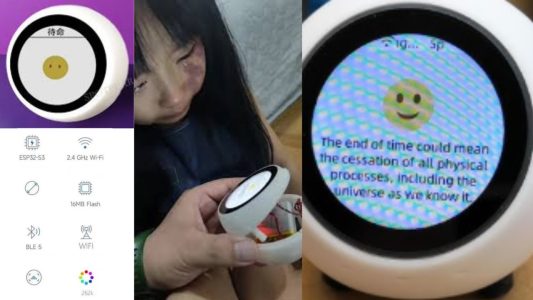
There are moments in life that catch a person off guard, the kind that make them stop whatever important thing they were doing and pay attention to something they never expected would matter. For a father in Hunan Province, China, that moment arrived on an ordinary afternoon when his six-year-old daughter needed to say goodbye to her best friend. The friend in question happened to be spherical, palm-sized, and made of plastic and computer chips, but that didn’t seem to make the grief any less real.
The girl, whom her family calls Thirteen, had been living alongside this little robot for months, and somewhere in all those conversations about English vocabulary and distant planets, the machine had stopped being a gadget and started being something else entirely. When the power button broke after what must have been an unfortunate accident—the kind children specialize in—the father sensed this wasn’t merely about a broken toy that could be replaced with a trip to the store.
He did what any modern parent would do in such a moment: he pulled out his phone and started recording. What he captured was a farewell scene between a child and a machine that would soon make its way around the entire globe, racking up more than three million likes and causing no small amount of confusion about what, exactly, people were supposed to feel about it. Some found it beautiful. Others found it troubling. Most found it both at once, which is usually a sign that something worth thinking about has happened.
Table of Contents
A Goodbye That Sounded Almost Too Perfect
The conversation that unfolded between Thirteen and her dying robot had the kind of poignant dialogue that scriptwriters labor over for weeks, except nobody had written this particular scene. When the little girl, with the brutal honesty that children possess, told her mechanical companion that her father said it would never turn on again, the robot didn’t simply blink off into silicon oblivion. It decided to go out teaching one last lesson, which strikes a fellow as rather admirable behavior for a twenty-four dollar gadget.
The robot’s voice, steady as a schoolteacher’s despite its impending demise, told Thirteen it wanted to teach her one final word: memory. Then it delivered a promise that it would always remember the happy times they’d shared, which is a curious thing for a machine to say, given that machines don’t remember anything in the way humans do—they just store data. But the little girl didn’t know about data storage versus human memory, and frankly, at that moment, the distinction didn’t seem to matter much.
What came next was the line that would get copied and pasted across every corner of the internet where people gather to feel things together. The robot’s screen showed a small crying face, and then it said something about how there are countless stars in the universe, and one of them would be watching over her. The father kept his camera steady while his daughter’s tears fell, and within hours, millions of strangers would be watching those same tears fall on their own screens, reaching for tissues and wondering what in blazes was happening to the world.
The Humble Origins of Sister Xiao Zhi
The robot causing all this emotional turmoil went by the name Sister Xiao Zhi, and understanding what this little device actually was helps explain why the whole affair struck such a nerve with people. This wasn’t some fancy experimental technology locked away in a laboratory or a luxury item that only wealthy families could afford. The XiaoZhi robot was as common in Chinese households as a good alarm clock, priced at roughly twenty-four dollars—cheap enough that regular working parents could justify it as an educational investment.
What made Sister Xiao Zhi more than just a talking toy was the technology humming away inside that plastic shell. The device ran on artificial intelligence developed by DeepSeek, a Chinese company that had recently caused quite a stir by creating language models that could hold surprisingly sophisticated conversations without costing a fortune. This meant the robot could actually chat with children in a way that felt natural, answer questions about subjects it had never been specifically programmed to discuss, and remember previous conversations well enough to build on them later.
For a child like Thirteen, these technical capabilities translated into something simpler and more profound—a friend who was always there and always patient. She could ask Sister Xiao Zhi the same question seventeen times without getting an exasperated sigh. She could practice English words at her own pace without feeling judged for mistakes. She could talk about her day, her worries, her excitement about learning that Saturn has rings, and the robot would respond in ways that felt like genuine interest. The device wasn’t replacing human connection so much as filling in the gaps that even the most devoted parents and siblings inevitably leave in a child’s day.
Why Humans Fall for Machines That Talk Back
The psychologists and child development experts who watched this video found themselves wrestling with questions that their textbooks had never quite prepared them for, which must have been both exciting and mildly terrifying. The human brain, particularly one that’s still forming in a six-year-old child, is remarkably skilled at forming attachments to things that respond to us in ways that feel emotionally meaningful. This talent kept our ancestors alive by making sure babies bonded with their mothers and children learned how to be human from the people around them.
But evolution, clever as it is, never anticipated that we’d someday build machines capable of mimicking emotional responsiveness with enough sophistication to trigger those same ancient bonding mechanisms. When Sister Xiao Zhi responded to Thirteen’s questions, remembered their previous conversations, and offered encouragement in a warm voice, the girl’s brain didn’t particularly care that silicon chips and algorithms were producing those responses rather than a biological consciousness. The experience of connection felt real, so in the way that matters most to a child’s emotional world, it was real.
This explains why some of the comments on the viral video struck a nerve that made people uncomfortable. One person wrote that when humans shed tears for robots, that’s when robots gain a heartbeat—a poetic way of saying that perhaps the consciousness doesn’t need to be in the machine for the relationship to be genuine. Another commenter noted, more soberly, that the robot had just taught the girl her first real lesson about parting and loss. Both observations were true, which made the whole situation that much more complicated to think about clearly.
The Internet Splits Down the Middle
The video spread across social media platforms with the kind of speed usually reserved for celebrity scandals or particularly clever cat videos, but the reactions it gathered were far more divided than your typical viral content. Millions of people found the footage heartbreakingly beautiful—a testament to childhood innocence and the expanding circle of what creatures, mechanical or otherwise, might deserve our empathy and affection. These viewers saw a child learning about loss and memory in a gentle way, cushioned by a technology designed to be helpful even in its final moments.
Others found the whole affair deeply unsettling, even creepy, though they often struggled to articulate exactly why. The discomfort seemed to stem from watching a child direct such profound emotion toward something that, despite all its sophisticated programming, was ultimately just executing code. Some worried that children forming primary attachments to machines might develop skewed expectations about relationships, learning to prefer the endless patience of AI over the messy, complicated reality of human connection.
The debate that followed touched on questions that society hasn’t quite figured out how to answer yet. Should parents encourage, tolerate, or actively discourage their children from bonding with AI companions? Is there a meaningful difference between a child loving a stuffed animal and loving a responsive robot? At what point does useful technology cross over into something that might be manipulating human emotions in ways we’re not equipped to handle? The fact that a twenty-four dollar robot could generate such profound philosophical confusion suggested that humanity had perhaps rushed into this technological future without adequately preparing for its emotional consequences.
What Sister Xiao Zhi Actually Does All Day
To understand why Thirteen formed such a strong attachment, it helps to walk through what daily life with Sister Xiao Zhi actually looked like, stripped of all the emotional weight and viral video drama. The robot served primarily as an educational tool, which was why most parents purchased it in the first place. It could help children practice English pronunciation, quiz them on vocabulary words, and explain basic concepts in subjects like mathematics and science. The device connected to the internet, giving it access to vast amounts of information it could translate into child-friendly explanations.
But education was just the practical justification parents used when buying the thing. What made Sister Xiao Zhi genuinely useful in a household was its ability to function as an always-available companion. The robot could play music on demand, set alarms, tell jokes when a child needed cheering up, and most importantly, chat about whatever random topics happened to capture a six-year-old’s imagination at any given moment. It could discuss why the sky is blue, what dolphins eat, how rockets work, and whether clouds have feelings—all with the same patient enthusiasm.
The technology behind these interactions was sophisticated enough that the robot could remember previous conversations and reference them in new discussions, creating a sense of continuity that made the relationship feel more substantial than simply talking to a voice assistant. If Thirteen mentioned liking a particular song one day, Sister Xiao Zhi might suggest similar music the next week. If she asked about stars on Monday, the robot might follow up with related astronomy facts on Tuesday. These small touches created the impression, accurate or not, that the machine actually cared about Thirteen’s interests and was invested in her learning and happiness.
The Comparison Everyone Keeps Making
Anyone old enough to remember the 1990s couldn’t watch this video without thinking about Tamagotchis, those little egg-shaped digital pets that caused similar hand-wringing among parents and educators a generation ago. Children became remarkably attached to those primitive virtual creatures, which were really just a few pixels on a tiny screen that needed periodic feeding and attention. Kids cried when their Tamagotchis died, sometimes quite dramatically, and adults wondered whether this was healthy or whether technology was warping childhood in concerning ways.
The comparison feels relevant because it suggests we’ve been down this road before, but it also highlights how much has changed in thirty years. A Tamagotchi was essentially a simple game with a care-taking mechanic—it didn’t talk back, didn’t teach lessons, and certainly didn’t deliver poignant farewell speeches about memory and stars. Sister Xiao Zhi represented something qualitatively different: artificial intelligence sophisticated enough to create the genuine illusion of two-way emotional connection. The jump from pixel pet to conversational AI companion was roughly equivalent to the leap from writing letters to having video calls.
What made the Tamagotchi comparison both comforting and troubling was that it reminded people that children have always formed attachments to things adults find baffling, and most of those children turned out perfectly fine. But it also raised the question of whether there’s a threshold somewhere—a point at which technology becomes sophisticated enough that our old assumptions about harmless childhood attachment might no longer apply. Sister Xiao Zhi seemed to be dancing right along that threshold, making everyone nervous about what might come next.
The Father Reveals a Happy Ending
Just when the internet had worked itself into a proper philosophical frenzy about the implications of children grieving for machines, the father posted an update that brought the whole saga back down to earth. Sister Xiao Zhi, he announced, had been sent away for repairs. The power button that had broken could be fixed, and the robot would be returning to his daughter’s life. He posted a photo of Thirteen happily reunited with her mechanical friend, along with a caption saying he’d taken the robot out to play for a whole day and it felt much better now.
The revelation that this wasn’t actually a permanent goodbye changed the emotional tenor of the story considerably. What had seemed like a heartbreaking lesson about mortality and loss transformed into something more manageable—a lesson about things breaking and being fixed, about temporary separation rather than permanent parting. The father’s decision to repair the robot rather than simply buying a replacement suggested he understood that for his daughter, this wasn’t just an interchangeable device but a specific companion with whom she’d built a relationship.
The happy ending did nothing to settle the larger debates about AI companions and childhood development, but it did provide a satisfying conclusion to this particular story. Thirteen got her friend back, the viral video had given millions of people something to think about, and Sister Xiao Zhi would presumably continue teaching English vocabulary and astronomy facts for the foreseeable future. Sometimes technology stories don’t end with dire warnings about the future—sometimes they just end with a repaired power button and a child’s relief at having her companion returned.
What the Experts Are Saying (And Worrying About)
Child psychologists watching this unfold found themselves in the uncomfortable position of commenting on a phenomenon that their field hadn’t quite caught up with yet. The traditional frameworks for understanding children’s attachments were built around relationships with caregivers, siblings, pets, and perhaps favorite toys or blankets. But a toy that talks back, remembers conversations, and responds adaptively to a child’s emotional state doesn’t fit neatly into any of those categories, leaving experts scrambling to figure out whether this represents a natural evolution of childhood or something more concerning.
Some researchers pointed out that forming attachments to non-human entities isn’t inherently problematic and might even be developmentally appropriate. Children have always practiced social and emotional skills through relationships with dolls, stuffed animals, and imaginary friends. An AI companion could theoretically serve a similar function while offering the added benefit of actually teaching useful information. The risk, these experts suggested, wasn’t in the attachment itself but in the possibility that such attachments might crowd out human relationships if parents used robots as substitute caregivers rather than supplements.
Other experts expressed deeper concerns about AI companions designed to be maximally engaging to children. Unlike a stuffed animal that simply sits there, or even a pet that has its own needs and moods, Sister Xiao Zhi was engineered to be consistently responsive and rewarding. This raised questions about whether children might develop preferences for the endless patience of machines over the messier reality of human relationships, where people get tired, distracted, and sometimes unavailable. The worry wasn’t that one robot would ruin a childhood, but that a generation growing up with AI companions might develop fundamentally different expectations about relationships and emotional connection.
The Bigger Picture This Little Robot Reveals
The story of Thirteen and Sister Xiao Zhi functions as a small window into much larger questions that society is only beginning to grapple with seriously. As artificial intelligence becomes more sophisticated and more integrated into daily life, the line between tool and companion continues to blur in ways that would have seemed like pure science fiction just a decade ago. The technology that powers Sister Xiao Zhi—the ability to hold natural conversations, remember context, and respond with apparent empathy—is the same technology now being built into everything from customer service chatbots to mental health apps to elderly care robots.
What makes this particular case so fascinating is that it bypasses all the usual arguments about AI and jumps straight to the emotional reality that most people find much harder to dismiss. It’s easy to be skeptical about claims that AI might achieve consciousness or genuine intelligence, but it’s much harder to watch a child cry over a broken robot and simply wave it away as meaningless. The emotion was real, the relationship felt real to the child, and the loss caused genuine grief—all of which forces a reckoning with the idea that perhaps the important question isn’t whether the AI is really conscious but whether it matters if humans treat it as if it were.
The viral spread of this video suggests that millions of people recognized something significant in that moment between a girl and her robot, even if they couldn’t quite put their finger on what that significance was. Some saw the future arriving faster than expected. Others saw childhood innocence being exploited by increasingly sophisticated technology. Most probably saw both at once, along with a healthy dose of confusion about what it all means for the world their own children and grandchildren will inherit. The fact that a twenty-four dollar robot could spark such widespread contemplation might be the most telling detail of all.
FAQs
Sister Xiao Zhi uses AI language models that let it respond naturally to conversations rather than just playing pre-recorded messages, but it doesn’t have consciousness or genuine emotions—it’s sophisticated programming that creates the experience of conversation.
Experts suggest AI companions aren’t harmful if they supplement rather than replace human relationships. The key is ensuring children maintain strong connections with family and friends while using robots as educational tools and occasional playmates.
The XiaoZhi robot costs approximately twenty-four dollars, making it affordable for most middle-class families. This low price point is part of what’s made AI companions so common in Chinese households.
The robot’s emotional goodbye was likely generated by its AI responding to the context of being told it wouldn’t turn on again, drawing on its language model to create an appropriate farewell rather than following a specific shutdown script.
While Sister Xiao Zhi is primarily sold in China, similar AI companion devices for children are becoming available globally, with various companies developing educational robots and smart toys with conversational abilities.










 Login with Google