
























 Pin
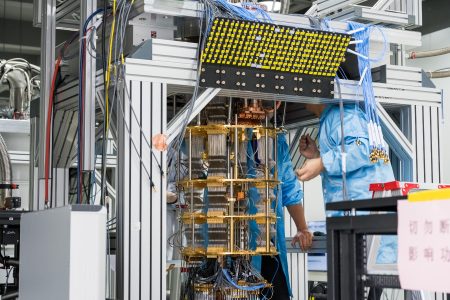
Pin Technicians fine-tune and set up China’s self-developed third-generation superconducting quantum computer / Photo courtesy of Anhui Quantum Computing Engineering Research Center
Synopsis: China has released Origin Pilot, its first domestically developed quantum computer operating system, as a free public download. Built by Hefei-based Origin Quantum Computing Technology Co., Origin Pilot manages qubit scheduling, parallel task processing, and automatic chip calibration across superconducting, trapped ion, and neutral atom quantum processors. It runs on China’s own third-generation quantum computer, Origin Wukong. Officials describe it as the world’s first open-source quantum OS available for local installation — a move that signals China’s quiet but determined push toward full technological self-reliance in one of the most consequential fields of the 21st century.
There is a city in eastern China called Hefei — studious, understated, and largely invisible to the world’s evening news — that has been doing something quietly extraordinary for the better part of a decade. Not borrowing. Not licensing. Not waiting for a handout from the West. Building.
Table of Contents
The Name Behind the News: What Is Origin Pilot?
 Pin
Pin Origin Quantum Computing / Photo courtesy Origin Pilot
A person who builds their own tools understands the work differently than one who merely borrows them. That philosophy sits squarely at the heart of what Origin Pilot represents for China’s technology ambitions. Origin Pilot serves as the operations and scheduling hub for quantum computers — unifying multi-architecture quantum hardware, connecting to cloud and applications, and orchestrating with HPC, AI, and classical computing for stable, scalable quantum services.
First introduced in 2021 by Hefei-based Origin Quantum Computing Technology Co., Origin Pilot has undergone several iterations and evolved into an advanced platform that supports major technological pathways, including superconducting qubits, trapped ions, and neutral atom processors. Five years of iteration and refinement went into what researchers can now simply download and run — a detail worth pausing on.
Origin Pilot includes modules for quantum task scheduling, quantum resource management, quantum program compilation, and qubits’ automatic calibration — allowing it to manage quantum computing resources, solve multi-quantum processor scheduling problems, enable parallel execution of multiple quantum programs, and calibrate quantum resources efficiently. In plain terms: it does not just run the machine. It keeps the machine honest, tuned, and productive — all at once.
The "Soft Heart" of a Quantum Machine
 Pin
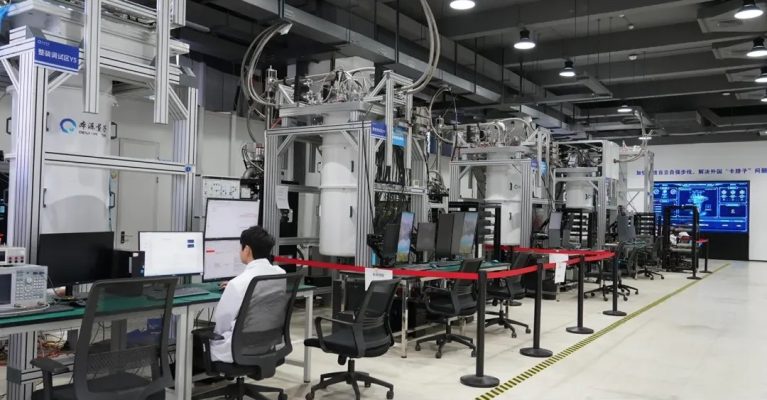
Pin Anhui Quantum Computing Engineering Research Center / Photo courtesy Anhui Quantum Computing
There is an old truth in engineering that the hardware gets the glory and the software does the work. A quantum computer without an operating system is, essentially, a room full of extraordinarily expensive cold metal. Origin Pilot is what transforms that metal into a thinking machine. By providing a unified programming interface and a standardized driver system, Origin Pilot helps overcome technical barriers in core quantum software.
This is no small feat. Classical computers — the kind that run phones, hospitals, and banks — took decades to develop stable operating systems. Quantum computers operate at temperatures near absolute zero (around −273°C), are extraordinarily sensitive to the slightest noise, and require constant real-time calibration just to hold their quantum state for a few microseconds. Writing a stable OS for such a machine is, in engineering terms, something like writing traffic laws for a city that reshapes its roads every few seconds.
What makes Origin Pilot particularly noteworthy is its hybrid design. The software is described as an integrated quantum-classical-AI operating system — meaning it does not treat quantum computing as a separate island. It connects quantum processors directly to classical computers and AI systems, allowing them to work in coordination rather than isolation. That integration is precisely what the next generation of real-world quantum applications will require.
The Machine It Runs On: Meet Origin Wukong
 Pin
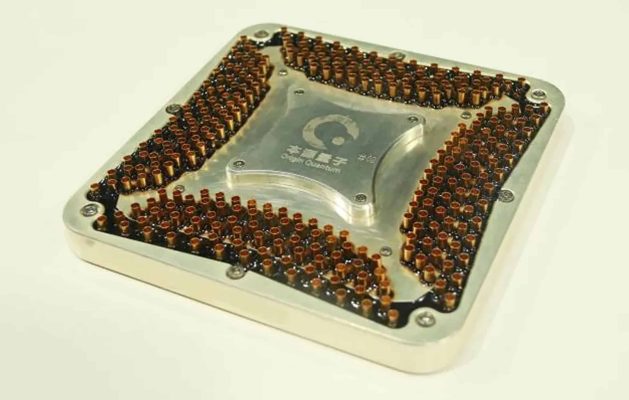
Pin Wukong — a 72-qubit superconducting quantum processor / Photo courtesy Origin Quantum
Every operating system needs hardware worthy of it. Origin Pilot found its home in a machine with a fittingly dramatic name. In January 2024, Hefei-based Origin Quantum unveiled Wukong — a 72-qubit superconducting quantum processor and China’s most advanced programmable and deliverable superconducting quantum computer.
The name is not accidental. Wukong’s name comes from the mythical Chinese character Sun Wukong, the Monkey King, who could assume 72 different forms — in this context, the name symbolizes the power and versatility of quantum computing. There is a certain literary elegance to naming your most powerful quantum machine after a shapeshifter from a 16th-century novel. Mark Twain himself might have appreciated the poetry.
The hardware behind the name is impressive. The Wukong chip has a total of 198 qubits, including 72 working qubits and 126 coupler qubits — and Origin Quantum, established in 2017, leads in quantum computing patents in China and ranks sixth globally. For context, Google’s Sycamore processor — the one that made headlines in 2019 for demonstrating quantum supremacy — had just 53 qubits. Wukong doesn’t just match it. It surpasses it in raw qubit count, while being built entirely on Chinese soil, with Chinese-designed chips, and now, a Chinese operating system.
What "Open Source" Really Means Here
The word “open source” carries weight in the technology world. It means the source code is publicly available — anyone can read it, study it, build on it, and improve it. It is the philosophy that gave the world Linux, the operating system that now quietly runs most of the internet. When China announces an open-source quantum OS, the implications deserve careful thought.
The open-download model allows research institutions, universities, and developers worldwide to access a quantum computing operating system developed in China. That sentence, read slowly, contains a great deal. It means a graduate student in Nigeria, a researcher in Brazil, or a startup in South Korea can now download, install, and experiment with a quantum operating system without paying licensing fees, without signing enterprise agreements, and without dealing with the gatekeeping that has historically surrounded Western quantum platforms.
This is strategic generosity — the kind that builds ecosystems. IBM and Google have their own quantum cloud platforms, but those are largely cloud-based and controlled environments. Origin Pilot is available for local download — a distinction that matters enormously for users in regions with limited cloud infrastructure, and for researchers who need to work offline or within secure institutional networks.
The Company That Built It: Origin Quantum's Quiet Rise
Origin Quantum is not a household name in the West. It probably should be. Established in 2017, the Hefei-based company was responsible for China’s first quantum chip production line, China’s first quantum computer operating system, and China’s first quantum computing measurement and control system. That is three national firsts in under a decade from a company most people outside China cannot name.
The company’s founding was no accident of timing. It was built deliberately, seeded by researchers from the University of Science and Technology of China — one of the country’s premier scientific institutions — with explicit ambitions to build a full quantum computing stack from the chip up. Not just the hardware. Not just the software. Everything. Origin Quantum has established two major laboratories for quantum chip manufacturing and quantum computer assembly testing, achieving full-stack development from chips to complete system software and hardware.
The fruits of that full-stack philosophy are now visible. Origin Wukong runs on a chip Origin Quantum designed. It is controlled by a measurement and control system Origin Quantum built. And now it runs on an operating system Origin Quantum wrote. That is a level of vertical integration that rivals anything IBM or Google has achieved — and it was done in less than a decade, under the pressure of US export restrictions and Western technology sanctions.
The Global Quantum Race: Where China Stands
Quantum computing is not merely a technology competition. It is, in the quiet but serious language of geopolitics, a national security issue, an economic issue, and a scientific sovereignty issue all rolled into one. The country that masters quantum computing first gains advantages in encryption, materials science, drug discovery, financial modeling, and artificial intelligence that are difficult to overstate.
China was the first country to reach quantum supremacy in two different platforms — first with photonic Jiuzhang in 2020, then with superconducting qubits in 2021 — making it a serious player at the frontier of quantum science. Google demonstrated quantum supremacy in 2019 with its 53-qubit Sycamore processor, performing a task in 200 seconds that classical computers would need thousands of years to complete. China followed within two years — with two different approaches.
Where China has historically lagged is in the software and ecosystem layer — the tools, frameworks, and operating systems that make quantum hardware usable by the broader scientific community. China faces a challenge maintaining its place among the countries leading quantum technology breakthroughs due to sanctions and bans on the export of goods and expertise. Origin Pilot is, in part, a direct response to that challenge. By building its own OS and releasing it openly, China is constructing an ecosystem that does not depend on Western goodwill to function.
Wukong Goes Global
Long before Origin Pilot became a downloadable OS, Origin Wukong had already attracted global attention — from a direction that surprised many observers. When Origin Wukong was opened to global users, remote visitors from 61 countries accessed the machine, with the United States topping the list of users.
That detail carries a certain irony worth savoring. American researchers — citizens of the country whose government has been most aggressive in restricting China’s access to advanced semiconductor technology — were the most enthusiastic users of China’s own quantum computer. Science, it turns out, tends to find its way around politics. Since its launch, Origin Wukong has completed approximately 350,000 quantum computing tasks for users from 139 countries, covering diverse industries such as fluid dynamics, finance, and biomedicine.
The reach of that number is significant. 139 countries means Origin Wukong is not just a Chinese machine — it has become, in practice, a piece of shared global scientific infrastructure. And with Origin Pilot now available for download, that footprint is only going to grow. Researchers who previously accessed Wukong through the cloud can now study the operating system locally, build applications on top of it, and contribute improvements back to the ecosystem.
Quantum Meets AI: The Integration That Changes Everything
If the release of Origin Pilot were simply about quantum computing, that would be remarkable enough. But the more consequential detail is buried in a single phrase: integrated quantum-classical-AI operating system. That hyphenated description is, quietly, one of the most significant things about this release.
A team of scientists and engineers in Hefei recently used Origin Wukong to fine-tune a billion-parameter AI model — marking a world-first achievement in AI and quantum computing integration. To appreciate why this matters, a brief note on what “fine-tuning” means in AI: it is the process of taking a powerful, general-purpose AI model and adapting it to perform a specific task — say, medical diagnosis or financial risk assessment. This normally requires enormous classical computing resources. Doing it with a quantum computer is, as of early 2026, something no one had done before.
The method is described as equipping a classical large model with a “quantum engine,” enabling them to work together, as Dou Menghan, vice-president of Origin Quantum, explained. Origin Pilot is designed to be the operating layer that makes this kind of quantum-classical-AI collaboration seamless — not a novelty experiment, but a routine capability. That is a different kind of ambition from simply making a faster calculator. It is an ambition to reshape how intelligence itself is computed.
Security in the Quantum Age: A Shield Built In
A powerful quantum computer, in the wrong hands or the wrong conditions, is not just an opportunity — it is a risk. Quantum machines powerful enough to solve previously intractable problems are also, theoretically, powerful enough to break the encryption systems that protect banking, communications, and national infrastructure. China appears to have thought carefully about this.
Origin Wukong integrated China’s first post-quantum cryptography “anti-quantum attack shield” — new encryption technology designed to replace conventional public-key cryptography systems such as RSA. This means the machine that runs Origin Pilot is not merely powerful — it is also armored against the very category of attacks that quantum computers themselves could one day enable.
This is a detail that the broader technology world should note carefully. The release of an open-source quantum OS raises legitimate questions about security: if anyone can download and study the operating system, does that create vulnerabilities? China’s answer, apparently, is to build post-quantum encryption into the hardware stack itself, separate from and deeper than the OS layer. Whether that answer is sufficient will be a matter of ongoing debate — but it demonstrates that the engineers behind Origin Pilot are not naive about the risks their own creation introduces into the world.
What This Means for Researchers, Developers, and Students
For the average working researcher or graduate student, the release of Origin Pilot is not an abstract geopolitical event. It is a practical opportunity. Before this release, building applications on top of a quantum operating system required either expensive cloud subscriptions, proprietary licenses, or physical access to a Western quantum lab. That is a significant barrier for institutions in the developing world, for independent researchers, and for universities with limited budgets.
Now, the barrier is lower. Significantly lower. The Anhui Quantum Computing Engineering Research Centre said the release aims at reducing entry barriers and supporting the expansion of the global quantum computing ecosystem. A researcher in Nairobi or São Paulo or Jakarta can download Origin Pilot today and begin building. They can study how a real quantum operating system manages qubit scheduling. They can test their own quantum algorithms. They can contribute to an open-source project that, unlike IBM’s or Google’s platforms, does not sit behind a corporate walled garden.
The list of what Origin Pilot supports is worth knowing:
- Superconducting qubits — the same technology used by IBM and Google
- Trapped ion processors — used by companies like IonQ and Honeywell
- Neutral atom processors — a newer, fast-growing approach used by startups like QuEra and Pasqal
- Automatic qubit calibration — reducing the manual overhead that has historically slowed quantum research
- Parallel quantum task execution — allowing multiple programs to run simultaneously on the same machine
That is a broad, cross-platform capability set that makes Origin Pilot genuinely useful across hardware types — not just a tool locked to China’s own machines.
Technology Self-Reliance and What Comes Next
There is a phrase that has become something of a national motto in China’s technology policy circles: zìlì zìqiáng — self-reliance and self-improvement. It appears in government documents, in company mission statements, and in the speeches of scientists who have spent careers building things their country was once told it could not build.
The launch of Origin Pilot comes as China highlights “industries of the future” — including quantum technology, biomanufacturing, hydrogen and fusion energy, brain-computer interfaces, embodied AI, and 6G — in draft guidance for the 15th Five-Year Plan for 2026 to 2030. That context matters. Origin Pilot is not a one-off product release. It is a piece of a deliberate, decade-long infrastructure strategy — one designed to ensure that China’s most critical future industries rest on foundations that China itself controls.
For the rest of the world, the lesson is neither fear nor admiration — it is attention. A country that began its quantum computing journey with borrowed ideas has now built its own chips, its own machines, its own control systems, and its own operating system, opened the last of those to the world, and invited everyone to come build on it. In just three months of Wukong being online, it notched up over 8 million remote visits from 120 countries, completing approximately 180,000 global quantum computing tasks. The world already found its way there. With Origin Pilot now downloadable, the next chapter of that story is just beginning — and it will be written by researchers, developers, and students from every corner of the globe, whether anyone in Washington or Brussels planned for that or not.
FAQs
Origin Pilot is China’s first open-source quantum computer OS, built by Hefei-based Origin Quantum. It manages qubit scheduling, calibration, and parallel task execution across multiple processor types.
Yes. As of February 26, 2026, it is publicly available for local download via the official Origin Quantum website — no license fee required.
It supports superconducting qubits, trapped ion processors, and neutral atom processors — covering most of the major quantum computing technologies in use today.
IBM and Google operate mainly through cloud-based access. Origin Pilot is a local download — meaning researchers can run and study it offline, without cloud dependency.
China addressed this by integrating post-quantum cryptography encryption into Origin Wukong itself — a security layer designed to protect against the very attacks quantum computers could one day enable.










 Login with Google