






















 Pin
Photo Courtesy of Horizon Dwellers
Synopsis: Half of a right angle and one-eighth of a full circle, this modest slice of a turn does far more work than its size suggests. It splits a square corner into two matching halves, gives the diagonal its famous √2 stretch, and decides how far a thrown ball can fly. This article explains what it is, how to draw it, the neat side ratio, and the mistakes that trip people up, then shows how geometry, carpentry, architecture, engineering, plumbing, and daily life rely on it.
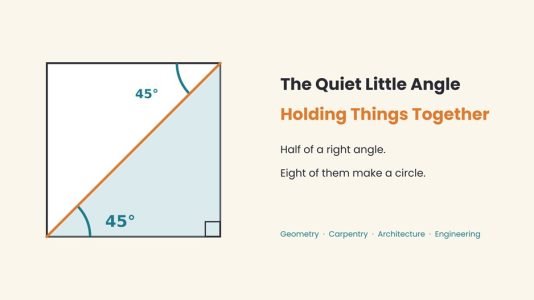
A square sheet of paper, folded corner to corner, has very little to say for itself. The crease it leaves cuts the corner neatly in two, though, and each half is a 45 degree angle. No ruler, no protractor, no permission slip from the geometry department. Just a fold.
This is the angle that sits exactly halfway between lying flat and standing upright. It is fair-minded and refuses to lean too far either way, which is why builders, designers, and physics teachers all keep a soft spot for it. Quick facts before the real story starts:
- Half of a right angle (90°)
- Eight of them fill a full circle (360°)
- An acute angle, because it is smaller than 90°
Most people have met it a hundred times without a proper introduction: in a picture frame corner, a diagonally cut sandwich, a brace holding up a roof. The next ten sections make the introductions properly.
Table of Contents
45° Angle Definition: Half of a Right Angle
Strip away the fuss and a 45° angle is simply half of a right angle: 90 divided by 2. It counts as an acute angle, which is geometry’s polite way of saying “smaller than a square corner”, and it sits at the exact midpoint between a flat line (0°) and an upright one (90°).
It answers to several names. Mathematicians write it as π/4 radians, carpenters call it a miter angle, and anyone feeling blunt can call it a half-right angle. One-eighth of a full turn is the most honest description of the lot.
Two of them make a right angle and eight make a circle. That tidy arithmetic explains its popularity: it fits into other angles without leaving crumbs.
- In degrees: 45°
- In radians: π/4
- Share of a full turn: 1/8
- Its complement: also 45°, which makes it the only angle that is its own complement
The 45-45-90 Triangle: Properties and Side Ratio
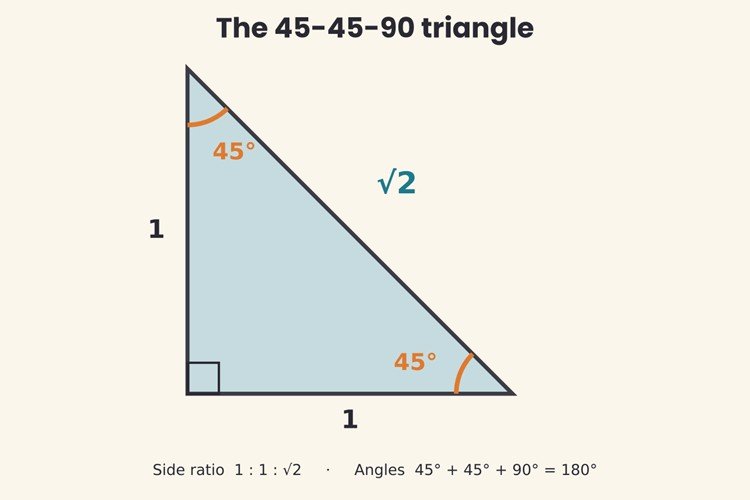
The angle’s favorite address is the 45-45-90 triangle, also known as the isosceles right triangle. It has one right angle and two matching 45° angles. A triangle’s angles always add up to 180°, so once the right angle takes its 90°, the remaining 90° has no choice but to split evenly.
 Pin
Photo Courtesy of Horizon Dwellers
Equal angles mean equal sides opposite them, so the two legs match, and the hypotenuse, the long side facing the right angle, equals a leg multiplied by the square root of 2, about 1.414. Make the legs 1 and the hypotenuse is √2. Make them 10 and it is 10√2. The size changes, but the ratio never changes its mind.
- Angles: 45°, 45°, 90°
- Sides: 1 : 1 : √2
- Pythagoras check: 1² + 1² = 2, so the hypotenuse is √2
- Fun fact: it is the only right triangle that is also isosceles
Sin, Cos, and Tan of 45°: Trigonometry Values Explained
Trigonometry has a reputation for being difficult, but at 45° it relaxes. Both legs are equal, so the ratio of one leg to the other is exactly 1. That makes tan 45° equal to 1, with no calculator and no frowning required.
Sine and cosine divide a leg by the hypotenuse, which gives 1/√2, or about 0.707, for both. This is the one spot between flat and upright where sine and cosine look at each other and agree, because the angle and its complement are the same size.
These values turn up in exam papers, force calculations, and anything involving a slope or a push at an even tilt. Memorize them once and they pay rent for life.
- sin 45° = cos 45° = 1/√2 ≈ 0.707
- tan 45° = cot 45° = 1
How to Draw or Make 45° With a Compass, Protractor, or Paper
A protractor is the obvious tool: line up the baseline, find 45 on the scale, mark the dot, join the dots. Done, and slightly dull. Two other methods need no numbers at all and make a better story at dinner.
The first is the compass method, which bisects a right angle:
- Draw a right angle, using a set square or the corner of a book.
- Put the compass point on the corner and draw an arc that crosses both arms.
- From each crossing, draw an arc of equal width so the two arcs meet inside the angle.
- Join the corner to that meeting point. The new line cuts the right angle into two 45° angles.
The second method is paper folding. Fold one corner of a square sheet onto the opposite corner, and the crease gives 45° at both ends. Carpenters keep a 45° set square handy for the same job, but the cheapest tool in the house is still a square piece of paper.
45° in Geometry: Squares, Octagons, Clocks, and Compass Points
Draw a diagonal across any square and it splits two corners into 45° angles, leaving two identical 45-45-90 triangles. The diagonal comes out about 1.414 times as long as a side, and that √2 is a number that never ends and never repeats, which has irritated people who prefer tidy figures.
A regular octagon carries the angle around too. It turns 45° at every corner, so eight turns bring a walker back to the start, and every stop sign is quietly a lesson in this fact. A pizza cut into eight slices does the same trick, with each slice tapering to a 45° point.
Clocks and compasses join in. The hour hand covers 45° in an hour and a half, the minute hand in seven and a half minutes, and northeast sits exactly 45° between north and east.
- Square diagonal: two 45-45-90 triangles
- Regular octagon: a 45° turn at each corner
- Eight-slice pizza: 45° per slice
- Northeast: halfway between north and east
45° Miter Cuts in Carpentry and Picture Frames
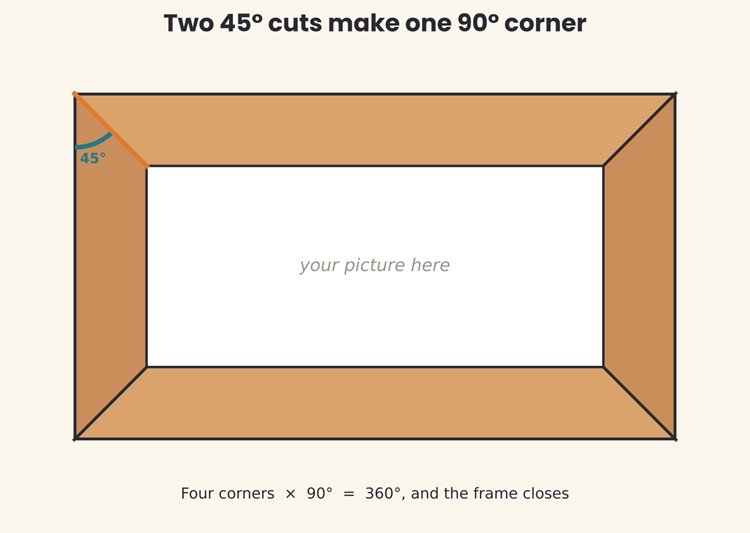
Woodworkers knew this angle long before laser levels existed. A miter joint cuts two pieces at complementary angles, usually 45°, so they meet as a crisp 90° corner with no end grain on show. Look at nearly any picture frame and one is sitting there, four times over.
 Pin
Photo Courtesy of Horizon Dwellers
The trick has a catch: the cuts must be accurate. One woodworker’s sums show that a mere 0.12° error in each cut, repeated over a frame’s eight cuts, grows into about a full degree, which is easy to spot.
Clever makers let geometry do the correcting. If the two matching pieces are cut on opposite sides of a true 90° fence, the errors cancel, since 45.1° plus 44.9° still makes 90°. One more warning: a miter glues end grain to end grain, so it is handsome rather than strong. Frames and trim are fine. Bridges are not.
45° in Architecture: Diagonal Bracing and Chamfered Edges
Buildings have a nervous habit of leaning. Wind, weight, and time push on a frame, and a rectangle made only of upright and flat pieces can fold into a parallelogram like a tired cardboard box. A diagonal brace stops the folding.
UK roofing standards say how steep that brace should be: diagonal rafter bracing at about 45° to the rafters when seen from above, and chevron bracing at about 45° between roof truss members, nailed to at least three trusses. Truss industry guides draw the same angle for bracing webs.
Builders also use the angle on edges. A chamfer shaves a corner off at 45°, so it stops catching shins and chipping at the first knock. Roof braces and chamfers have little in common except this one angle, which is rather the point.
- Diagonal rafter bracing: about 45° to the rafters, seen from above
- Chevron bracing: about 45°, fixed to at least three trusses
- Chamfer: an edge trimmed at 45°
45° in Engineering and Physics: The Best Projectile Launch Angle
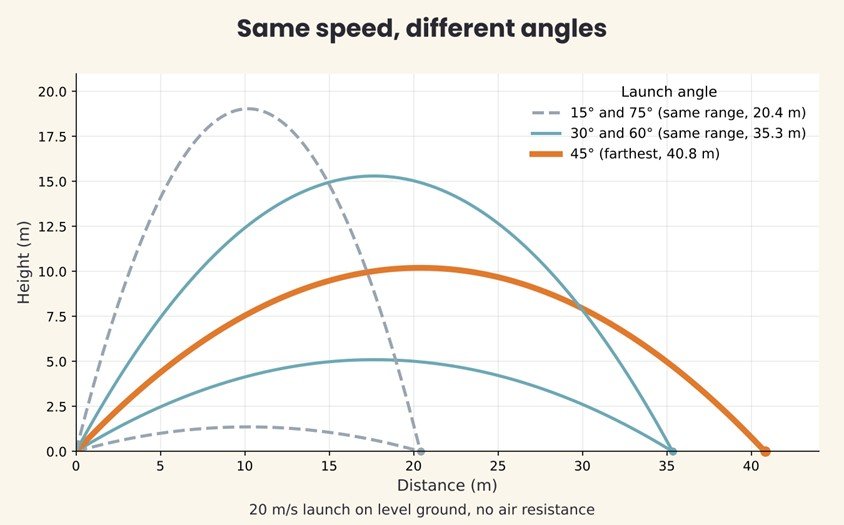
On level ground, with no air in the way, a thrown object travels farthest when it leaves at 45°. The range formula, R = v² × sin(2θ) ÷ g, peaks when sin(2θ) equals 1, and that happens when θ is 45°.
 Pin
Photo Courtesy of Horizon Dwellers
A launch at 20 meters per second on Earth lands about 40.8 meters away. Angles that add up to 90°, such as 30° and 60°, land at the same spot as each other, and the 45° launch beats them both. Real air steals some distance, yet the best angle stays close to 45°.
Engineers like the angle for another reason. A force pushing at 45° splits into two equal parts, one along each axis, using the very same 45-45-90 triangle from earlier. Equal parts make the sums short and the answers cheerful.
- Best launch angle (flat ground, no air): 45°
- Same range, different paths: pairs that add up to 90°, such as 30° and 60°
45° Pipe Elbows in Plumbing: Why Gentle Turns Matter
Pipes dislike sharp corners. Water that meets a 90° elbow has to change direction in a hurry, which stirs up turbulence and costs pressure. A 45° elbow asks for a gentler turn, and the water goes along with it more politely.
Published figures vary by pipe type and source, but one fitting guide gives a resistance coefficient of roughly 0.15 to 0.20 for a long-radius 45° elbow, against 0.25 to 0.30 for a 90°. In drains, two 45° elbows are often used in place of one sharp 90° to keep the flow moving.
A fair warning: in ordinary home plumbing the difference is small, and some plumbers point out that two 45° fittings can add up to slightly more friction than one 90°. It matters more in long runs, narrow pipes, and low-pressure systems.
- 45° elbow: gentler turn, less resistance each, needs more room
- 90° elbow: sharper turn, fits tight spaces
45° in Everyday Life, Plus Common Mistakes to Avoid
Everyday life is full of this angle. A sandwich cut corner to corner becomes two 45-45-90 triangles, and a chess bishop slides along diagonals that cross the board at 45°, quietly obeying the same geometry as the paper fold that opened this article.
The common slips are worth knowing. The first is trusting the drawing: a triangle that looks like a 45-45-90 may not be one, and it has to be proved, not eyeballed. The second is the leg-and-hypotenuse step, which runs differently in each direction, so it pays to check which way the multiplying goes.
That is the whole story of a small angle with a large workload. The next time a frame hangs straight or a roof stays on in a gale, a quiet 45° is probably doing its job.
- Leg to hypotenuse: multiply by √2
- Hypotenuse to leg: divide by √2
- Saw set to 45°: make two test cuts and check them with a square
FAQs
Acute. Any angle smaller than 90° is acute, and 45° is exactly half of a right angle, which puts it right in the middle of the acute range.
Fold a square sheet of paper corner to corner. The crease splits the corner into two 45° angles. A compass works too: draw a right angle and bisect it.
On level ground with no air, range follows v² × sin(2θ) ÷ g. Sine peaks at 1 when 2θ is 90°, so θ is 45°. Air resistance nudges the best angle a little, but not by much.
Sin 45° and cos 45° both equal 1/√2, about 0.707. Tan 45° equals 1, because the two legs of a 45-45-90 triangle are the same length.
Two 45° cuts meet as a 90° corner with no end grain showing, and four corners close a square. The catch is accuracy: tiny errors add up fast, so test cuts matter.










 Login with Google