
















 Pin
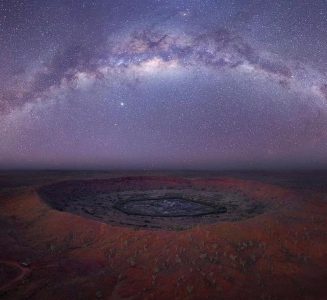
Pin Wolfe Creek Meteorite Crater (880 metres wide) earth impact craters by size / Courtesy of Hike Australia
Synopsis: Our planet bears the marks of violent cosmic encounters—giant bowl-shaped scars left by asteroids and comets that slammed into Earth millions of years ago. These impact craters tell stories of catastrophic events that reshaped landscapes, triggered mass extinctions, and influenced the course of life itself. Some stretch hundreds of kilometers wide, hidden beneath ice sheets or ocean floors. Others remain visible reminders of the universe’s raw power. Understanding these craters helps scientists decode Earth’s tumultuous past and prepare for potential future threats from space.
We drift through space on a blue marble, orbiting a star in the outer arm of an ordinary galaxy. But sometimes, the cosmos sends a reminder—a rock traveling at impossible speeds, carrying the energy of thousands of nuclear bombs.
These collisions don’t just leave holes. They bend time itself for the regions they strike, creating pressure so intense that rocks melt and vaporize in microseconds. The shockwaves ripple through the planet’s crust like rings on water.
Earth’s surface holds the evidence of these moments when space and stone collided. The earth impact craters by size range from small bowls to structures spanning hundreds of kilometers. Some are so ancient they’ve nearly vanished, worn smooth by billions of years of wind and rain. Others remain fresh enough to study, offering windows into the violent forces that govern our corner of the universe.
Table of Contents
1. Vredefort Crater
 Pin
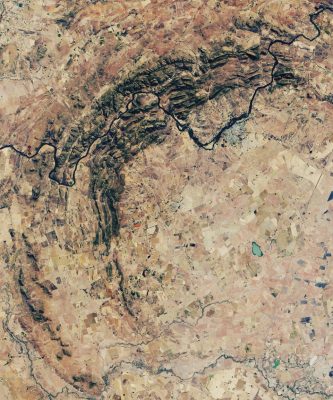
Pin Vredefort Crater, South Africa, OLI satellite image, 27 June 2018 / Courtesy of Wikimedia Commons
- Location: South Africa
- Age: ~2 billion years old
- Size: ~300 km diameter (largest known)
Two billion years ago, an asteroid struck what is now South Africa, creating the Vredefort Crater—the largest confirmed impact structure on Earth. The collision released more energy than a million volcanic eruptions combined, leaving a scar that dwarfs almost every other crater we’ve discovered.
The impact was so powerful it created rocks that exist nowhere else on the planet’s surface—minerals formed under pressures that normally only occur deep in Earth’s mantle. Today, erosion has worn away much of the original structure, but the dome’s curved geological layers still tell the story.
Local farmers plow fields over ground zero without realizing they’re working inside a cosmic impact zone that predates most life on Earth. It’s a monument to destruction on a scale our minds struggle to comprehend, a reminder that our planet has survived catastrophes we can barely fathom.
2. Sudbury Basin
 Pin
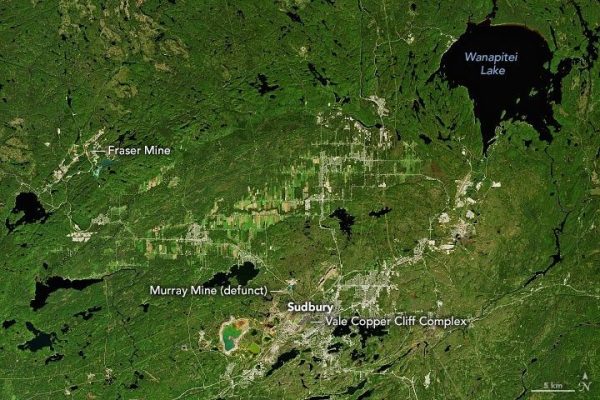
Pin Operational Land Imager (OLI) on Landsat 8 acquired this image of Sudbury Basin in southeastern Ontario on September 11, 2020 / Courtesy of NASA
- Location: Ontario, Canada
- Age: ~1.8 billion years old
- Size: ~200 km diameter (second largest)
The Sudbury Basin holds the title of the second-largest impact structure on Earth. Created about 1.8 billion years ago, this massive scar stretching 200 kilometers across has become one of the most economically valuable geological features on the planet.
What makes Sudbury extraordinary isn’t just its size—it’s what the impact created. The extreme heat and pressure melted rock deep underground, concentrating valuable metals like nickel, copper, and platinum. Today, mining operations extract billions of dollars worth of ore from this ancient cosmic gift.
The basin has been so heavily mined and developed that visitors might not recognize it as an impact site at all. Cities, highways, and industrial complexes now cover the crater floor. Yet beneath the modern landscape lies proof that catastrophic destruction can sometimes create unexpected wealth.
3. Chicxulub Crater
 Pin
Pin Courtesy of Google Earth
- Location: Yucatán Peninsula, Mexico
- Age: ~66 million years old
- Size: ~180 km diameter (dinosaur extinction event)
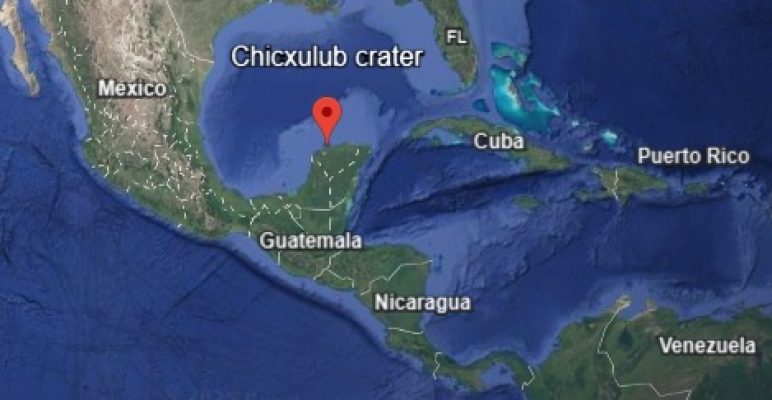
Sixty-six million years ago, an asteroid roughly 10 kilometers wide struck the Yucatán Peninsula in Mexico. The Chicxulub crater measures about 180 kilometers across, making it the third-largest impact structure by diameter—and arguably the most consequential in shaping modern Earth.
The collision released energy equivalent to billions of atomic bombs, triggering mega-tsunamis, global wildfires, and a “nuclear winter” that lasted for years. Dust and debris blocked out the sun, collapsing food chains worldwide. Three-quarters of all species went extinct, including every non-avian dinosaur.
Most of the crater now lies hidden beneath the Gulf of Mexico and limestone sediments. Scientists only confirmed its existence in the 1990s. This invisible scar represents the moment when the age of reptiles ended and the age of mammals began—a single day that rewrote the future of life on Earth.
4. Woodleigh Crater
 Pin
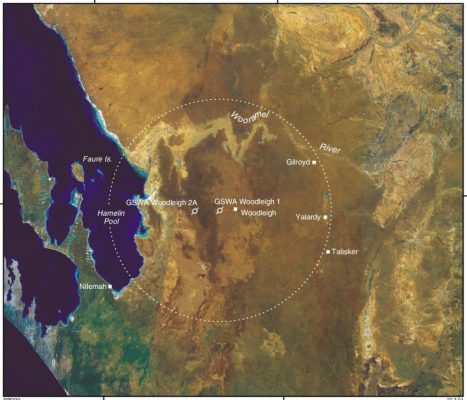
Pin Landsat image of the Woodleigh region, showing the lack of surface expression of the Woodleigh impact structure / Courtesy of Arthur John Mory
- Location: Western Australia
- Age: ~364 million years old
- Size: ~120-130 km diameter
About 364 million years ago, during the Devonian period, an asteroid struck Western Australia. The Woodleigh Crater spans approximately 120-130 kilometers, making it one of the largest impact structures in the southern hemisphere and fourth-largest overall.
The crater lies completely buried beneath younger sediments, discovered only through drilling programs and geophysical surveys. Its size suggests the impact was catastrophic, possibly contributing to the Late Devonian extinction events that affected marine life globally.
Western Australia’s ancient rocks preserve secrets that most of the planet has long since erased. The Woodleigh impact occurred when the first forests were spreading across the continents and armored fish ruled the seas. Whatever creatures witnessed this collision left no record, but the scar remains.
5. Manicouagan Crater
 Pin
Pin Courtesy of Wikimedia Commons
- Location: Quebec, Canada
- Age: ~215 million years old
- Size: ~100 km diameter (visible from space)
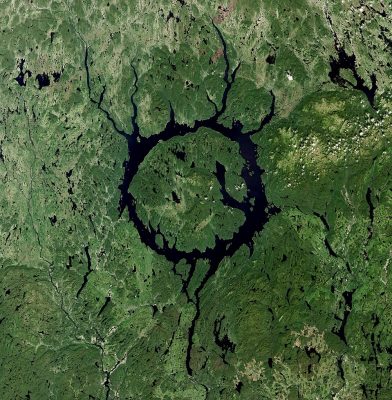
Two hundred fifteen million years ago, an asteroid created the Manicouagan impact structure in Quebec, Canada. The crater spans about 100 kilometers and has become one of the most recognizable impact sites on the planet, sharing fifth place with another massive scar.
A ring-shaped reservoir now fills the ancient impact basin, creating an almost perfectly circular lake. The raised central peak—an island called René-Levasseur—formed when the ground rebounded after the initial compression, like a drop of water splashing upward in reverse.
Astronauts aboard the International Space Station regularly photograph Manicouagan because it’s so distinctive from orbit. The impact occurred during the Triassic period, possibly contributing to a mass extinction event. What was once a moment of devastation has transformed into a landscape of strange beauty.
6. Popigai Crater
 Pin
Pin Courtesy of James Byous
- Location: Northern Siberia, Russia
- Age: ~35.7 million years old
- Size: ~100 km diameter
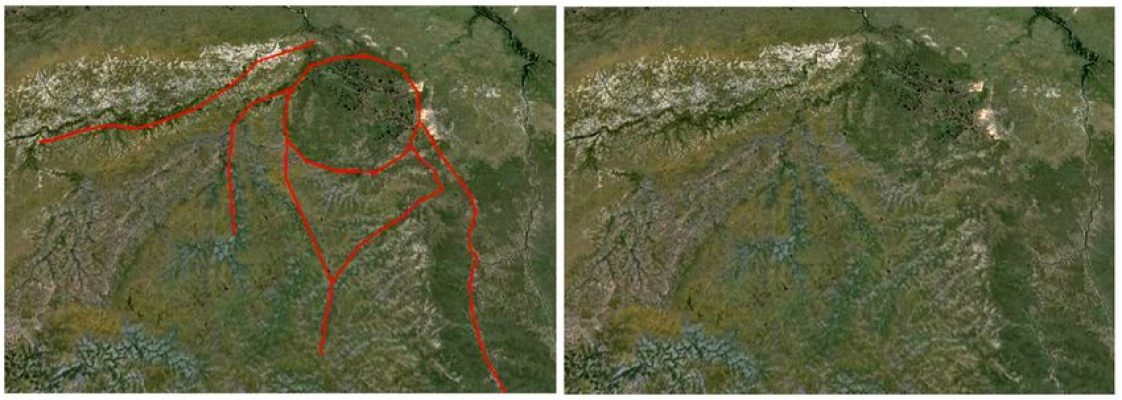
Thirty-five million years ago, an asteroid struck northern Siberia, creating the Popigai crater—another 100-kilometer-wide structure that rivals Manicouagan in size. The impact transformed ordinary carbon in the ground into trillions of carats of diamonds.
These are tiny, industrial-grade diamonds called impact diamonds, harder than anything formed naturally in Earth’s mantle. The heat and pressure of the collision exceeded anything volcanic activity could produce, creating a unique geological treasure that remains largely untapped.
Russia kept Popigai’s diamond reserves secret during the Cold War, revealing them only in 2012. The crater sits in one of the most remote regions on the planet, surrounded by Arctic wilderness. Its diamonds remain largely unmined, a fortune locked in frozen ground at the edge of the world.
7. Acraman Crater
 Pin
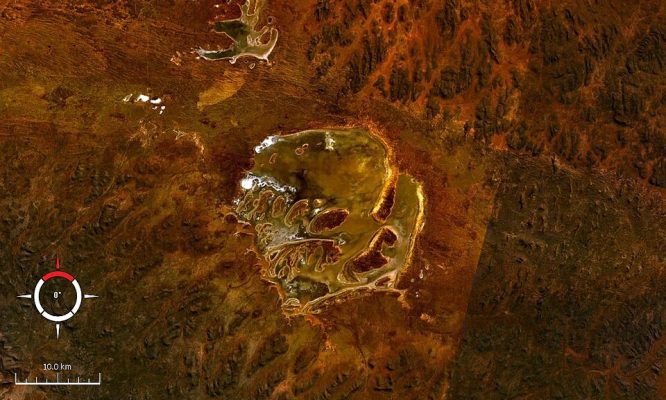
Pin Lake Acraman (impact crater) in South Australia, Landsat image. / Courtesy of Wikimedia Commons
- Location: South Australia
- Age: ~580 million years old
- Size: ~85-90 km diameter
About 580 million years ago, something massive struck South Australia, creating the Acraman crater—an 85-90 kilometer structure that ranks among Earth’s most ancient impact sites. This makes it one of the oldest well-preserved craters, dating back to before complex life exploded across the planet.
The crater sits in one of Earth’s most arid regions, where erosion happens slowly. Even so, most of the original structure has worn away over more than half a billion years. Scientists identified it by finding shocked quartz and other impact materials scattered across thousands of square kilometers.
Acraman’s age places it in a fascinating period—just before the Cambrian explosion, when complex life suddenly diversified. Some researchers wonder if major impacts like this one influenced the course of evolution by dramatically altering Earth’s environment and creating new ecological opportunities.
8. Chesapeake Bay Crater
 Pin
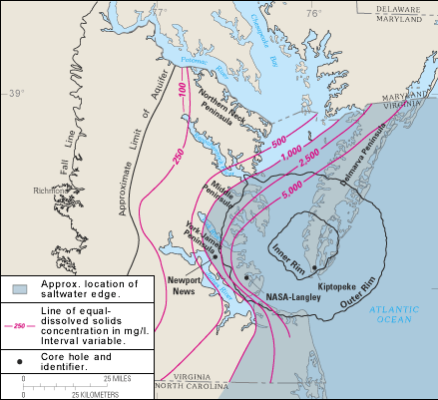
Pin Chesapeake Bay Crater Boundaries Map / Courtesy of Wikimedia Commons
- Location: Virginia/Maryland, USA
- Age: ~35 million years old
- Size: ~85 km diameter
Thirty-five million years ago, an asteroid or comet struck the eastern coast of North America. The Chesapeake Bay impact crater measures about 85 kilometers across—similar in size to Acraman—and lies buried beneath Virginia and Maryland.
Nobody knew it existed until the 1990s, when oil companies drilling in the area encountered strange, disturbed rocks. Further investigation revealed a massive crater that had shaped the region’s geology and even influenced the formation of Chesapeake Bay itself.
The impact created underground disruptions that still affect the area today. Some communities struggle with contaminated groundwater because the fractured rock allows saltwater to seep into freshwater aquifers. An event that happened millions of years ago continues to influence where people can safely build homes and dig wells.
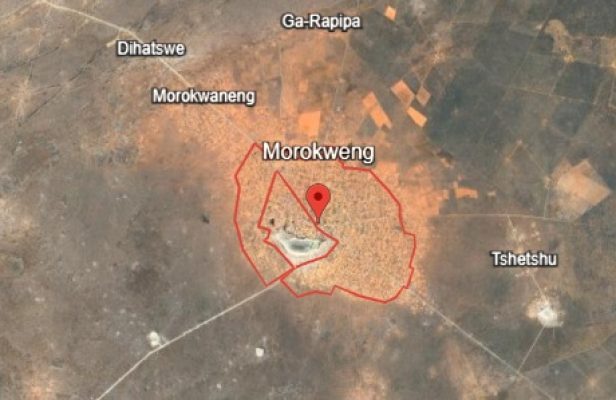
9. Morokweng Crater
 Pin
Pin Courtesy of Google Earth
- Location: South Africa
- Age: ~145 million years old
- Size: ~70 km diameter
One hundred forty-five million years ago, during the age of dinosaurs, an asteroid struck southern Africa, creating the Morokweng crater. This 70-kilometer impact structure lies completely hidden beneath the Kalahari Desert in South Africa.
Diamond drilling operations accidentally discovered Morokweng in the 1990s. At a depth of 770 meters, drillers extracted a meteorite fragment still embedded in the crater—an incredibly rare find. Most impact sites contain only shocked rock, with the actual space rock vaporized on contact.
The timing of this impact is intriguing. It occurred right at the boundary between the Jurassic and Cretaceous periods, during another period of biological turnover. The desert above holds no visual clue that beneath the sand lies evidence of a day when the sky fell.
10. Kara Crater
 Pin
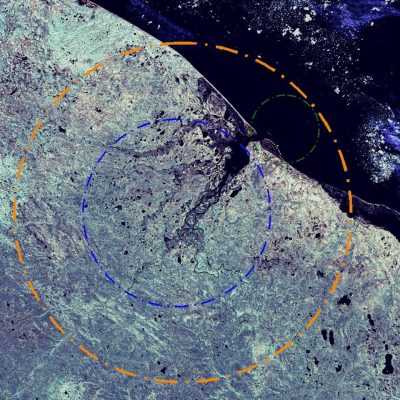
Pin Kara Crater, Russia Landsat image / Courtesy of Quesarella
- Location: Northern Russia
- Age: ~70 million years old
- Size: ~65 km diameter
Seventy million years ago, an asteroid struck northern Russia near the Arctic coast. The Kara crater measures about 65 kilometers across—the smallest on our list but still massive by any measure—and sits in one of the planet’s most inhospitable environments.
Permafrost and harsh conditions make the crater difficult to study, but also help preserve its structure. The impact occurred during the late Cretaceous period, just a few million years before the Chicxulub impact that ended the dinosaurs’ reign.
Some scientists have suggested that Kara and another nearby crater called Ust-Kara might actually be parts of a single, larger impact from a fragmented asteroid. If true, the combined structure would be even more impressive. The frozen north keeps its secrets well, revealing them only to researchers brave enough to work in extreme climates.
FAQs
Yes! Some like Meteor Crater in Arizona are easily accessible. Others like Manicouagan in Canada create stunning ring-shaped lakes visible from space.
Chicxulub-sized impacts occur roughly every 100 million years. Smaller impacts happen more frequently, but large enough asteroids to cause global catastrophe are rare.
Earth’s active geology erases evidence quickly. Plate tectonics, erosion, and volcanic activity destroy craters over time, unlike the Moon which preserves ancient impacts.
It’s possible but unlikely in our lifetimes. Space agencies now track near-Earth asteroids to provide early warning of potential threats.
Meteor Crater in Arizona is only 50,000 years old—practically yesterday in geological terms. Humans may have witnessed its formation.






 Login with Google