

















 Pin
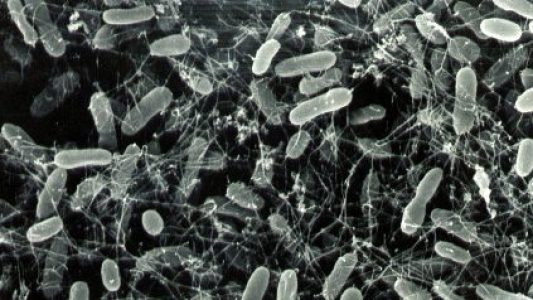
Pin This scanning electron micrograph shows a deep-sea microbe known as the “Snot Bug,” found around the submarine volcano Axial Seamount, about 300 miles (482 kilometers) west of Oregon. / Photo courtesy of Julie Huber, © Woods Hole Oceanographic Institution
Synopsis: In the deepest, most hostile corners of our planet, researchers recently uncovered thriving microbial life in a place once thought too extreme for any biology to endure. These hardy microbes survive without sunlight, in highly alkaline waters far beneath the ocean surface. This discovery pushes our understanding of life’s limits and challenges assumptions about where organisms can live. By studying how they operate, scientists gain insight into Earth’s early life and even where life might exist on other worlds.
When you think of places without life, deep ocean layers with hostile chemistry usually top the list. A new study upended that idea by finding active microorganisms in waters so alkaline — with a pH of about 12 — that survival seemed impossible. These tiny beings don’t rely on sunlight; they feed on methane and sulfate, drawing energy from chemical reactions instead of the sun’s glow.
What’s especially astonishing is not just their presence but how bustling this community appears. Using advanced tools that detect organic fats instead of DNA, scientists confirmed that these microbes aren’t just relics or dead remnants. They are living — metabolizing and contributing to carbon cycling in their environment.
This discovery opens new doors in how we define life and where it can exist. It shows that, even in extreme corners of Earth, life finds a way to make use of what’s available — no sunlight necessary.
Table of Contents
Life Beyond Light — Chemical Survival Tricks
Most life on Earth depends on sunlight. Plants turn it into energy, and animals — directly or indirectly — depend on that chain. Deep-sea microbes break this rule. They use chemosynthesis, a process where chemical reactions replace light as the energy source. Instead of sunlight, the heat and minerals from the Earth’s crust power life.
These microbes live near mineral-rich fluids, turning methane and sulfate into usable energy. Think of their world as a chemical buffet: it’s dark, pressurized, and alien, yet full of usable ingredients. The discovery challenges the idea that life must fit familiar patterns — like breathing oxygen or needing warmth.
Understanding these survival tricks matters. It gives scientists clues about how life might work on other planets or moons with extreme environments — places previously dismissed as barren.
How Scientists Detect Life in Extreme Places
Finding life hidden in harsh environments isn’t easy. Traditional DNA tests often fail when there are too few cells or DNA molecules. In this deep-sea discovery, researchers instead looked for lipid biomarkers — specific fats that linger only when life has been active.
Lipid molecules act like fingerprints. If intact fats are found, it means cells were recently alive. Researchers combined this with isotope studies — looking at tiny chemical clues that trace back to biological activity. This approach bypasses the challenges of detecting scarce DNA and gives a clearer picture of life in extreme settings.
These tools are now becoming essential in astrobiology — the science of searching for life beyond Earth — because similar detection challenges exist when examining other planets’ rocks and atmospheres.
Why These Microbes Matter for Earth’s Story
This isn’t just a curiosity — it reshapes how we understand life on our own planet. The deep sea’s harsh ecosystems could mirror Earth’s early years, before oceans supported complex life. Discoveries here act like time capsules, showing how primitive organisms might have survived when the world was young and hostile.
Diverse microbial life in extreme environments also plays key roles in global processes, like carbon cycling. These processes affect climate, ocean chemistry, and nutrient availability — all vital to life at every scale.
Recognizing how adaptable life can be broadens our perspective on Earth’s biosphere. It reminds us that even environments we once labeled sterile may teem with microscopic ecosystems.
Life Where We Least Expected It
Scientists have long defined life’s boundaries by human conditions — temperate climate, oxygen, sunlight. But research keeps pushing those boundaries. In deep soil, new microbial phyla were found hundreds of feet down, actively living and processing nutrients.
And extreme microbes like Methanopyrus kandleri, living at boiling temperatures more than 2,000 meters below sea level, show life’s capabilities glow at extremes of heat and pressure.
Such findings mean science must continuously update its lists of “habitable” conditions. What once seemed impossible may just be unfamiliar.
Extremophiles — the Outsiders of Biology
Organisms that thrive in extraordinary conditions are called extremophiles. These include microbes that flourish in boiling volcanic vents, icy deserts, or highly acidic lakes.
Many of these creatures depend on unique enzymes and molecular structures that let them function where others cannot. By studying them, researchers learn not just where life can be, but how it works at a biochemical level.
These studies also fuel innovation — enzymes from extremophiles are now used in industrial processes, biotechnology, and even medicine.
Could This Change How We Search Other Worlds?
Life on other planets remains one of humanity’s biggest questions. Recent research even identified atmospheric molecules around distant planets that usually signal biological processes.
If microbes on Earth can thrive in harsh, unlit environments, it strengthens the idea that life could exist in extreme worlds — like Mars’ icy soil or Jupiter’s moon Europa’s hidden oceans.
Scientists use Earth’s extreme ecosystems as testbeds for designing instruments for future missions. These tools may one day detect chemical signs of life far beyond our home planet.
Life That Adapts and Persists
When life persists in hostile places, it teaches resilience. These microbes don’t just survive — they make the most of what’s available. It’s a reminder that adaptability is life’s true strength.
Researchers studying these organisms are constantly surprised by their ingenuity — metabolic pathways that break rules, chemical reactions that replace sunlight, and cellular machinery that takes on extremes.
These lessons ripple into other disciplines, from ecology to planetary science. They remind us that nature’s rulebook is wide and still being written.
Future Science
This discovery is more than a paper — it’s a shift in how scientists define the possible. It fuels fresh questions: What other hidden ecosystems await? How far can life stretch beyond Earth’s familiar envelope?
Answering these will take collaboration across fields — microbiology, geology, chemistry, and astronomy. It’s a puzzle with pieces scattered across Earth and the cosmos.
As tools improve, anticipation builds for the next breakthrough — maybe beneath Antarctic ice, within rocky asteroids, or on moons circling distant stars.
A New Frontier of Living Possibilities
The discovery of microbes thriving at the edge of impossibility pushes science into new frontiers. These organisms are not outliers — they’re proof of life’s extraordinary resilience.
In each extreme environment, there’s a story of adaptation, survival, and unexpected complexity. As scientists continue probing Earth’s deepest and harshest realms, they redefine the boundaries of existence itself.
Whether for understanding Earth’s past, predicting its future, or searching the stars, these discoveries hold clues to life’s enduring mystery.
FAQs
Because microbes were found thriving in extreme deep-sea conditions once thought too hostile for any life.
They use chemosynthesis, turning chemical reactions into energy instead of light.
It suggests life could exist in harsh environments beyond Earth.
They’re rare but play important roles in deep-sea chemistry.
So far, only microscopic life is known to adapt to those extremes.









 Login with Google