

















 Pin
Pin Photo courtesy National Parks Guide
Synopsis: America harbors living monuments that dwarf human achievement in both age and resilience. The Most Incredible Trees in the United States include ancient bristlecone pines that predate written history, sequoias large enough to drive through, and coastal survivors clinging to eroding cliffs with roots exposed to saltwater and storms. These botanical giants aren’t merely old or large—they’re testament to nature’s stubborn refusal to surrender, having outlasted empires, disasters, and the full fury of geological time itself.
Across the United States, a few extraordinary trees have turned survival into an art form. They’ve endured wildfires, hurricanes, salt spray, erosion, lightning strikes, and centuries of human expansion without surrendering an inch more than necessary. Some are older than entire civilizations, some are larger than buildings, and others cling to cliffs or rubble where no tree should logically survive. Together, they stand as living proof that nature doesn’t give up easily.
These aren’t just trees you pass on a trail—they’re witnesses to history, silent observers of empires rising and falling while they continue the slow, steady work of growing. From ancient bristlecone pines that predate the pyramids to coastal spruces gripping bare earth with exposed roots, each one tells a story of stubborn endurance. Visit them once, and you start to realize: resilience isn’t loud or dramatic—it’s simply the decision to keep standing, year after year.
Table of Contents
1. General Sherman
 Pin
Pin General Sherman / Photo courtesy National Parks Guide
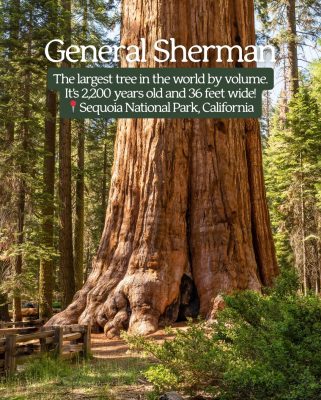
There stands in Sequoia National Park, California, a living thing so enormous that the English language struggles to capture its scale without resorting to numbers that make a person’s eyes glaze over. General Sherman measures 36 feet across at its base, which means a decent-sized living room could fit inside its diameter with room left over for uncomfortable small talk.
The giant sequoia has been growing for roughly 2,200 years, making it a contemporary of ancient Rome and considerably older than most European cathedrals that people cross oceans to photograph. While empires rose and collapsed, while languages evolved and disappeared, while humanity invented everything from the stirrup to the smartphone, General Sherman simply continued the business of photosynthesis with the steady determination of something that understands patience better than any living creature.
What strikes visitors most isn’t just the height, though at 275 feet it certainly commands attention. The real astonishment comes from the volume—the sheer amount of wood contained in a single organism. Scientists estimate General Sherman contains enough timber to build several dozen average homes, yet it began its existence as a seed smaller than an oat flake. That kind of growth requires not just time but an almost stubborn refusal to acknowledge the concept of “enough.”
2. Pando
 Pin
Pin Pando / Photo courtesy National Parks Guide
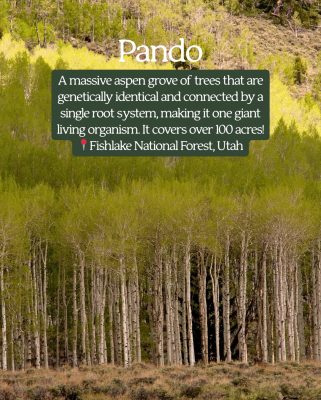
In Fishlake National Forest, Utah, there exists something that challenges the very definition of what constitutes a single living organism. Pando appears to casual observers as a grove of aspen trees covering more than 100 acres of mountainside, their golden autumn leaves shimmering in the breeze like thousands of individual dancers. The reality proves considerably stranger and more impressive.
Every tree in this grove shares identical genetics because they aren’t separate trees at all—they’re stems growing from a single massive root system hidden beneath the soil. Pando, which means “I spread” in Latin, represents one organism that decided the single-trunk approach lacked ambition. Instead, this quaking aspen colony sends up tens of thousands of stems, all connected underground like the world’s most extensive natural plumbing system.
The age estimates for Pando venture into numbers that make General Sherman look like a youngster. Some scientists suggest the root system could be 80,000 years old, which means it was already thriving when woolly mammoths still roamed North America and humans were just beginning to figure out that sharp rocks made decent tools. Whether that age estimate proves accurate or overly optimistic, Pando undeniably represents one of Earth’s most successful survival strategies—when in doubt, spread out and become too large to fail.
3. Tree of Life
 Pin
Pin Tree of Life / Photo courtesy National Parks Guide
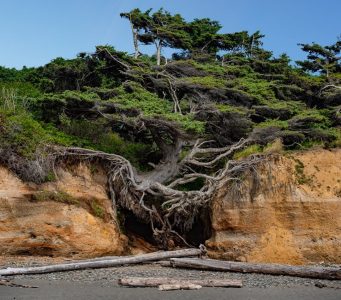
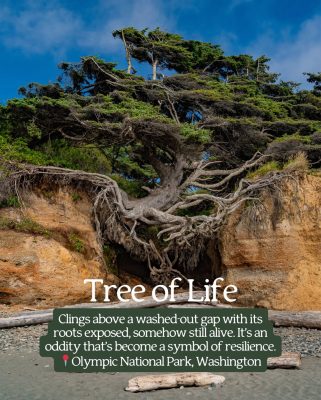
Along the wild coastline of Olympic National Park, Washington, clings a tree that appears to have missed the memo about proper growing conditions. The Tree of Life, as visitors have dubbed it, grows atop what used to be solid ground before erosion washed away the soil beneath it. The result resembles something from a fantasy illustration—a full-sized Sitka spruce suspended over a gap in the earth, its roots exposed and twisted like gnarled fingers reaching across empty space.
By all reasonable horticultural standards, this tree should have toppled decades ago when the creek below carved away its foundation. Yet it persists, drawing nutrients and water through roots that stretch across the chasm to anchor in soil that hasn’t been undermined. The roots themselves have become as much a part of the attraction as the tree’s canopy, displaying a structural engineering feat that would impress any architect.
The Tree of Life serves as a powerful metaphor that park rangers notice visitors responding to with unusual emotion. Here stands obvious proof that losing your foundation doesn’t necessarily mean losing everything. The tree adapted, redistributed its resources, and found new ways to thrive in conditions that would kill most organisms. Sometimes the most incredible thing about survival isn’t strength—it’s the willingness to change shape when circumstances demand it.
4. Methuselah
 Pin
Pin Methuselah / Photo courtesy National Parks Guide
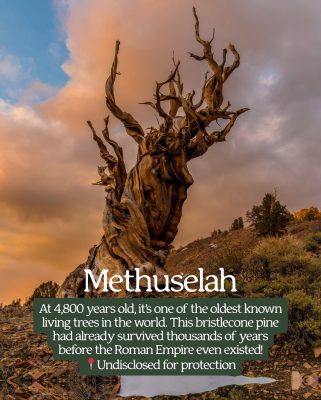
Hidden somewhere in California’s White Mountains at an undisclosed location lives a bristlecone pine named Methuselah that celebrated its 4,800th birthday sometime in the recent past. The exact location remains secret to protect it from souvenir hunters and well-meaning visitors whose combined foot traffic could damage the fragile alpine environment that sustains it.
Methuselah was already ancient when the pyramids were constructed. It was already centuries old when Stonehenge was nothing but a construction site. It had survived thousands of winters before the Roman Empire was even a gleam in Romulus’s eye. The tree witnessed the entire span of recorded human history while standing in the same spot, enduring temperature swings, lightning strikes, and the kind of harsh conditions that make regular forests pack up and move to friendlier neighborhoods.
Bristlecone pines achieve such remarkable longevity partly through a strategy that seems counterintuitive to anyone familiar with lush, fast-growing forests. These trees grow incredibly slowly in high-altitude environments where water is scarce and temperatures plunge well below freezing. The wood becomes extraordinarily dense and resistant to rot, insects, and disease. Much of Methuselah appears dead, with only narrow strips of living bark keeping the tree alive—a minimalist approach to survival that clearly works better than anyone might expect.
5. The Angel Oak
 Pin
Pin The Angel Oak / Photo courtesy National Parks Guide
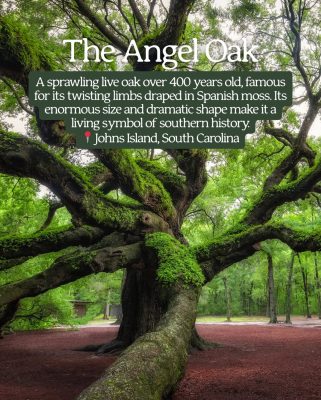
On Johns Island, South Carolina, there spreads an oak tree that defines the concept of “sprawling” with such thoroughness that it creates its own microclimate beneath its canopy. The Angel Oak stretches its massive limbs horizontally across the ground like a grandmother opening her arms to embrace an entire family reunion at once. Some branches grow so parallel to the earth that they rest directly on the soil, only to curve upward again at their tips in a show of arboreal determination.
Estimates place the Angel Oak’s age at over 400 years, making it a living witness to the entire history of European settlement in the region. Spanish moss drapes from its branches like nature’s own curtains, giving the tree an appearance that perfectly captures the essence of Southern Gothic atmosphere. On humid summer days, the dappled light filtering through the leaves creates patterns on the ground that seem designed specifically for contemplative thinking and sweet tea drinking.
The tree has become not just a tourist attraction but a genuine cultural landmark for the Charleston area. Local residents speak of it with the kind of pride usually reserved for beloved family elders. The Angel Oak survived Hurricane Hugo in 1989, which destroyed countless other trees across the region, proving that old age and structural wisdom sometimes trump youthful flexibility when storms arrive with serious intentions.
6. Lone Cypress
 Pin
Pin Lone Cypress / Photo courtesy National Parks Guide
Perched on a granite outcropping along California’s famously scenic 17-Mile Drive near Pebble Beach sits a Monterey cypress that has achieved the kind of fame usually reserved for movie stars and professional athletes. The Lone Cypress grows from what appears to be solid rock, enduring constant wind, salt spray, and the kind of exposure that would send most trees seeking employment elsewhere.
The tree’s silhouette against the Pacific Ocean has been photographed so many times that it ranks among the most recognizable trees on the planet. Its distinctive shape—windswept, asymmetrical, and somehow both fragile and defiant—captures something essential about the California coast’s wild beauty. The cypress doesn’t grow tall or straight; instead, it hunches against prevailing winds like a boxer protecting against punches, its branches streaming eastward as though frozen mid-gesture.
What makes the Lone Cypress particularly remarkable isn’t just its photogenic qualities or its precarious position. The tree demonstrates how organisms adapt their growth patterns to match environmental pressures. Every branch, every needle, every inch of trunk reflects decades of wind shaping the tree’s development. It’s not fighting the wind so much as dancing with it, having learned long ago that flexibility beats rigidity when nature decides to push back.
7. The Survivor Tree
 Pin
Pin The Survivor Tree / Photo courtesy National Parks Guide
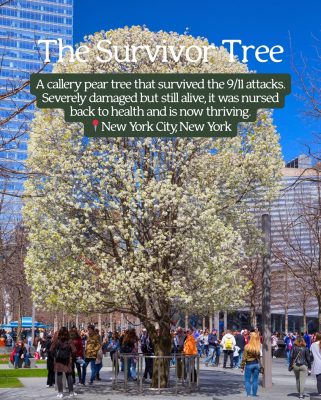
In Lower Manhattan stands a Callery pear tree that earned its name through circumstances nobody would wish for and everyone should remember. The Survivor Tree was discovered in the rubble of Ground Zero following the September 11 attacks, severely damaged but somehow still alive beneath the destruction. Workers found it buried in debris, its trunk charred, many branches shattered, barely clinging to life.
Rather than discarding what appeared to be a dying tree, recovery workers sent it to a nursery in the Bronx for rehabilitation. For nearly a decade, arborists nursed the pear tree back to health, treating its wounds and encouraging new growth. When it finally returned to the 9/11 Memorial in 2010, it stood as something more than landscaping—it had become a living symbol of resilience, recovery, and the refusal to let tragedy write the final chapter.
The Survivor Tree now thrives at the memorial, blooming each spring with white flowers that seem almost defiant in their beauty. Its trunk still bears scars from that September morning, visible reminders of what it endured. Yet those scars coexist with vigorous new growth, creating a powerful visual metaphor that resonates with millions of visitors. Sometimes survival isn’t about emerging unscathed—it’s about continuing to bloom despite carrying permanent marks of what tried to destroy you.
8. Chandelier Tree
 Pin
Pin Chandelier Tree / Photo courtesy National Parks Guide
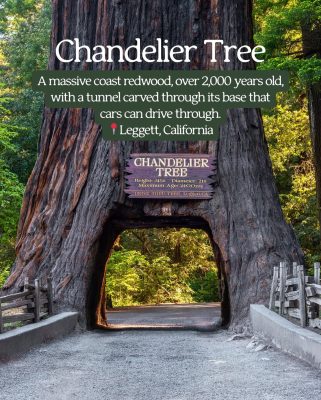
In Leggett, California, stands a coast redwood that underwent a modification in the 1930s which would horrify modern conservationists but delights tourists to this day. Someone carved a tunnel through the Chandelier Tree’s base large enough to accommodate automobiles, creating a drive-through attraction that became emblematic of mid-century American roadside culture.
The tree measures over 2,000 years old and 315 feet tall, which means it was already ancient when someone decided that punching a hole through its base would make excellent business sense. Remarkably, the redwood survived this indignity and continues growing, its massive size and resilient biology allowing it to function despite losing a significant portion of its structural support. The tunnel measures 21 feet in diameter, yet the tree’s remaining outer shell proves sufficient to transport nutrients and maintain stability.
While modern conservation ethics would never permit such alterations to ancient trees, the Chandelier Tree serves as an interesting historical artifact of changing attitudes toward nature. It represents an era when natural wonders were seen primarily as resources for human entertainment rather than treasures requiring protection. That the tree survives despite this treatment speaks to the remarkable resilience of coast redwoods—they’ve evolved to handle fire, flood, earthquake, and apparently even enthusiastic entrepreneurs with saws and dreams of roadside attraction profits.
9. Emancipation Oak
 Pin
Pin Emancipation Oak / Photo courtesy National Parks Guide
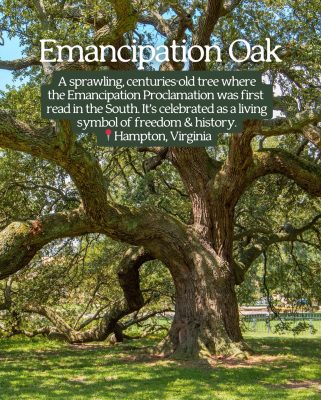
In Hampton, Virginia, there stands a live oak tree that served as witness to one of American history’s most significant moments. The Emancipation Oak earned its name when the Emancipation Proclamation was first read to Southern communities beneath its sprawling canopy in 1863. The tree, already centuries old at that time, became an immediate symbol of freedom and the beginning of a new chapter in American history.
The oak’s massive branches spread horizontally across the landscape, creating a natural gathering space that has hosted countless community events, celebrations, and educational moments throughout its existence. The tree grows on the campus of Hampton University, one of the nation’s oldest historically Black universities, adding layers of meaning to its historical significance. Students walk beneath its limbs daily, connecting present aspirations to past struggles in the most literal way possible.
What makes the Emancipation Oak particularly powerful isn’t just its historical association but its continued vitality. The tree doesn’t stand as a museum piece locked behind glass—it remains a living, growing organism that produces acorns, shelters wildlife, and provides shade just as it did when those historic words were first spoken beneath its branches. History isn’t something that happened here once; it’s something that continues happening every time someone pauses beneath those limbs to consider what freedom means and what it cost.
FAQs
Most are accessible, though Methuselah’s exact location stays secret for protection. General Sherman, Angel Oak, Emancipation Oak, Tree of Life, and Chandelier Tree welcome visitors through parks or designated viewing areas.
While Methuselah at 4,800 years is famous, another bristlecone pine in the same region is over 5,000 years old but remains unnamed and unlocated to protect it from damage and vandalism.
Yes—measures include limiting foot traffic around root zones, controlling visitor access, monitoring for disease, and protecting surrounding ecosystems that support the trees’ continued health and growth.
Spring through fall offers best access for most locations, though timing varies by tree. Pando’s golden aspen leaves peak in late September, while General Sherman is accessible year-round despite winter snow.
Absolutely—hundreds of champion trees exist nationwide, including the tallest tree (Hyperion, a coast redwood over 380 feet), oldest bald cypress, and largest western red cedars, each with unique stories.








 Login with Google