






















 Pin
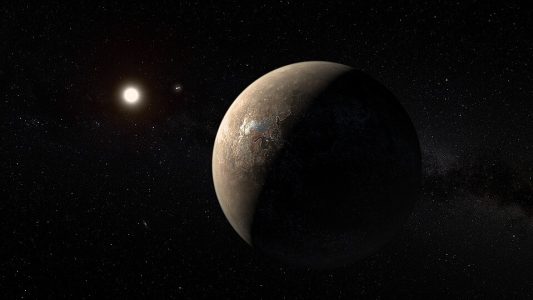
Pin Artist’s impression of the exoplanet Proxima Centauri b / Photo courtesy of ESO/M. Kornmesser
Synopsis: For decades, NASA scientists have been scanning the cosmos for worlds that could support life — and the list keeps growing. From icy moons hiding vast oceans beneath their frozen crusts to distant exoplanets sitting in the sweet spot around their stars, space is full of surprising candidates. Some are in our own solar system. Others orbit stars light-years away. This article breaks down 10 planets and moons where life could exist, and what makes each one worth watching.
Humanity has always looked up and asked the same question: Is there anyone else out there? For a long time, that question belonged to philosophers and poets. Today, it belongs to scientists with telescopes, spectrometers, and a growing list of very interesting worlds to study.
NASA and space agencies around the world have spent decades developing tools to measure atmospheres, detect water, and analyze the chemistry of distant planets. And what they’ve found has changed everything about how we think of life in the universe.
The search for 10 planets and moons where life could exist isn’t just about finding aliens. It’s about understanding what life actually needs — and how many places in the cosmos might quietly meet those requirements. Some candidates are shockingly close to home. Others are hundreds of light-years away. All of them are real, researched, and genuinely fascinating.
What scientists look for in a habitable world:
- 💧 Liquid water — on the surface or hidden underground
- 🌡️ Stable temperatures that don’t swing to deadly extremes
- 🧪 Key elements: carbon, hydrogen, nitrogen, oxygen
- 🛡️ Atmospheric or magnetic protection from radiation
- ⚡ An energy source — stellar, geothermal, or chemical
Table of Contents
1. Kepler-22b
 Pin
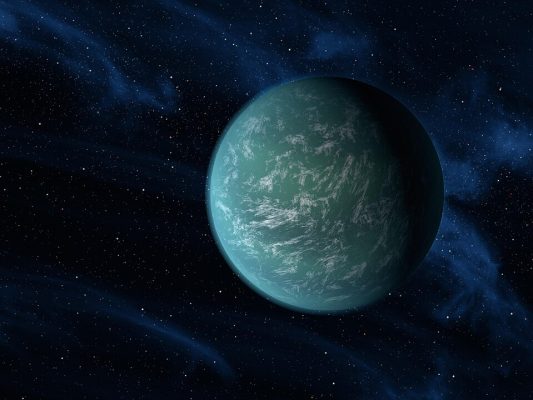
Pin Artist’s concept of an oceanic exoplanet Kepler-22b / Photo courtesy of NASA/Ames/JPL-Caltech
When NASA’s Kepler telescope spotted Kepler-22b back in 2011, it caused a quiet stir in the scientific community. Here was a planet sitting comfortably inside its star’s habitable zone — not too close, not too far — with surface temperatures that could theoretically allow liquid water to exist.
At about 2.4 times the size of Earth, Kepler-22b is what scientists call a “super-Earth.” It orbits a star very similar to our Sun, completing one year in just 290 days. That’s remarkably close to Earth’s own rhythm, which is part of what makes it so compelling.
The big unknown is its composition. If Kepler-22b turns out to be a rocky world, humans might one day survive there with the right technology. If it’s mostly ocean or wrapped in a thick gaseous shell, the picture gets complicated. Either way, it remains one of the most talked-about candidates in exoplanet research — a world that keeps scientists genuinely curious.
Quick facts about Kepler-22b:
- 📍 Distance from Earth: ~620 light-years
- 📏 Size: ~2.4x Earth’s radius
- 🌡️ Estimated surface temp: ~22°C (similar to a mild spring day)
- ☀️ Orbits a Sun-like star every 290 days
2. Proxima Centauri b
 Pin
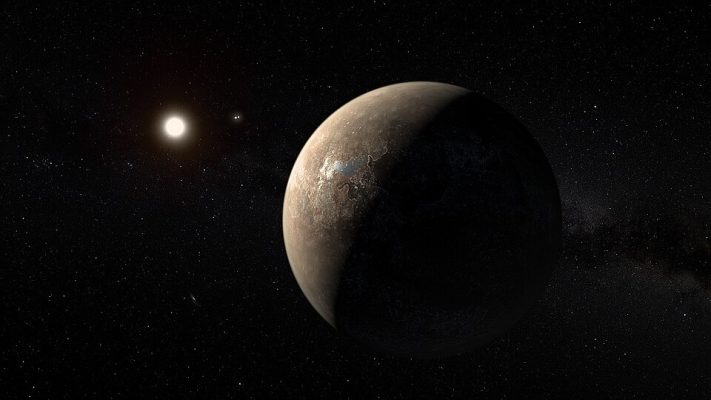
Pin Artist’s impression of the exoplanet Proxima Centauri b / Photo courtesy of ESO/M. Kornmesser
If there’s one exoplanet that gets astronomers genuinely excited, it’s Proxima Centauri b. Why? Because it orbits Proxima Centauri — the closest star to our own Sun, just 4.2 light-years away. In cosmic terms, that’s practically next door.
Discovered in 2016, this rocky planet sits within its star’s habitable zone. In theory, liquid water could exist on its surface. But there’s a significant catch — Proxima Centauri is a red dwarf star, and red dwarfs are famously temperamental. They throw out intense radiation bursts that could strip away a planet’s atmosphere over time.
Scientists believe Proxima Centauri b is also tidally locked — one side permanently facing its star in blazing heat, the other in permanent frozen darkness. Any habitable zone would likely be a narrow band running between those two extremes, sometimes called the “twilight zone.” It’s not ideal, but it’s not impossible either. With the right atmospheric conditions, that band could be livable.
Why Proxima Centauri b matters:
- 📍 Closest known exoplanet to Earth
- 🔴 Orbits a red dwarf — frequent radiation flares are a concern
- 🌓 Likely tidally locked — only a narrow zone may be habitable
- 🔭 A top target for future direct imaging missions
3. Kepler-186f
 Pin
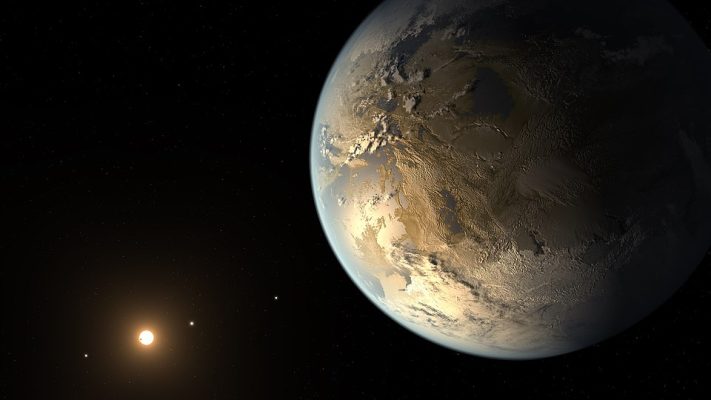
Pin Artist’s concept Kepler-186f / Photo courtesy of NASA Ames/SETI Institute/JPL-Caltech
Kepler-186f holds a special distinction — it was the first Earth-sized planet ever confirmed in the habitable zone of another star. That announcement in 2014 was a genuinely big moment in space science, and the planet hasn’t lost its appeal since.
It sits at the outer edge of its star’s habitable zone, which means it receives less warmth than Earth does from the Sun. To sustain liquid water, scientists suggest it would need a thick carbon dioxide atmosphere to trap enough heat — essentially a greenhouse effect working in the planet’s favor for once.
The visuals astronomers imagine for this world are striking. Its star is a red dwarf, meaning the sunlight reaching Kepler-186f would be dim and reddish. Any plant life there, if it existed, might have evolved darker pigmentation to absorb more of that faint light — giving the landscape an eerie, rust-tinted beauty. Whether life could thrive there remains unknown, but the conditions aren’t off the table.
Kepler-186f at a glance:
- 📍 Distance: ~500 light-years in the constellation Cygnus
- 📏 Size: Very close to Earth’s size
- ☀️ Orbits a red dwarf star — receives less heat than Earth
- 🌿 Needs a thick CO₂ atmosphere to support liquid water
4. TRAPPIST-1e
 Pin
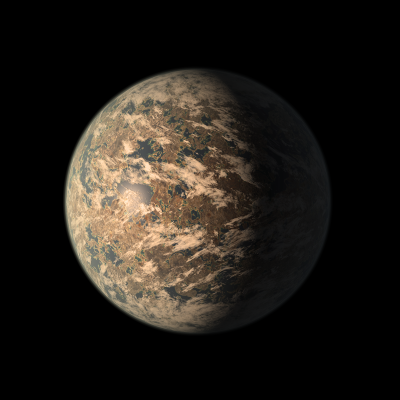
Pin Artist’s concept TRAPPIST-1e / Photo courtesy of NASA Ames/SETI Institute/JPL-Caltech
Ask any astrobiologist which exoplanet they’d most want to study up close, and TRAPPIST-1e tends to come up fast. It’s considered one of the strongest candidates for habitability ever found — and for good reason.
TRAPPIST-1e orbits within the habitable zone of the TRAPPIST-1 star system, receiving a similar amount of energy from its star as Earth receives from the Sun. It’s rocky, Earth-sized, and sits in a system packed with planets — seven in total, three of which are in the habitable zone. The odds of at least one of them having something interesting going on feel notably high.
The James Webb Space Telescope has already begun studying the TRAPPIST-1 system, looking for signs of atmosphere. Results so far are cautious but not discouraging. TRAPPIST-1e remains firmly on the priority list for deeper study. If there’s a world out there waiting to surprise us, this one has as good a chance as any.
Why TRAPPIST-1e stands out:
- 📍 Distance: ~39 light-years — relatively close
- ⚡ Receives Earth-equivalent energy from its star
- 🪨 Rocky and Earth-sized
- 🔭 Already being studied by the James Webb Space Telescope
5. Gliese 667Cc
 Pin
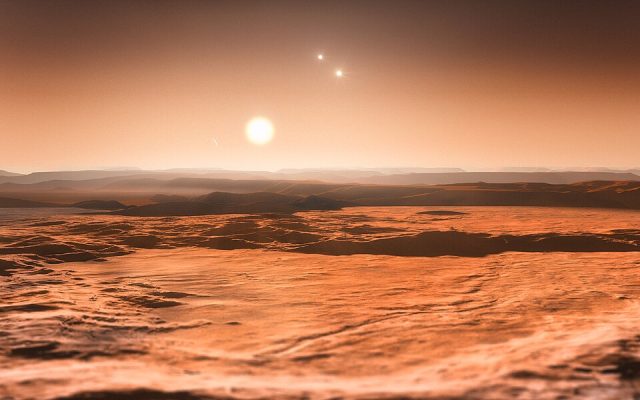
Pin Artist’s concept Gliese 667Cc / Photo courtesy of ESO/M. Kornmesser
Gliese 667Cc has one of the more dramatic addresses in space — it orbits within a triple-star system. Look up from its surface and you’d see not one sun but three, at varying distances, lighting up the sky in different shades of orange and red.
Despite the theatrical setting, the science is solid. Gliese 667Cc sits comfortably within its host star’s habitable zone, receiving enough energy for liquid water to potentially exist on its surface. It’s a super-Earth, somewhat larger than our planet, and its position in the habitable zone has made it a recurring name in discussions about life-friendly worlds.
The concern here is the same one that follows many red dwarf planets — radiation. The host star occasionally flares, sending bursts of high-energy particles toward the planet. Any life there, or any future human presence, would need serious shielding. But the location is promising enough that scientists haven’t written it off. It’s a world that earns its place on this list.
Gliese 667Cc highlights:
- 📍 Distance: ~23.6 light-years
- ☀️ Part of a triple-star system — a rare setup
- 🛡️ Radiation shielding would be essential for human survival
- 💧 Surface liquid water is considered plausible
6. Europa
 Pin
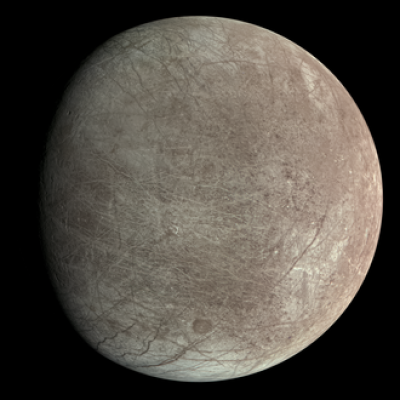
Pin This is Europa in true color, cropped from Juno’s flyby of Europa at Perijove 45 / Photo courtesy of NASA/JPL-Caltech/SwRI/MSSS/Kevin M. Gill
Europa doesn’t look like much from the outside — a smooth, icy ball wrapped in a criss-cross of cracks and ridges. But underneath that frozen shell, scientists believe something remarkable is happening: a vast, salty ocean, possibly twice the volume of all Earth’s oceans combined.
That ocean stays liquid because of tidal heating — Jupiter’s immense gravity squeezes and stretches Europa as it orbits, generating heat deep within. Where there’s heat, liquid water, and the right chemistry, life has a habit of finding a way. On Earth, entire ecosystems exist around deep-sea hydrothermal vents with no sunlight at all. Europa’s ocean floor may have similar vents.
NASA’s Europa Clipper mission, launched in 2024, is currently on its way to study this moon up close. It will arrive around 2030 and begin mapping Europa’s surface and ocean conditions in detail. The results could be some of the most important data in the history of astrobiology.
Europa fast facts:
- 🪐 Orbits Jupiter — our solar system’s largest planet
- 🌊 Subsurface ocean: possibly 2x the volume of Earth’s oceans
- ♨️ Tidal heating keeps the ocean liquid
- 🚀 Europa Clipper mission arrives ~2030
7. Enceladus
 Pin
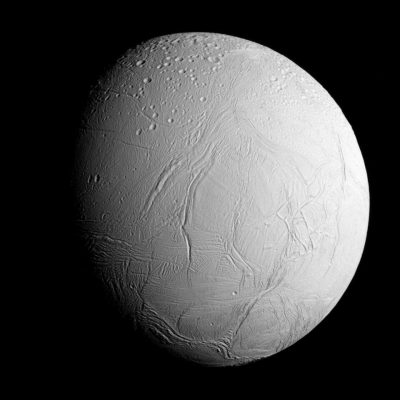
Pin NASA’s Cassini spacecraft captured this view as it neared icy Enceladus for its closest-ever dive past the moon’s active south polar region / Photo courtesy of National Aeronautics and Space Administration (NASA) / Jet Propulsion Laboratory (JPL) – PIA17202 from the NASA/JPL Photojournal
Enceladus is small — about the width of Arizona — but it punches well above its size when it comes to astrobiological interest. This little moon of Saturn does something no other world in our solar system does: it actively shoots jets of ocean water into space from cracks near its south pole.
NASA’s Cassini spacecraft flew directly through those plumes and detected water vapor, ice particles, salts, and organic molecules — including hydrogen, which suggests active hydrothermal vents on the ocean floor below. All of that together is a compelling chemical recipe. Scientists didn’t expect this level of activity from such a small moon, and that surprise is part of what makes Enceladus so valuable.
The extraordinary thing is that a future mission wouldn’t even need to land or drill. Samples from Enceladus’s ocean are already being delivered into space, free of charge. A well-equipped spacecraft could fly through those plumes and potentially detect signs of microbial life directly. No other world makes the search this accessible.
What makes Enceladus special:
- 💦 Active water plumes erupting from the south pole
- 🧪 Cassini detected organic molecules and hydrogen in the jets
- ♨️ Hydrothermal vents likely active on the ocean floor
- 🛸 A future mission could sample its ocean without landing
8. Titan
 Pin
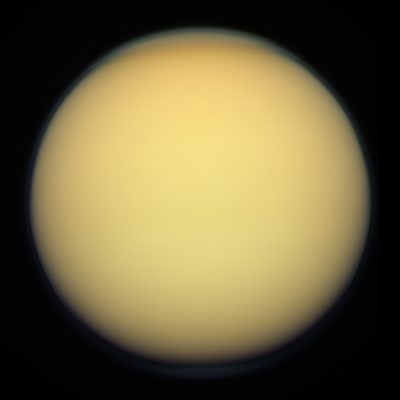
Pin A slightly larger image that is processed by Kevin M. Gill, with far less noise. Titan’s color in this image also more closely match with its spectra color / Photo courtesy of NASA/JPL-Caltech/SSI/Kevin M. Gill
Titan is unlike anything else in our solar system. It’s the only moon with a dense, planet-like atmosphere, and the only world besides Earth known to have stable bodies of liquid on its surface — rivers, lakes, and seas, though made of methane and ethane rather than water.
Temperatures on Titan hover around -179°C, which rules out liquid water on the surface. But scientists haven’t dismissed it entirely. Beneath Titan’s crust, there may be a subsurface ocean of liquid water. And in the thick orange haze of its atmosphere, some researchers have proposed that exotic chemistry could support a completely different kind of life — one that doesn’t rely on water at all.
NASA’s Dragonfly mission, a nuclear-powered rotorcraft, is set to fly through Titan’s atmosphere and explore its surface in the 2030s. It will study the chemistry of organic molecules pooling in Titan’s lakes and riverbeds. Whether life exists there or not, Titan is one of the most alien and fascinating worlds we’ve ever had a chance to study up close.
Titan’s key characteristics:
- 🌫️ Only moon in our solar system with a thick atmosphere
- 🏞️ Has rivers, lakes, and seas — filled with liquid methane
- 🌊 Possible subsurface water ocean beneath the crust
- 🚁 NASA’s Dragonfly mission will explore Titan in the 2030s
9. Mars
 Pin
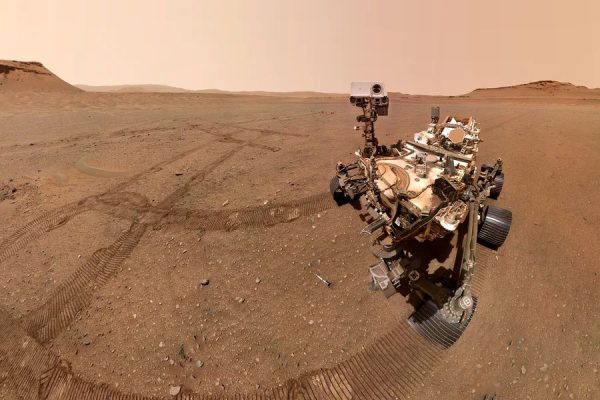
Pin This striking selfie, captured by NASA’s Perseverance rover in January 2023, shows the explorer surrounded by scattered sample tubes across the rocky terrain of Jezero Crater. NASA is currently designing a mission to return the majority of those collected samples to Earth for scientific study in the 2030s / Photo courtesy of NASA/JPL-Caltech/MSSS
Mars is the most studied world beyond Earth, and for good reason. It’s our nearest planetary neighbor with a day length almost identical to ours, seasons, weather patterns, and a landscape that looks hauntingly familiar — red plains, ancient riverbeds, towering volcanoes, and polar ice caps.
Billions of years ago, Mars was a warmer, wetter world. Liquid water once flowed across its surface in rivers and possibly gathered in lakes or shallow seas. Something changed — the planet lost its magnetic field, its atmosphere thinned, and the water disappeared. But it didn’t all vanish. Radar data from orbiting spacecraft has revealed large underground lakes of liquid water beneath the Martian south pole, kept liquid by salts and geothermal heat.
The Perseverance rover is currently collecting rock samples that may contain ancient microbial fossils. Those samples are planned to return to Earth in the early 2030s. If they contain evidence of past life, it would be the most significant scientific discovery in human history. Mars may be cold, dry, and dusty today — but its story isn’t finished yet.
Mars habitability highlights:
- 📍 Distance: ~54–400 million km from Earth (varies by orbit)
- 🌊 Ancient river channels and lake beds confirmed
- 🧊 Underground liquid water lakes detected at the south pole
- 🤖 Perseverance rover collecting samples for return to Earth
10. K2-18b
 Pin
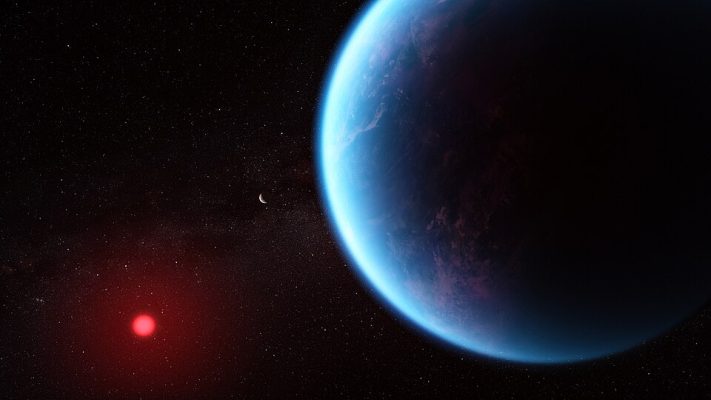
Pin An artist’s illustration of exoplanet K2-18 b, a massive ocean world 120 light-years from Earth where James Webb detected carbon-bearing molecules hinting at possible life / Photo courtesy of Illustration: NASA, ESA, CSA, Joseph Olmsted (STScI) Science: Nikku Madhusudhan (IoA)
K2-18b sits in a category of its own. When the James Webb Space Telescope analyzed its atmosphere in 2023, it detected carbon dioxide, methane, and possibly dimethyl sulfide — a molecule that, on Earth, is only produced by living organisms. Scientists were careful not to overclaim, but the scientific community took notice.
This world is what researchers call a “Hycean planet” — a new class of world thought to be covered by a vast, deep ocean beneath a thick hydrogen-rich atmosphere. It’s about 8.6 times Earth’s mass and orbits a red dwarf star about 120 light-years away. The ocean, if it exists as theorized, could be thousands of kilometers deep — nothing like Earth’s relatively shallow seas.
Humans couldn’t walk freely on K2-18b. The gravity would be crushing, the hydrogen atmosphere unbreathable, and the ocean likely has no solid floor to stand on. But the question isn’t whether humans could live there comfortably — it’s whether life of any kind could exist there at all. And right now, K2-18b is the most chemically interesting world astronomers have ever studied from a distance.
K2-18b standout details:
- 📍 Distance: ~120 light-years
- 🌊 Possibly covered by a planet-wide deep ocean
- 🧬 James Webb detected possible biosignature molecules in 2023
- 🌬️ Hydrogen-rich atmosphere — unbreathable but scientifically thrilling
FAQs
TRAPPIST-1e is currently considered the strongest candidate — it receives Earth-like energy from its star and is rocky, making it the most Earth-comparable exoplanet found so far.
Not without protection. Mars has thin air, deadly radiation, and freezing temps. But with sealed habitats and life support, long-term human presence is considered possible — possibly within decades.
Europa sits inside Jupiter’s intense radiation belts, making it extremely hazardous for humans without heavy shielding. Robotic missions are the practical approach for now.
A Hycean planet is a world covered by a vast ocean under a thick hydrogen atmosphere. K2-18b is the leading example — a new class of world that may expand how we define habitability.
No confirmed proof yet. But detected molecules on K2-18b, organic compounds on Enceladus, and underground water on Mars have made the scientific case for life elsewhere more serious than ever before.









 Login with Google