





















 Pin
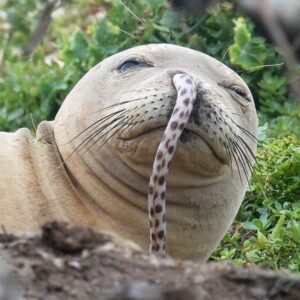
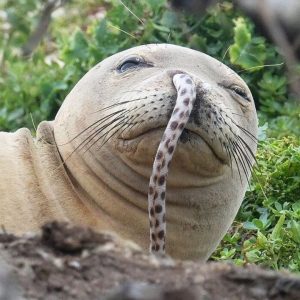
Pin Hawaiian monk seal with eel in a nose / Photo courtesy of NOAA Fisheries
Synopsis: Science has come a long way in understanding the animal kingdom — but some behaviors still leave researchers genuinely puzzled. Hawaiian monk seals get eels stuck in their noses. Dolphins may be intentionally getting high. Crows gather around their dead. These aren’t myths or exaggerations — they’re documented, real, and still not fully explained. This article walks through 10 of the most fascinating, bizarre, and oddly heartwarming animal behaviors that even the sharpest scientific minds haven’t cracked yet.
Humans have been studying animals for thousands of years. We’ve tracked migrations across continents, decoded whale songs, and mapped the neurons of a fruit fly. And yet — every so often — an animal does something that stops a researcher cold and makes them reach for their notebook with a slightly confused expression.
The natural world has a habit of humbling us. Just when a field biologist thinks they’ve seen everything a species has to offer, a monk seal shows up with an eel hanging out of its nostril. Not once. Multiple times. Different seals, different islands, different eels. No clear explanation.
That’s the thing about nature. It doesn’t care about our theories. It just keeps doing what it does, unbothered and occasionally baffling. These ten animal facts aren’t folklore — they’re documented, peer-reviewed, head-scratching reality.
Table of Contents
1. Eels in Noses
 Pin
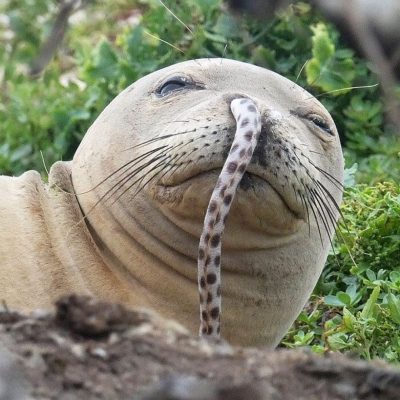
Pin Hawaiian monk seal with eel in a nose / Photo courtesy of NOAA Fisheries
The Hawaiian monk seal is already one of the rarest marine mammals on Earth. Critically endangered, carefully monitored, studied by dedicated researchers for decades. So when one showed up with a spotted eel lodged firmly in its nostril, scientists noticed.
What made it stranger was the follow-up. It happened again. Then again. Always juvenile seals. Always eels. Always nose-first. The eels were alive when found, and researchers carefully removed them — but the why of it all remains completely open. Leading theories suggest the seals may snuffle through reef crevices hunting for fish, accidentally inhaling an eel that has no intention of going quietly.
But that’s still a guess. No one has watched it happen in real time. No one has confirmed it. It sits in the scientific record as one of those animal facts that is absolutely true and absolutely unexplained — which, depending on your disposition, is either maddening or wonderful.
- First documented cases were reported by NOAA researchers in Hawaii
- Always juvenile seals — adults haven’t been found with this issue
- Eels are removed alive and the seals recover fully
2. Dolphins and the Puffer Fish
 Pin
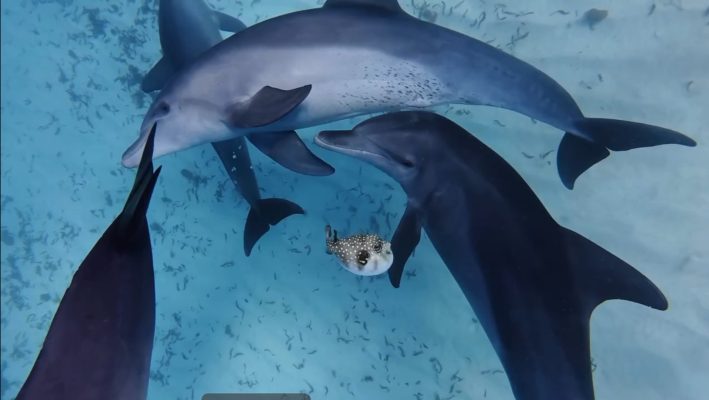
Pin Dolphins and the Puffer Fish / Photo courtesy of Zanzibar Mermaid
There’s a BBC documentary moment that marine biologists still argue about at conferences. A group of dolphins is filmed passing a puffer fish between themselves — gently, deliberately, like they’re sharing something at a party. Afterward, they float near the surface in a dreamy, slack sort of way.
Puffer fish, when threatened, release small amounts of tetrodotoxin — a potent neurotoxin. In large doses, it’s lethal. In tiny amounts? Some researchers believe it produces a mild narcotic effect. The dolphins in the footage seemed to know exactly how much was enough.
The debate hasn’t settled. Skeptics say it could be play behavior, curiosity, or coincidence. Believers point to the deliberate, careful handling — behavior that looks nothing like typical dolphin play. Either way, the footage exists, the behavior is documented, and the explanation remains contested. Dolphins are already known to be cognitively sophisticated. The possibility that they’ve figured out recreational chemistry is just the next logical — if deeply strange — step.
- Tetrodotoxin in small doses may act as a mild intoxicant
- The behavior was captured on film for a 2014 BBC documentary
- Similar observations have been reported independently by other researchers
3. Crow Funerals
 Pin
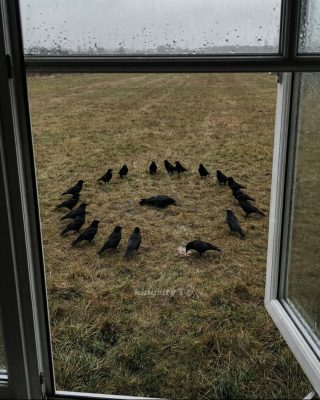
Pin Crow Funeral / Photo courtesy of Kingxitytv
If you’ve ever seen a large group of crows gathered silently around a dead crow on the ground, you weren’t imagining the atmosphere. It feels ceremonial. Somber, even. And it turns out, it kind of is — just not in the way we might romantically assume.
Researchers at UC Davis conducted studies where they presented crows with dead crow specimens in various conditions. The living crows consistently gathered, called loudly, and then avoided the area for days. The leading scientific interpretation is that this is threat-assessment behavior — the crows are essentially asking, “What killed this, and should I be worried?”
But here’s the thing: the behavior looks like mourning. The crows remember. They avoid. They respond to the dead with a kind of attention they don’t give to other objects. Whether that constitutes grief in any meaningful sense is a question science hasn’t answered — and may not be able to answer with current tools.
- Studies show crows remember dangerous locations associated with death
- They’ll mob perceived predators near a dead crow
- The behavior has been observed in wild populations across multiple continents
4. Birds Navigating with Quantum Physics
 Pin
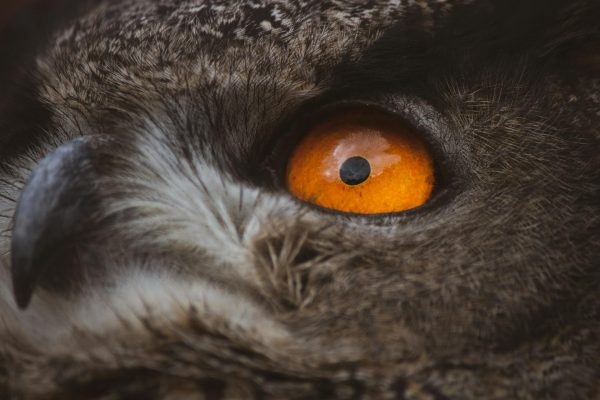
Pin Bird Eye / Photo courtesy of Pexel
Migratory birds fly thousands of kilometers and land in roughly the right place. We’ve known for a while that they use Earth’s magnetic field to navigate. What we didn’t expect was how they do it.
Current research points to a protein in bird eyes called cryptochrome. When light hits this protein, it appears to produce pairs of electrons in a quantum state called entanglement — where the spin of one electron is instantly linked to another, regardless of distance. The bird’s brain may actually be reading quantum-level magnetic signals to determine direction.
This is not metaphor. Physicists studying quantum entanglement in labs have a hard time maintaining it in controlled conditions. Birds appear to be doing it constantly, in flight, in all weather, using biology. The full mechanism isn’t confirmed yet, and how the brain converts quantum signals into navigational decisions is still being worked out. It’s one of those animal facts that makes physics professors and biologists equally uncomfortable.
- The protein cryptochrome is found in the eyes of many migratory species
- Quantum effects are notoriously fragile — yet birds seem to use them reliably
- Research is ongoing at the intersection of quantum biology and neuroscience
5. Octopuses and What Might Be Dreams
 Pin
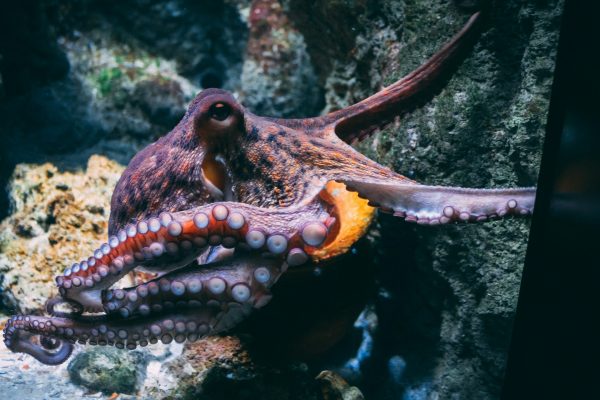
Pin Octopus / Photo courtesy of Unsplash
An octopus has no centralized brain in any sense we’d recognize. Its neurons are distributed — about two-thirds of them live in its arms, which can act semi-independently. The central brain coordinates, but the arms think too, in their own way.
So when researchers filmed octopuses cycling rapidly through skin colors and textures while asleep — flashing, pulsing, shifting from pale to dark in seconds — the question of what was happening became genuinely complicated. In humans and many mammals, vivid dreaming happens during REM sleep, when the brain replays and processes experience. The octopus skin changes look startlingly similar to active-state behavior.
The researchers who published this observation were careful not to claim the octopuses were dreaming. But they didn’t rule it out either. What would a dream even look like for a creature whose arms can think? What would it replay? The honest answer is that we have almost no framework to even ask the question properly yet.
- Octopuses show two distinct sleep states, similar to REM and non-REM in mammals
- Skin color changes during sleep were documented in a 2021 study
- The cognitive implications remain almost entirely unexplored
6. Elephants and the Bones They Return To
 Pin
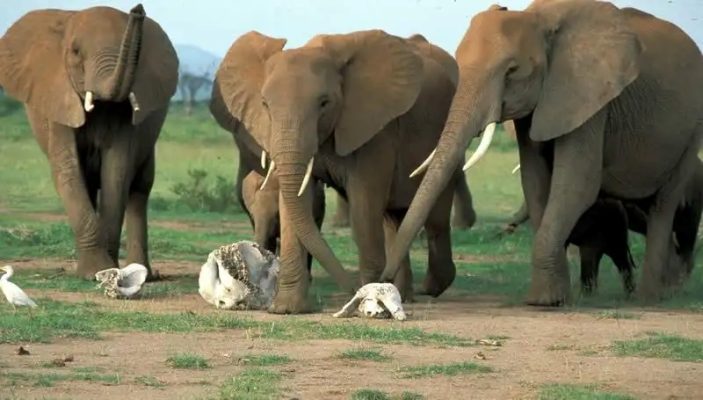
Pin Elephants with bones of their relative / Photo courtesy of Royal Society/Karen McComb
Elephants have been documented returning to the bones and bodies of deceased herd members — sometimes traveling considerable distances to reach them. They touch the bones with their trunks. They stand quietly. They sometimes carry pieces of bone for short distances before setting them down.
This has been observed enough times, by enough independent researchers, that it’s no longer considered anecdotal. It’s a documented behavior pattern. What it means, though, is where the conversation gets difficult. We have no reliable way to ask an elephant what it’s experiencing. We can measure behavior, but we can’t measure what, if anything, that behavior feels like from the inside.
Some researchers use the word grief carefully, with qualifications. Others resist the word entirely, preferring “complex social response to mortality.” The behavior itself doesn’t change based on what we call it. Elephants return to their dead. They pay attention in a way that looks, from the outside, like something that matters to them.
- Elephants have been observed responding to bones of non-related elephants too
- Matriarchs appear to initiate or lead these encounters more often
- Joyce Poole and Cynthia Moss documented this extensively in Amboseli, Kenya
7. Fainting Goats and the Gene That Stuck Around
 Pin
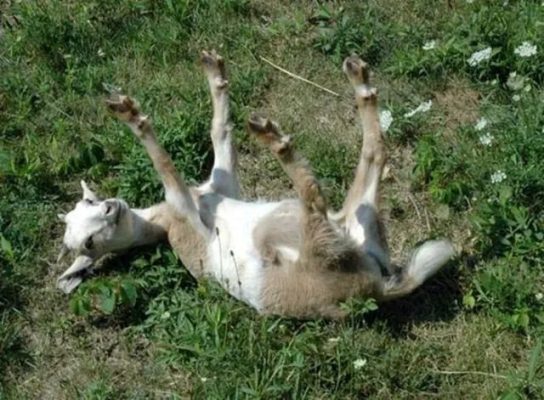
Pin Fainting Goat / Photo courtesy of Church Planting
Myotonic goats — popularly called fainting goats — have a genetic mutation that causes their muscles to seize up briefly when startled. The animal tips over, lies stiff for a few seconds, then gets up and goes back to whatever it was doing, apparently unbothered. It looks dramatic. The goat is fine.
The mutation affects a chloride ion channel in the muscle cells, preventing normal relaxation after a contraction. It’s well understood at the molecular level. What’s less understood is how this trait persisted at all. In the wild, a prey animal that freezes and falls over when startled would have an extremely short career as a living thing.
The working explanation is that the trait was maintained and amplified by human selective breeding — people found it useful or interesting, and kept breeding those animals. But the original appearance of the mutation, and why it wasn’t eliminated before humans got involved, is still not fully resolved. Sometimes genetics keeps a surprise in its pocket just to stay interesting.
- The condition is called myotonia congenita
- It’s painless — the goats have a normal quality of life
- The same ion channel mutation exists in some human neuromuscular conditions
8. Sea Otters and Their Favorite Rocks
 Pin
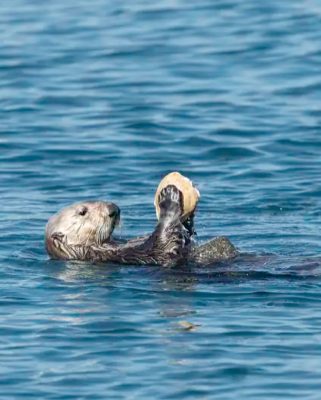
Pin Sea otters are one of the only mammals that use tools, and they’ll often carry the same favourite rock / Photo courtesy of artifaxing
Sea otters use rocks as tools — they float on their backs, balance a rock on their chest, and crack open shellfish against it. This is well known and widely celebrated, because it is genuinely charming. What’s less widely known is that many otters keep the same rock for months or even years.
Research has shown that otters carry their preferred rocks in a loose skin pouch under their foreleg. They take them diving. They wake up with them. The rocks get personal. Studies suggest there’s a practical logic — otters prefer rocks in a specific size range, and a good rock that fits well is worth keeping. But the attachment goes beyond utility in observed cases. Otters have been seen carrying rocks that are chipped, worn, and objectively replaceable.
Whether this is habit, comfort, or something in between isn’t settled. The rock preference appears to be partly learned — young otters seem to pick up tool-use behavior by watching their mothers, which means rock preferences may be culturally transmitted. A tradition of rock ownership, passed down generations. It’s either very practical or very sweet, and possibly both.
- Otters show individual “paw preferences” — like handedness — in how they use their rocks
- Rock use is one of the few documented tool behaviors in marine mammals
- Preferred rock size ranges from about 6 to 15 cm across studies
9. Contagious Yawning and the Species Problem
 Pin
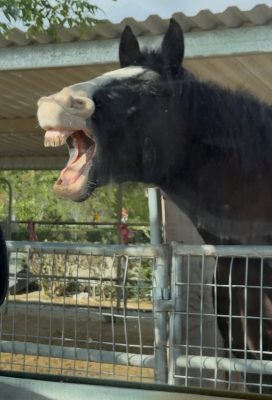
Pin Contagious Yawning Horse / Photo courtesy of Reddit user r/Horses
Contagious yawning — catching a yawn from someone else — is thought to be linked to empathy in humans. You see someone yawn, something in your brain mirrors it, and suddenly your jaw is dropping too. Dogs do it. Chimpanzees do it. Even some birds do it. The list keeps growing.
Horses yawn contagiously among themselves. Bonded horses, familiar horses, horses that spend time together — they catch each other’s yawns at rates above chance. But when researchers looked at whether horses catch yawns from humans they know and trust, the results were murkier. The cross-species contagion didn’t hold as clearly as it does in dogs.
Nobody is sure why the line seems to fall where it does for certain species. It may be about the specific neural pathways involved in social mirroring. It may be about how deeply a species tracks human facial cues. The research is still early and the methodology varies between studies. What’s clear is that yawning is doing something socially and neurologically interesting — and the full picture isn’t in yet.
- Dogs catch yawns from their owners at notably high rates
- Contagious yawning in children develops around age 4, alongside empathy markers
- Some studies suggest yawn contagion is stronger between socially bonded individuals
10. Slow Blinking Cats and What We Still Don't Know
 Pin
Pin Slow Blinking Cat / Photo courtesy of Uma
Cat owners have long sensed that the slow blink — that languid, deliberate eye close and open — means something good. A 2020 study at the University of Sussex confirmed it: cats are more likely to slow blink back at humans who slow blink at them, and they approach humans more readily after the exchange.
So the behavior is real and measurable. What it means at a deeper level — what a cat is actually experiencing when it does this, or what it’s communicating beyond “I’m not threatened right now” — is still open. The study confirmed the pattern. It didn’t confirm the emotion. There’s a difference between a behavior that correlates with calm and a behavior that expresses affection, and that gap is hard to close with current methods.
What makes this particularly interesting is that cats are not pack animals. They didn’t evolve reading social cues the way dogs did. The fact that they developed any kind of deliberate visual communication with humans at all — especially one that feels warm and reciprocal — suggests the domestic cat has adapted to human company in ways we’re still mapping.
- The 2020 study was led by Dr. Karen McComb at the University of Sussex
- Cats also slow blink more toward familiar humans than strangers
- The behavior may have developed specifically in response to domestication
What All of This Actually Tells Us
There’s a pattern running through every entry on this list. In each case, scientists have observed something real, documented it carefully, and then reached the edge of what current tools and frameworks can explain. The observation is solid. The interpretation is not.
That’s not a failure of science. That’s science working exactly as it should — collecting honest data and resisting the urge to invent clean answers where messy uncertainty exists. The seal with an eel in its nose is real. The explanation is still pending. Both things are true at the same time, and that’s fine.
What these animal facts share, beyond their strangeness, is a quiet reminder that the natural world is not a solved puzzle. Every species we study has depth we haven’t reached yet. Every behavior we think we understand probably has a layer underneath it we haven’t looked at properly. The most useful thing science — and the rest of us — can do is stay curious, stay honest, and maybe stop assuming we already know what’s going on.
- Many of these mysteries are actively being researched right now
- New tools like neuroimaging and long-term field tracking are opening new doors
- The best scientific attitude toward the unknown is patient, documented curiosity
FAQs
Nobody knows for certain. The best theory is that juvenile seals accidentally inhale eels while foraging in reef crevices — but this hasn’t been directly observed. The eels are removed alive and the seals recover fine.
It’s been filmed and debated. Dolphins handle puffer fish gently and appear calm afterward. Some researchers believe small doses of tetrodotoxin cause a mild effect. Others aren’t convinced. The behavior is real; the explanation is still contested.
Probably not in the human sense. Research suggests crows gather around dead crows to assess danger — not to mourn. But they remember, they avoid, and they react in ways that go beyond simple curiosity. It’s complicated.
Current research strongly suggests yes. A protein in their eyes appears to produce quantum-entangled electrons sensitive to magnetic fields. It’s not fully confirmed, but it’s the leading explanation and it’s as strange as it sounds.
They show sleep states with rapid skin color changes that look similar to active behavior — possibly like REM sleep. Researchers won’t say definitively that they dream, but they haven’t ruled it out either. The question may be unanswerable with current tools.







 Login with Google