






















 Pin
Pin Synopsis: Well now, here’s a thing that’ll knock the wind out of your sails: while we’ve been patting ourselves on the back for inventing radar and GPS, nature’s been running circles around us since before the first monkey fell out of a tree. Sharks pick up on electrical whispers a mile away, pigeons carry magnetic compasses in their heads, and snakes see heat like we see color. These critters didn’t need blueprints or billion-dollar budgets—just time, hunger, and the simple motivation of not wanting to be somebody else’s supper.
Before we go getting too proud of ourselves and our pocket computers, let me tell you about the pigeon sitting on your windowsill. That scraggly bird you’re shooing away from your lunch has navigation equipment inside its skull that would make a Boeing engineer weep with envy. It can find its way home from a thousand miles away without so much as glancing at a map, and it doesn’t need to stop and ask for directions either.
The plain truth is, animals have been solving problems we’re still scratching our heads over. While our scientists huddle in laboratories trying to build better sensors, an ordinary barn owl is out there pinpointing a mouse in total darkness using nothing but the sound of a footfall. A dog walks past a lamppost and reads a whole newspaper’s worth of information that was left there three days ago. These aren’t party tricks or happy accidents—they’re survival tools honed sharper than any blade.
What gets under my skin in the most delightful way is how casually animals do these impossible things. A shark doesn’t brag about detecting the heartbeat of a fish hiding under sand. A bat doesn’t write papers about its sonar system that puts our submarines to shame. They just go about their business, using equipment we can barely understand, let alone recreate. Evolution handed them capabilities that took millions of years to debug and refine, and they work without instruction manuals or customer service hotlines.
Table of Contents
1. Sharks
 Pin
Pin Photo courtesy of Daniel N
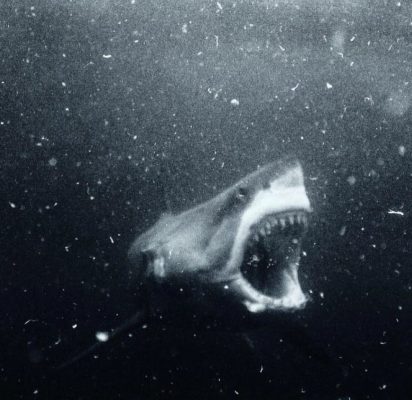
A shark swimming through murky water doesn’t need eyes to find you. It’s got something far more unsettling than good vision—it can sense the electrical field your muscles make just by twitching. Every time your heart beats or you flex a finger, you’re basically sending out a signal that says “I’m right here, and I’m delicious.”
These ocean predators have tiny pores scattered across their snouts called ampullae of Lorenzini, which sounds fancy but really just means “nature’s voltage detectors.” They can pick up on electrical signals as weak as one billionth of a volt. That’s like detecting a single AA battery from a thousand miles away, except the battery is your nervous system and the shark is uncomfortably close.
Our best metal detectors and electrical sensors need bulky equipment, constant calibration, and a patient operator who knows what they’re doing. A shark just swims around with this ability built right into its face, working perfectly in salt water where our gadgets throw tantrums and corrode. The thing hunts in complete darkness, murky waters, or buried sand, and it never once complains about poor visibility. It doesn’t need to see when it can feel your heartbeat from thirty feet away.
2. Pigeons
 Pin
Pin Photo courtesy of Mankey
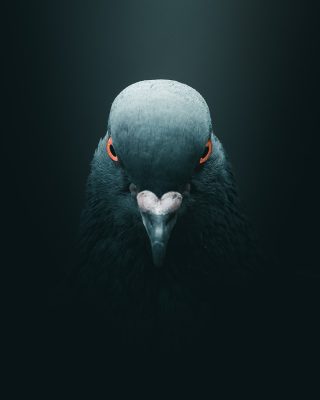
Your average city pigeon, the one scrounging for crumbs and making a general nuisance of itself, contains navigational hardware that would cost you thousands of dollars to replicate. These birds have tiny magnetic crystals in their beaks and brains that let them sense Earth’s magnetic field like we sense which way is up. They’re walking around with a compass that never needs batteries and never points the wrong direction.
Scientists spent years trying to figure out how pigeons always find their way home, and the answer turned out to be equal parts clever and embarrassing for us humans. These birds can detect variations in magnetic fields so subtle that our instruments struggle to measure them. They build mental maps using magnetism, landmarks, the sun’s position, and probably a few other tricks we haven’t figured out yet.
The military spent billions developing GPS satellites, and here’s a bird that’s been doing something similar since before we invented the wheel. Drop a pigeon five hundred miles from home in a place it’s never been, and it’ll be back on its perch by suppertime. Our smartphones lose signal if you drive through a tunnel, but a pigeon just shrugs and adjusts its internal compass. No subscription fees, no satellite connection required, and it works during solar flares that knock our technology offline.
3. Snakes
 Pin
Pin Photo courtesy of world of snakes
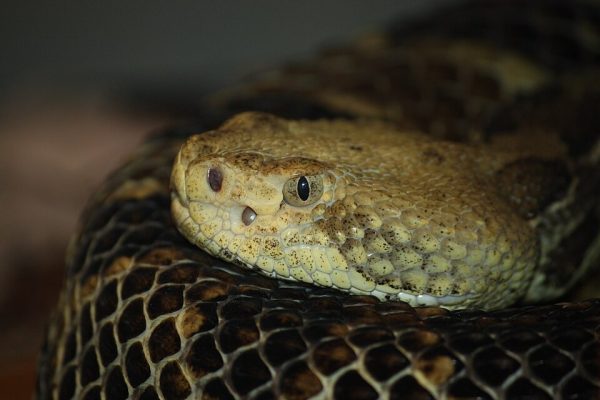
A pit viper doesn’t need light to see you. It’s got heat sensors built into its face that detect infrared radiation—the warmth radiating off your body. While you’re stumbling around in the dark looking for a flashlight, the snake is watching you glow like a neon sign at midnight. Every warm-blooded creature shows up in living color on its thermal display.
These facial pits can detect temperature differences as small as a few thousandths of a degree. That means a mouse hiding behind a rock or a bird roosting in complete darkness might as well be wearing a spotlight. The snake strikes with perfect accuracy in conditions where you and I would be helplessly blind, and it does this without any of the bulky cooling systems our thermal cameras require.
Our military spends fortunes on infrared goggles and thermal imaging equipment that needs batteries, maintenance, and careful handling. A rattlesnake carries this technology in its face, fully operational from the moment it hatches, never needing an upgrade or a warranty repair. It works in rain, dust, and desert heat without complaint. The resolution isn’t quite as sharp as our best cameras, but considering it fits in a snake’s head and runs on mouse meat, that’s a pretty impressive engineering feat.
4. Dogs
 Pin
Pin Photo courtesy of piper the dachshund
Here’s something that’ll bend your brain a bit: your dog doesn’t just smell things, it smells when things happened. That fire hydrant on the corner isn’t just a scent marker—it’s a whole timeline of who walked by, how long ago, and what kind of mood they were in. A dog’s nose reads the past like we read yesterday’s newspaper.
The science behind this is wonderfully strange. Scent molecules decay and change over time, and a dog’s nose—which has about three hundred million scent receptors compared to our measly six million—can detect those changes. It knows the difference between a scent trail from this morning and one from three days ago. When your dog sniffs a spot for what feels like forever, it’s not being stubborn. It’s reading a story written in molecules.
We’ve built atomic clocks and cesium oscillators that can measure time down to billionths of a second, but we can’t smell time at all. A bloodhound tracking a criminal can follow a trail that’s days old, distinguishing between similar paths and knowing which direction the person traveled. Our best chemical sensors need careful sample collection and laboratory analysis. A dog just puts its nose down and goes to work, processing information our instruments can barely detect.
5. Bats
 Pin
Pin Photo courtesy of Christine C. W.
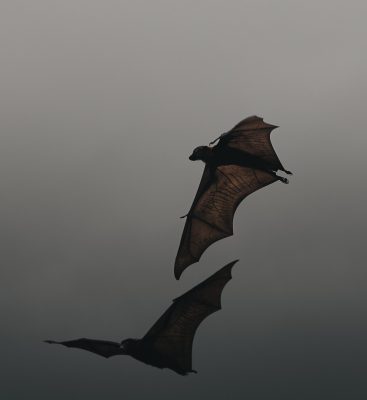
A bat flying through a cave in pitch darkness isn’t just lucky or blessed with good memory. It’s shooting out ultrasonic chirps and listening to the echoes that bounce back, building a sound-picture of everything around it. It can tell the difference between a moth, a mosquito, and a leaf fluttering in the wind—all by the way sound waves bounce off them.
This echolocation system works so fast and so precisely that a bat can catch a mosquito mid-flight in total darkness while dodging tree branches and other bats doing the same thing. The bat’s brain processes these sound echoes in real-time, creating a three-dimensional map that updates dozens of times per second. It knows size, distance, texture, and speed of everything around it, all from listening to its own voice bounce around.
Our submarines use sonar that works on similar principles, but those systems need rooms full of equipment, trained operators, and computers to process the data. A bat does all this with a brain the size of a grape, and it works perfectly while the creature is performing aerial acrobatics that would make a fighter pilot nervous. We’ve been trying to build sonar systems as good as bat echolocation for decades, and we’re still not quite there. The bat just hangs upside down and sleeps all day, completely unimpressed with itself.
6. Mantis Shrimp
 Pin
Pin Photo courtesy of Sylvain Corbel
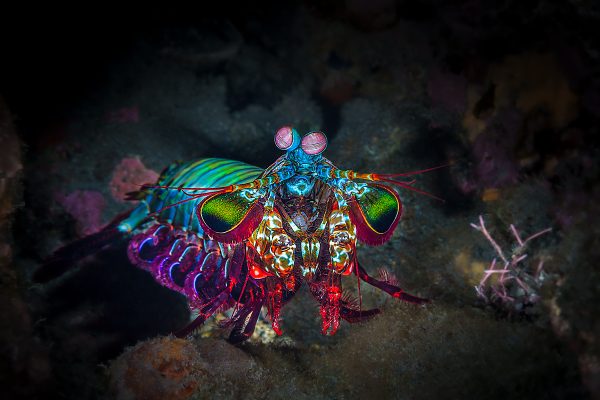
The mantis shrimp has sixteen types of color receptors in its eyes. Humans have three. Let that sink in for a moment—this little underwater prizefighter sees colors we literally cannot imagine, the way you can’t imagine a new primary color that doesn’t exist. It perceives ultraviolet, visible, and polarized light all at once, living in a visual world so rich and complex that our brains couldn’t process it even if we had the eyes for it.
But here’s where it gets really unfair: those eyes move independently, can perceive depth with a single eye, and process visual information faster than our nervous system can fire. A mantis shrimp sees the world in high-definition, super-slow-motion, multispectral glory while also being able to punch with the acceleration of a bullet. It’s like someone gave a heavyweight boxer the vision of an alien and the reaction time of a quantum computer.
Our best cameras use three color channels—red, green, and blue—to capture images. Even our fanciest multispectral imaging satellites don’t approach what a mantis shrimp sees naturally. We’ve tried to build cameras that can detect polarized light for scientific research, and they’re expensive, fragile, and need careful calibration. The shrimp just wakes up every morning with eyes that would make NASA engineers quit their jobs in frustration.
7. Owls
 Pin
Pin Photo courtesy of Jennils photography
A barn owl sitting in a tree on a moonless night can hear a mouse’s heartbeat in the grass forty feet away. Not footsteps—the actual cardiovascular system of a tiny rodent doing its business. The owl’s ears are positioned asymmetrically on its head, one slightly higher than the other, which lets it pinpoint sounds in three dimensions with eerie precision.
When an owl hunts, it’s performing acoustic triangulation that would impress a sound engineer. The tiny time difference between a sound reaching its left ear versus its right ear tells it exactly where the prey is located, down to the inch. Its facial disk—that heart-shaped arrangement of feathers—acts like a satellite dish, funneling sound to its ears. The whole setup is so sensitive that an owl can track prey through grass, snow, or leaf litter without seeing it at all.
Our directional microphones and sound-locating equipment need multiple units spread across distances, computer processing, and ideal conditions to do what an owl does with just its head. We build elaborate microphone arrays for theater sound systems and military applications, and they still can’t match the precision of an owl on a hunting run. The bird manages this while flying silently—its feathers are specially designed to muffle the sound of air rushing past—so it doesn’t give away its position. It’s a flying stealth acoustics laboratory that runs on mice.
8. Elephants
 Pin
Pin Photo courtesy of Elephant lovers world
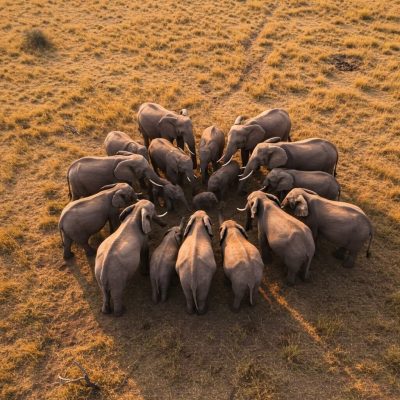
When an elephant talks, it’s not just making noise with its trunk. It’s sending low-frequency rumbles through the ground that other elephants can feel through their feet from miles away. These infrasound communications travel through soil and rock better than they travel through air, creating a private channel of conversation that most other animals can’t even detect.
An elephant’s foot is packed with special sensors that pick up on these vibrations. They can tell the difference between an elephant call, distant thunder, or a predator approaching just by the way the ground shakes. Herds coordinate movements across vast distances using this underground telegraph system. A matriarch can warn distant family members about danger, or a male can advertise his presence to potential mates, all through vibrations we’d need sensitive seismographs to detect.
We’ve built seismographs to detect earthquakes and ground-penetrating radar to study what’s beneath our feet, but elephant communication shows us how much we’re missing. Their system works in conditions that would baffle our instruments—dry ground, wet ground, sandy deserts, or dense forests. No towers, no satellites, no fiber optic cables required. Just big feet, patient listening, and millions of years of refinement.
9. Salmon
 Pin
Pin Photo courtesy of Ankit Suniyal
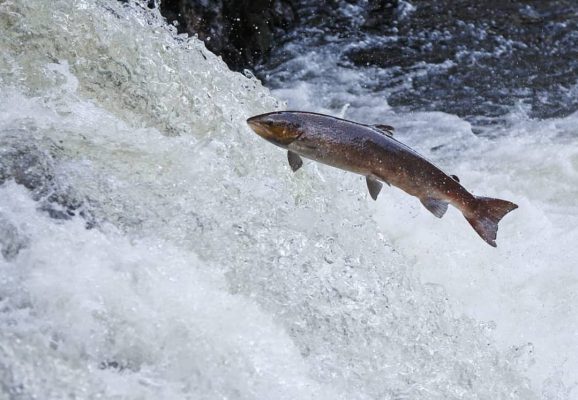
A salmon born in a tiny creek in the mountains doesn’t just remember where it came from—it remembers what that water smelled like. After spending years in the ocean, swimming thousands of miles and growing from a fingerling to a full-sized fish, it finds its way back to that exact same creek using nothing but its nose. Not the general area, mind you—the specific stretch of gravel where it hatched.
This chemical memory is so precise it defies reasonable explanation. The salmon navigates ocean currents, avoids predators, survives in salt water that should erase any freshwater memories, and then returns to spawn in the same spot its parents did. It recognizes the unique chemical signature of its home stream, distinguishing it from thousands of other waterways. Scientists have tried to confuse salmon by altering stream chemistry, and the fish still figure it out somehow.
Our GPS systems can navigate you to within a few meters of any location on Earth, but they need satellites, ground stations, and constant signal updates. A salmon carries a chemical map in its brain that works across oceans and years. We build elaborate tracking systems to follow tagged fish, spending millions to understand what the salmon does naturally. It swims upstream against rapids, leaps waterfalls, and arrives home without asking for directions once. Then it spawns and dies, completing a navigation feat we still can’t fully explain.
10. Honeybees
 Pin
Pin Photo courtesy of Passion Raw
A honeybee that finds a good patch of flowers doesn’t just go back and forth getting nectar. It returns to the hive and performs a waggle dance in complete darkness that tells other bees exactly where the flowers are—distance, direction, and quality of the nectar—all through movement and vibration. It’s giving GPS coordinates through interpretive dance on a vertical surface, and every bee watching understands perfectly.
The dance encodes the angle to the food relative to the sun’s position, compensating for the time that’s passed and the sun’s movement across the sky. Bees watching in the dark hive feel the vibrations and decode this information, then fly out and find the flowers with remarkable accuracy. They’re using a symbolic language that represents abstract concepts like distance and direction, something we thought only humans could do until we really started paying attention to bees.
Our attempts to create swarm intelligence and distributed computing networks are crude compared to what bees do naturally. They’re running a decentralized information network with thousands of individuals making independent decisions that benefit the whole colony. No central server, no data plans, no infrastructure except the hive itself. When our internet goes down, society panics. When a bee colony needs to move to a new hive, thousands of bees vote through dancing until they reach consensus, then relocate without a single instruction manual.
FAQs
Not likely anytime soon. Evolution needs millions of years and specific survival pressures. We’d need our descendants to desperately need electroreception or magnetoreception for countless generations before it might develop naturally.
We’re trying, but biology is messy and efficient in ways our rigid technology isn’t. A shark’s electrical sensors work in seawater using living cells—hard to replicate with circuits and batteries without making it bulky and expensive.
Probably the dog’s sense of smell. Detecting diseases, explosives, or spoiled food through scent alone would be incredibly practical. Plus, it doesn’t require darkness or special conditions like some other animal senses do.
No more than you think your eyesight is magical. To a bat, echolocation is just how things work. These senses feel normal to the animals using them—it’s only special when compared to what humans can do.
Absolutely. Biomimicry researchers study everything from shark skin for better swimsuits to owl wings for quieter aircraft. Nature’s already solved problems we’re just starting to understand, so copying homework makes sense.









 Login with Google