























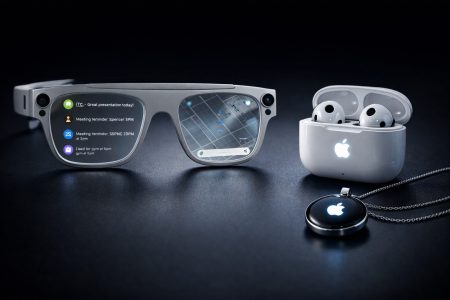
 Pin
Pin Photo courtesy Horizon Dwellers
Synopsis: Apple is accelerating work on three AI-powered wearables: smart glasses, a small pendant, and camera-equipped AirPods. All three connect to the iPhone and rely on a smarter version of Siri that can see the world around the wearer. The glasses could enter production by December 2026, with a 2027 launch. The AirPods with cameras may arrive even sooner. This is Apple’s most ambitious wearable push since the Apple Watch — and Meta is already watching.
There is a certain kind of quiet that happens just before something big moves. Not the dramatic kind that comes with press releases and spotlights — the other kind, where engineers are bent over workbenches, prototypes are being passed around, and someone in a room in Cupertino has said, with the calm authority of a person who means it, that this time they are not going to be late.
Apple is accelerating development of three new wearable devices as part of a shift toward artificial intelligence-powered hardware — smart glasses, a pendant that can be pinned to a shirt or worn as a necklace, and AirPods with expanded AI capabilities. Each device will connect to the iPhone. Each one will have a camera. And each one will be built around Siri — a version of Siri that, for the first time, will actually be able to see.
Meta reportedly sold seven million smart glasses in 2025, triple the figure from 2024. Apple sold more than 200 million iPhones that same year. The company is not panicking. But it is moving — and moving with the deliberate speed of a company that has decided the time for watching is over.
Table of Contents
The Three Devices Apple Is Building
Apple’s wearable AI push is not a single product. It is three products, each aimed at a different corner of a person’s day.
Apple is developing AI smart glasses, a wearable AI pin or pendant, and AI AirPods, all of which will connect to the iPhone and interface with a smarter version of Siri. Cameras will be integrated into all three products to allow the AI to “see” around the wearer and answer questions about the wearer’s surroundings.
The thinking behind this approach is sound. Not every person will wear glasses. Not every person wants something dangling around their neck. But nearly everyone who owns an iPhone already owns a pair of AirPods. Rather than betting everything on smart glasses, Apple is hedging with three different form factors, each targeting different use cases and user preferences — a strategy that mirrors how the company launched the Apple Watch, iPad, and iPhone as complementary devices rather than replacements for each other.
The Smart Glasses — Apple's Answer to Meta Ray-Bans
The glasses are the centerpiece. Code-named N50, these glasses are designed to challenge the dominant position held by Meta. Unlike a full-blown augmented reality headset, they will lack a traditional display, relying instead on speakers and a dual-camera system to provide real-time assistance — such as identifying grocery items or adding events to a calendar based on a poster.
Apple’s smart glasses will have an advanced camera system with a high-resolution camera capable of capturing photos and videos, as well as a second camera that provides visual information to Siri and environmental context. The latest prototypes have a battery and all components embedded in the frame, and Apple is aiming for the glasses to serve as an all-day AI companion.
Apple reportedly wants to differentiate the glasses from Meta’s Ray-Bans by giving them better cameras and better build quality. The frames are developed in-house by Apple in a variety of sizes and colors. They will have two cameras — one for high-resolution imagery and one dedicated to computer vision, a technology similar to what is used in the Vision Pro, giving the device environmental context and helping it more accurately interpret surroundings and measure distance between objects.
The Pendant — A Small Thing With Big Ambitions
The pendant is the most unusual of the three. It is roughly the size of an AirTag, designed to clip onto a shirt or hang from a necklace, and it is meant to be the eyes and ears of a person’s iPhone without the person ever having to pull the phone from their pocket.
The device will represent Apple’s answer to the AI clip category previously occupied by the Humane AI Pin. However, unlike that ill-fated project, Apple is not expected to position the pendant as a phone replacement. It is currently being designed to rely heavily on an iPhone for processing — serving as an always-on camera for the smartphone and including a microphone for Siri input. This would allow Siri to understand what a user is looking at — whether that’s ingredients in a meal or an event poster on a wall — without the user ever needing to take their phone out of their pocket.
Apple is reportedly considering adding a speaker to enable two-way conversations with Siri. The pendant will be similar in size to an AirTag but with computing power closer to that of AirPods. It is a small thing. But small things, in Apple’s history, have occasionally changed quite a lot.
Camera AirPods — The Closest Device to a Release
Of the three devices, the AirPods with cameras appear to be the closest to actually landing on a store shelf. The AI AirPods with cameras could launch as early as this year.
The cameras will be low-resolution affairs designed to help the AI assistant be spatially aware of its surroundings, rather than for snapping photos. They may be similar to the 6.5 MP 3D main camera system on the Vision Pro, designed to record spatial awareness rather than traditional photos and videos.
From previous rumors, these would be infrared cameras, offering advanced gesture controls and support for Siri. Apple may finally be taking the plunge to launch these AI-powered earbuds. The genius of this product, if it works, is that it requires no new habit from the user. The AirPods are already in most ears. Adding a camera to them is simply adding another sense to something already trusted.
Siri Gets Its Most Important Upgrade Yet
All three devices hinge on one thing working: Siri. Not the Siri that forgets a user’s calendar, or mishears names, or offers to open an app when asked a question about the weather. A different Siri entirely.
All three products would be built around Siri and utilize a camera system. Apple CEO Tim Cook told employees that the company is focusing heavily on AI devices.
Siri is slated for a massive overhaul in iOS 27 to support chatbot-like interactions. The success of the new lineup hinges on a revamped Siri, which has been plagued by development delays. By moving the assistant into glasses and pendants, Apple is attempting to turn Siri into an all-day companion capable of navigating users through the real world rather than just a voice on a phone.
Apple has reportedly tapped Google’s Gemini model as the backbone of the relaunched Siri, which would function as both a voice assistant and a text-based chatbot. Apple building its flagship AI strategy on a rival’s model is a detail worth noting — but it would not be the first time Cupertino used someone else’s engine while perfecting the chassis.
How Apple Plans to Beat Meta on Design
Meta won the first round of smart glasses on price and approachability. Apple has little interest in winning on price. Its answer has always been the same: make the thing so well-built, so considered in its design, that the cost becomes secondary.
Apple considered partnering with an existing glasses brand and tested embedding hardware in off-the-shelf frames, but it has decided to develop its own frames in-house. Apple is using high-end materials, including acrylic elements, for a premium feel. The glasses will come in multiple sizes and colors, with more styles potentially coming over time.
Apple reportedly wants to differentiate the glasses from Meta’s Ray-Bans by giving them better cameras and better build quality. The goal is a pair of glasses that a person would want to wear even if they did nothing at all — and then are quietly surprised when they do quite a lot. That has always been the Apple method: make the object desirable first, useful second, indispensable third.
The Timeline — What Arrives When
Apple’s three devices are not arriving at the same time. They are staggered, each moving at its own pace through development.
Camera AirPods are planned for as early as this year. Apple recently provided its hardware engineering team with prototypes for the glasses, and it is targeting a 2027 launch. Production on the glasses could begin as soon as December 2026.
Apple’s work on the AI pin is in the early stages, and it is possible that it could still be canceled. If work continues, the AI pin could launch as early as 2027.
The pendant’s future is the least certain of the three. Apple kills more products in development than it ever releases — that discipline is part of what makes the products that survive so strong. The glasses and AirPods appear to be on firmer ground. The pendant is, for the moment, promising but not promised.
The Humane AI Pin Ghost — Why This Time Might Be Different
Any honest conversation about an AI pendant must make room for the Humane AI Pin — a device that arrived with great excitement and departed with quiet embarrassment. It tried to replace the smartphone. It failed.
Unlike the ill-fated Humane project, Apple is not expected to position the pendant as a phone replacement. It is being designed as an iPhone accessory — an always-on camera for the smartphone rather than a standalone device.
That distinction matters enormously. The Humane Pin failed because it asked users to abandon their phones. Apple’s pendant does not ask that. It asks users to keep their phone in their pocket while a small, quiet device on their lapel handles the looking. The phone still does the thinking. The pendant just adds the eyes. It is a more modest ambition — and modest ambitions, in hardware, tend to survive.
The Competition — Meta, Google, and OpenAI Are Not Standing Still
Apple is not entering an empty room. Big tech companies including Apple, OpenAI, Meta, Google, and Samsung are all racing to produce new AI wearables and smart glasses. Sales of Meta smart glasses reportedly tripled in 2025, and Google is expected to release its Android XR smart glasses by the end of the year.
Apple will be aiming for a much larger market than Meta’s seven million units. The company sold more than 200 million iPhones in 2025 — a number that represents a ready-made audience for anything that clips, hangs, or rests on the ears of iPhone users.
The pendant would also represent Apple’s answer to the AI clip category that OpenAI and former Apple design chief Jony Ive are reportedly working on, with a similar device not expected to ship before late 2027. Apple is not the earliest. But it has rarely needed to be.
What These Devices Mean for Siri and Apple Intelligence
For years, Apple Intelligence has been more promise than product. These three wearables are, in many ways, the physical argument for why that promise needed to be kept.
The project is being spearheaded by the Vision Products Group, which developed the Vision Pro. The move marks a strategic pivot toward “visual intelligence,” where the Siri digital assistant uses onboard cameras to see and interpret the physical world.
For navigation, Siri will reference real-world landmarks, telling a user to walk past a described vehicle or building before making a turn. A user will be able to look at an object and ask what it is, and get assistance with everyday tasks. The glasses will also add event data from a poster directly to a calendar, and create context-aware reminders — like prompting someone to grab an item when they are looking at a specific shelf in a grocery store.
This is the version of Siri Apple has always talked about. Ambient, aware, genuinely useful. The glasses and pendant are simply the first hardware that might finally let it become that.
Apple's Next Chapter Runs on Cameras
The smartphone era, which Apple itself launched in earnest in 2007, built a world where people reached for a glowing rectangle to understand the one around them. What Apple appears to be building now is quieter than that — a world where the understanding happens before the reaching.
By creating multiple entry points for visual AI — each suited to different contexts and user preferences — Apple is building an ecosystem where Siri can finally see the world through users’ eyes.
Camera-enabled AirPods and an AI pendant can scale faster than glasses, seeding a large installed base of devices that generate on-device context data and reinforce Apple’s position in the daily computing environment. Whether all three devices survive the journey from prototype to shelf, only Cupertino knows. But the direction is clear. Apple has decided that the next version of itself wears a camera — probably several — and asks Siri to do something with what it sees. That is a considerable bet. Apple has made considerable bets before.
FAQs
Production could begin December 2026, with a consumer launch targeted for 2027.
No. The cameras are low-resolution and designed only to give Siri visual context — not for photography.
It works as an iPhone accessory, not a phone replacement — far simpler and more practical.
Apple is reportedly using Google’s Gemini model to power the overhauled, chatbot-style Siri in iOS 27.
Not yet. The first version has no display. True AR glasses with a lens display are still several years away.










 Login with Google